
Mantua–Viadana Tramway
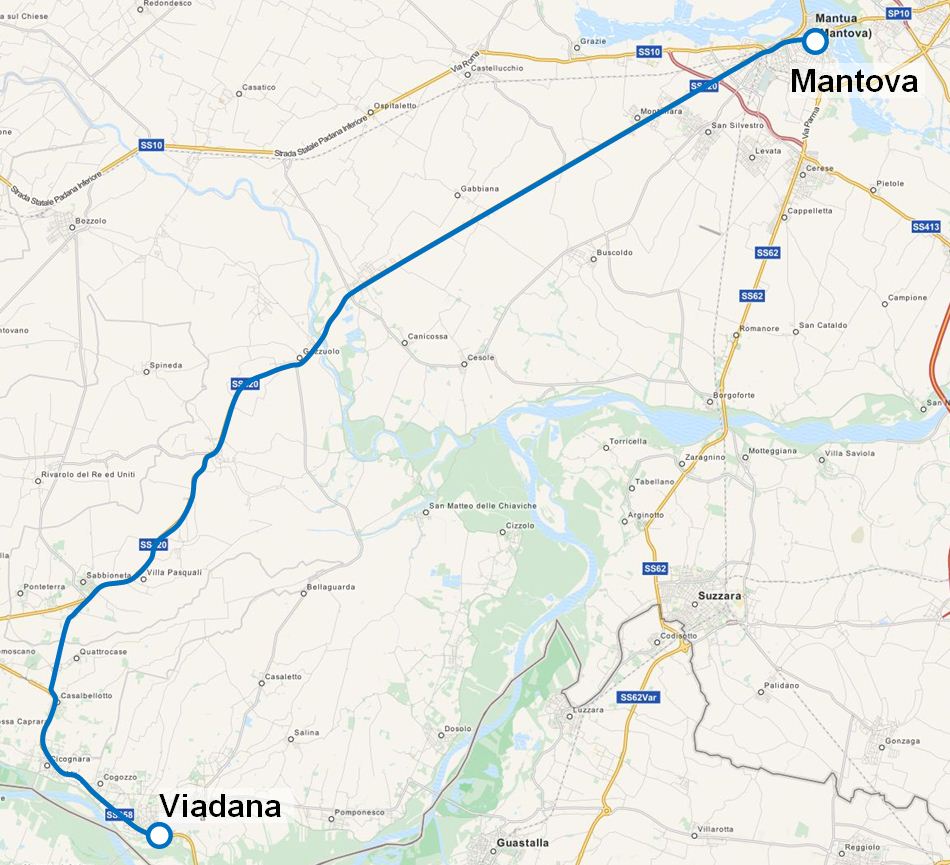
The Mantua–Viadana tramway was an interurban tram line, part of the provincial network, that connected the cities of Mantua and Viadana from 1886 to 1933.
History
Since the early 1880s, there had been debate in the province of Mantua about the opportunity to build tram lines in the province. The provincial council session of 19 April 1880 had indicated the possibility of building the Mantua–Asola, Mantua–Castiglione, Mantua–Ostiglia, and Mantua–Viadana tramways. The lines were built by the Belgian Société Anonyme d'Entreprise Generale de Travaux (EGT), which in 1882 had opened the Brescia–Montichiari–Castiglione delle Stiviere section of the line.
Steam and battery traction operation
In March 1886, the imminent opening of the first sections of the lines to Asola and Viadana was announced: on 17 April of the same year, the Mantua (tollgate 1)–Gazzuolo section, with a transfer at tollgate 54, of the line to Viadana was inaugurated, officially opened on Thursday 25 November 1886. Tollgate 1 consisted of a temporary wooden structure that stood just outside Porta Belfiore and was built as a temporary terminus pending authorisation from the Rete Adriatica for the level crossing of the three existing railways; on 28 December 1887, the line was extended from tollgate 1 to Mantua Ognissanti station, where it connected with the .
The "steam tramways" to Asola and Viadana were initially operated by the company Valentini and Mazzorin, owned by Banca Zaccaria Pisa and holder of the concession for the construction and operation of both lines; the same company had already been involved in the construction of the Suzzara–Ferrara railway. In 1906, these lines were taken over by the provincial administration.
With Royal Decree No. 6147 of 20 August 1913, the project presented by the tramway directorate on 21 May of the previous year for the upgrading of the facilities was approved, consisting of the construction of some passenger buildings and the improvement of access to other facilities.
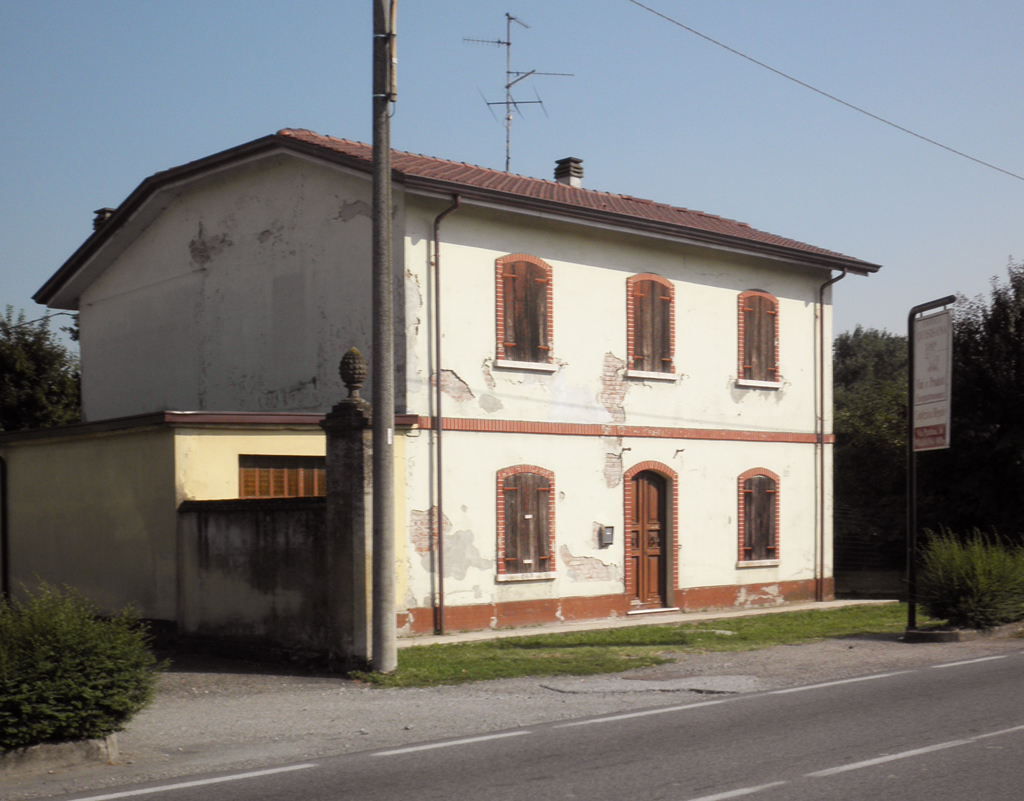
At Ponte Majocche station, a hamlet of Casalmaggiore, the Casalmaggiore–Ponte Majocche Tramway terminated from 1888, connecting the Mantuan tram network with that of Cremona: to this end, the two provincial administrations signed an agreement in 1899 for the joint operation of the station, which stipulated that traffic management was entrusted to a stationmaster employed by the Mantuan lines, who was assisted in his work by a second one employed by the Cremonese lines. The operating regulations, to avoid misunderstandings, were entrusted exclusively to the management of the Mantuan line.
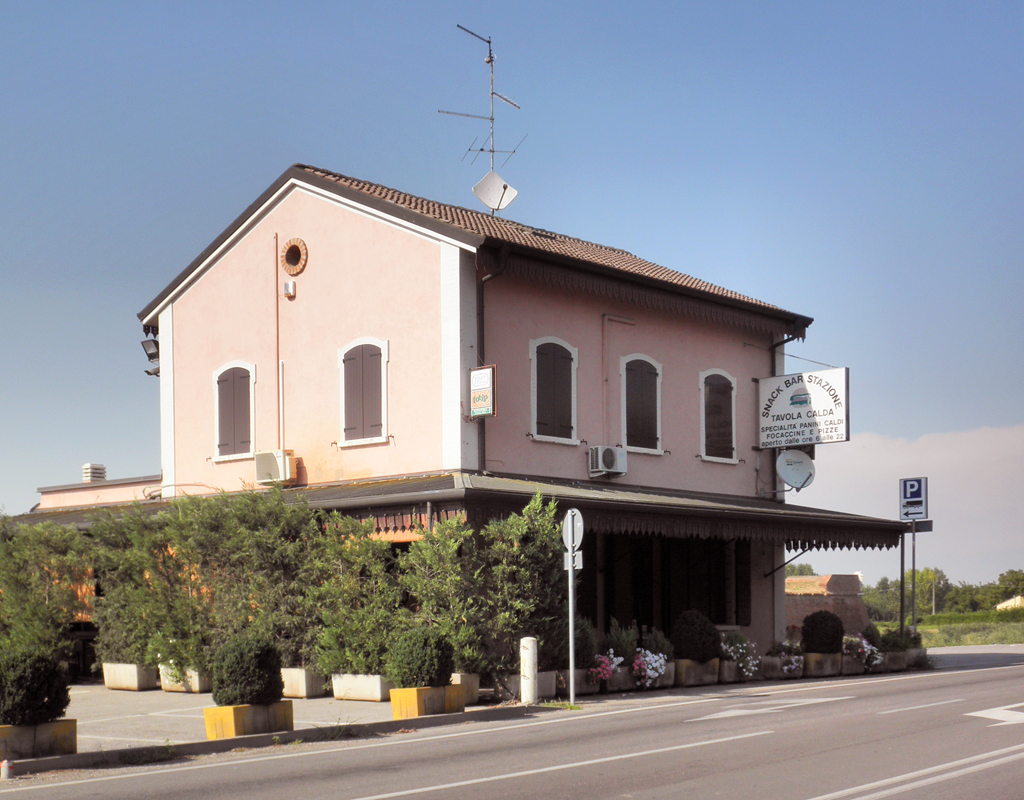
The Great Depression triggered by the Wall Street crash severely affected the Mantuan lines, located in an economic context characterised by the absence of large industries and a flourishing agriculture, which conditioned the commercial sector and consequently tram transport. Added to this in 1931 was the cessation of passenger traffic on the Casalmaggiore–Ponte Majocche line, on which only freight service remained, limited to one pair of trains per day.
From 1927, battery railcars were introduced into service, which on the one hand improved the service, but also proved to be a source of difficulties, as the battery charging station was located in Mantua. Furthermore, the consolidation of mixed and freight trains led to longer delivery times for loads.
Urban service
Meanwhile, in 1925, the presence of the tramways to Asola and Viadana allowed the construction of two new electrified suburban lines that integrated the Mantua tram network, serving the Angeli locality and Montanara along the Dosso del Corso road that hosted the tramway to Viadana); a third line was activated in 1928 to connect with the then-new Pompilio hospital.
The urban penetration section, consisting of a specially built track along Corso Vittorio Emanuele II to the Piazza Cavallotti terminus, was 700 metres long and was common to the three routes to Grazie, Montanara, and Pompilio; these works were authorised by Royal Decree No. 2232 of 5 November 1925. All lines were electrified with overhead lines supported by tubular Mannesmann poles.
In 1926, the operating company took the name Tranvie Provinciali Mantovane (TPM) and later Tramvie Elettriche Mantovane (TEM).
Even with these modernisations, the service was not destined to last long: in 1933, supplementary and replacement bus services were introduced on the Mantua–Ostiglia line as well, and in the same year, services to the Asola and Viadana termini were also replaced by buses operated by Lazzi e Govigli; the Viadana tramway closed on 28 October 1933, replaced by buses from the same company. Part of the track was reused the following year for the renewal of the line to Casalmaggiore and Ostiano of the Provinciali Cremonesi.
The electrified section up to Montanara remained in service until 1953, the year of the definitive suppression of the network. The last run is dated by authors to 23 May or the morning of 30 May 1953.
Characteristics
Ponte Majocche uexCONTgq\uexABZgr~~ ~~ ~~ (TPC) (*1888 †1934) uexBHF~~35.400~~Casalbellotto uexBHF~~37.600~~Cicognara uexHST~~ ~~Tagliavini uexBHF~~40.000~~Cogozzo uexKBHFe~~41.300~~Viadana }}
The tram line was of standard gauge, 1,445 mm, and extended for 41.425 km, of which 19.062 km were on their own right-of-way. The maximum gradient was 30 mm/m and the minimum radius of curves was 50 m. The maximum permitted speed was 30 km/h for steam trams and 40 km/h for electric railcars.
Rolling stock
On the Mantuan tramways, seven two-axle steam locomotives of tramway type, built in 1885 by Maffei, initially served. Between 1889 and 1908, three more locomotives of a similar type, also of Maffei construction, were added.
Between 1927 and 1928, four bogie battery railcars entered service, built by the Milanese company Rognini & Balbo with electrical parts from Tecnomasio Italiano Brown Boveri. These railcars could carry 70 people and reach a maximum speed of 40 km/h. The first two units were newly built, while the latter resulted from the rebuilding of two bogie trailers. When the Mantuan tramways closed, they were sold in 1935 to the Monza–Trezzo–Bergamo tramway, where they remained in service until 1958.
The trailer material in service on the Tranvie Provinciali Mantovane network consisted of 24 two-axle carriages, two bogie carriages (to be used with the Rognini & Balbo railcars), 40 closed goods wagons, and 67 open goods wagons.
Motive power summary table
Unit |
Year built |
Builder |
Works number |
Type |
Notes |
|---|---|---|---|---|---|
1 – Mantova |
1885 |
Maffei |
1391 |
2-axle |
|
2 – Virgilio |
1885 |
Maffei |
1392 |
2-axle |
|
3 – Belfiore |
1885 |
Maffei |
1393 |
2-axle |
|
4 – Montanara |
1885 |
Maffei |
1394 |
2-axle |
|
5 – Curtatone |
1885 |
Maffei |
1395 |
2-axle |
|
6 – Viadana |
1885 |
Maffei |
1396 |
2-axle |
|
7 – Asola |
1885 |
Maffei |
1397 |
2-axle |
|
8 – Pomponazzi |
1889 |
Maffei |
1505 |
2-axle |
|
9 – Sordello |
1908 |
Maffei |
2852 |
2-axle |
|
10 – Mincio |
1908 |
Maffei |
2853 |
2-axle |
|
1÷4 |
1927 |
Rognini&Balbo-TIBB |
Battery railcars |
sold to the MTB |
|
See also
- History of rail transport in Italy
- List of railway stations in Lombardy
- Mantua railway station
- Mantua–Asola tramway
- Casalmaggiore–Ponte Majocche Tramway