
Cremona–Ostiano Tramway
The Cremona–Ostiano tramway, in operation between 1889 and 1955, connected the town of Ostiano with its provincial capital, Cremona.
Laid as a single-track line, the tramway ran in a mixed-traffic configuration along the former Strada statale 10 Padana Inferiore from Cremona as far as Montanara (frazione of Vescovato), then continued along provincial roads.
History
Planning and construction
The idea of an extra-urban tramway linking Cremona to the judicial district of Pescarolo and Ostiano was first proposed in 1883 by provincial councillor Lazzaro Rizzi, representing the interests of that area. However, the provincial council gave priority to lines that could facilitate interchange with other tram and railway networks, such as those to Casalmaggiore, Soncino and Mezzano, since Ostiano lacked such connections.
The awarding of the concession for the Cremona–Casalmaggiore Tramway in 1887 prompted the English company Piacenza-Bettola-Cremona Tramways Co. Ltd to ask the province for concessions for the other two lines, adding the Cremona–Ostiano to the package. In the session of 3 May of that year, the Provincial Council allocated 300,000 Lire for this latter connection.
On 24 January 1888, a preliminary concession agreement for the tram line was signed between the Provincial Deputation and engineer Carlo Bastogi of Pavia, which was approved by the Council on 21 February; the reasons why the preliminary agreement with the English tram company fell through are not known; the latter retained the concession for the line to Mezzano, considered essential to complete the important Piacenza–Cremona tramway. The conditions for building the line were similar to those in the convention for the Casalmaggiore tramway.
The project was drawn up by engineer Ruggero Manna of Cremona and envisaged touching San Marino, Gadesco and its hamlets, Vescovato, Pescarolo, Gabbioneta and Ostiano. During the design phase, some problems arose:
- the Italian Southern Railways Company refused a level crossing of the Cremona–Mantua railway and insisted on the construction of a flyover;
- the Public Works Department did not deem the bridge over the river Oglio near Ostiano suitable for tram traffic.
Consequently, it was decided to open the line to traffic on 2 February 1889, without the terminal stations of Cremona and Ostiano, since trams ran from Via Mantova, just beyond the level crossing of the Cremona–Mantua line, to one hundred metres from the Oglio bridge at Ostiano. Operation was entrusted to the Società anonima per la Tranvia Cremona-Ostiano (TCO), which was headed by engineer Bastogi.
At the end of 1891, with the completion of the new bridge and having obtained permission for the level crossing of the railway, the line was inaugurated over its full route.
Private operation
Following Bastogi's bankruptcy, on 14 December 1897 ownership of the TCO passed to Paolo Beolchini, who sold it to the Banca Manzi of Rome. This bank owned the Società tramvie nella provincia di Cremona (STPC), which at that time operated the tramway to Casalmaggiore, with which close collaborative relations had been fostered by sharing the terminal station in Cremona. The TCO thus passed into the hands of the latter on 20 May 1899.
In 1900, ownership of the two Cremonese tramways passed to the Società Nazionale Ferrovie e Tramvie (SNFT).
In April 1907, the SNFT asked the province of Brescia for the concession of the Brescia–Ostiano Tramway. In the National Company's project, the new tramway would connect the Brescia railway station to the Cremona line, allowing the Cremonese network to connect with the Brescia–Iseo–Edolo railway then operated by the SNFT. However, the Brescian Deputation awarded the concession for the Brescia–Ostiano to the Società Elettrica Bresciana (SEB), which completed the tramway in 1914 following a completely different project. The small Cremonese town on the Oglio thus had two tram stations. To allow cumulative transport between the network operated by the SEB and that of the SNFT, the two facilities were connected to each other.
Operation by the Tramvie Provinciali Cremonesi
The Tramvie Provinciali Cremonesi (TPC), having obtained management of the Cremona extra-urban tram lines, could not, however, start the planned restructuring process of the network due to limited financial resources.
In 1927, the track was moved to a reserved right-of-way near Gabbioneta. At the end of the same year, the Montanara stop in Vescovato was transformed into a station with a three-track yard, following the opening of the first section of the Cremona–Asola Tramway.
Between 1933 and 1934, in anticipation of the introduction of FIAT petrol railcars, the sleepers were replaced along the entire route and the section passing through Pescarolo was moved to a reserved alignment outside the built-up area.
The bombings of the Second World War did not spare the line: in January 1945 the bridge over the Oglio at Ostiano collapsed; it was rebuilt and reopened on 15 November 1948.
In the same period, the TPC had asked the Government for the possibility of extending the concession for the tram line, which was due to expire on 30 July 1949. It obtained two partial extensions: the first extended to 31 July 1950, the second to 31 July 1952. In view of the opposition of ANAS, the manager of the Strada statale 10 Padana Inferiore on which the tram ran between Cremona and Montanara, and in view of the financial difficulties of the provincial administrative body to transform the tramway into a railway, the TPC decided to forgo requesting further extensions. On 22 May 1955, the tram service on the Cremona–Ostiano line was completely replaced by buses.
Characteristics
The tramway was a single-track line with standard gauge of 1,445 mm and ran in a mixed-traffic configuration for most of its route. At the time of construction, its total length was 22.015 km, reduced to 21.796 km after track realignments carried out by the TPC.
The rails were of the Vignoles type. At the time of construction, it was decided to adopt a rail weighing 17 kg/m, suitable for a commercial speed of 18 km/h, as for the Cremona–Casalmaggiore. Between 1923 and 1927, the TPC partially replaced the track with new 27.7 kg/m rails. In 1935, the 17 kg/m rails that had not been renewed earlier were replaced with 23 kg/m rails coming from the Mantuan extra-urban tram network, which was being dismantled at that time.
Route
As far as Largo di Porta Venezia, where a station was located, the line's track was shared with that of the tramway to Casalmaggiore. After this point, the tramway entered the provincial road to Mantua, occupying its left side. At the livestock market near Porta Venezia, there was a double track and a siding, used for loading and unloading.
Shortly after the market, the tramway crossed the level crossing of the Cremona–Mantua railway at grade, where a service stop was observed for this purpose: TPC trains stopped at a rotating signal connected to a protection switch with points normally set for the diverging route; the crossing keeper's hut, located at kilometre 29+800 of the railway, was connected by telephone to both the FS station and the TPC station, and once consent for the crossing was obtained, the closing of the barriers and the wing signals on the railway side were activated. In 1943, the original disc signals and gates were replaced by wing signals and barriers, together with the adoption of the then-new safety system of the Max Judel type. For the operation of this system, the province paid the FS an annual fee.
After Montanara, the line left the provincial road to pass through the inhabited centres of Vescovato, Pescarolo and Gabbioneta. After crossing the bridge over the Oglio, which in 1950 was a 97-metre-long, three-span structure, the tramway reached Ostiano, the terminal station of the line. A connecting track linked the Cremonese facility with that of the line to Brescia, and a shunting movement was necessary to transfer freight wagons from one line to the other.
Only the stations of Cremona, Montanara, Pescarolo and Ostiano were equipped with passenger buildings.
Rolling stock
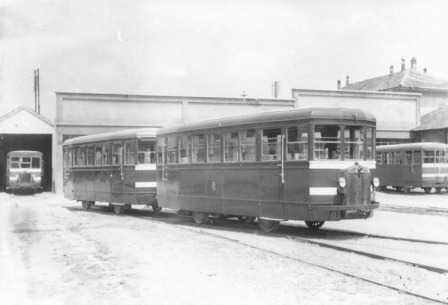
On the Ostiano line, the company's pooled rolling stock was used, which was interchangeable with that employed on the entire provincial network, including the petrol railcars produced by FIAT that entered the fleet starting in 1934.
On mixed passenger and freight runs, steam traction remained in use until the end of the 1930s, when Badoni locomotives were acquired, powered by petrol and designed also for methane operation.
See also
- Cremona railway station
- Monza–Trezzo–Bergamo tramway
- Piacenza–Cremona railway
- Cremona–Casalmaggiore Tramway
- Cremona–Asola Tramway
- Brescia–Ostiano Tramway