
Brescia–Ostiano Tramway
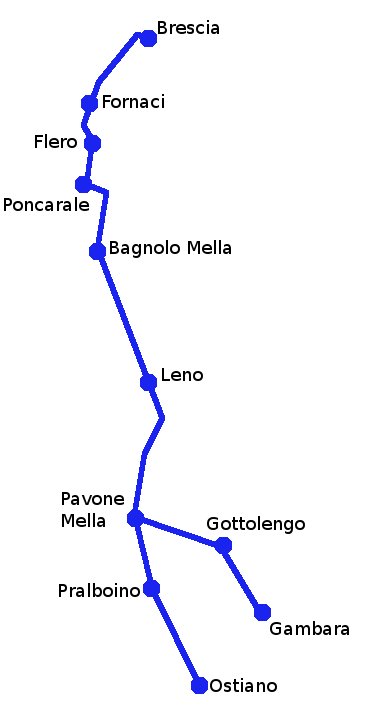
The Brescia–Ostiano tramway (between 1933 and 1936, the Brescia–Leno tramway; from 1936, the Brescia–Poncarale tramway) was an interurban tram line of the Brescia provincial network that connected the capital city of the Province of Brescia with the Cremonese town of Ostiano, passing through Poncarale, Leno and Pavone del Mella. The latter town was also connected by a tram branch to Gottolengo and Gambara.
In Ostiano, there was a tram station independent from that of the line to Cremona; however, the two facilities were connected by a connecting track.
History
The intention to connect the municipality of Leno and its judicial district with the city of Brescia via tram was hindered at the end of the 19th century by the presence of the nearby railway lines Brescia–Cremona and Brescia–Parma. Several projects were instead developed that aimed to connect Ostiano with Desenzano del Garda, passing through the eastern part of the Province of Brescia and the western part of Mantua. These hypotheses were moreover opposed by both deputations, which feared losing the commercial traffic of those areas.
In 1906, the municipalities of the Leno district presented a Memorial requesting the construction of a Brescia–Ostiano tramway.
In April 1907, the Società Nazionale Ferrovie e Tramvie, concessionaire of the Cremona–Ostiano tramway and of the railway to Edolo, offered itself to obtain the concession for the Brescia–Ostiano line. In the same period, the province opened negotiations with the Società Elettrica Bresciana, which was about to take over the provincial tram concessions from the Compagnie Generale des Chemins de fer secondaires. The preference for the Brescian company over the Roman one was immediately evident: the convention of 29 July 1907 committed the electric company to build the line for the Bassa, obtaining its concession until 31 December 1960.
The route was determined as the tortuous Brescia–Fornaci–Flero–Poncarale–Bagnolo Mella–Leno–Pavone Mella–Pralboino–Ostiano. At Pavone Mella there would be a deviation towards Gottolengo and Gambara with a possible continuation towards Fiesse. Originally, traction was to be steam, but with the new convention of 16 November 1912, the SEB committed to adopting electric traction. Moreover, the company guaranteed at least eight pairs of daily trips along the line. The Province of Cremona issued the concession for the section under its jurisdiction with the Convention of 8 July 1911.
The works were completed in 1914. On 13 September, the Brescia–Leno section was opened, while the remaining Leno–Ostiano and Pavone–Gambara sections were opened on 17 October.
The world war and the increase in raw material prices that occurred at the end of the conflict put an end to hopes for an extension of the line to Fiesse and the opening of a branch that would connect Quinzano d'Oglio from the Fornaci of Brescia. In 1922, the concession passed from the SEB to the Tramvie Elettriche Bresciane.
On 1 June 1932, passenger service on the Pavone–Gambara branch was suppressed, while on the same day in 1933, the Leno–Pavone–Ostiano section was suppressed. On this last stretch, freight service, both local and cumulative with the Tramvie Provinciali Cremonesi (TPC) and with the Società Italiana Ferrovie e Tramvie (SIFT), was maintained until 1935. From the following year, the tram service was limited to the Brescia–Poncarale section only. The dismantling of the tracks on the decommissioned sections took place instead during 1938.
During the phase of dismantling the tram structures, the populations of Pralboino and Milzano requested the restoration of the Pralboino–Ostiano section and its subsequent operation by the TPC, which at the time operated the Cremona–Ostiano line. The provincial administration of Brescia did not give its consent.
The interurban tram ran along the Brescia–Poncarale route until after the war: only on 20 September 1948 was service suspended.
Characteristics
For the line, the standard tramway gauge of was adopted. Vignoles rails of 22 kg/m were used on extra‑urban sections and 34 kg/m through built‑up areas. The ballast occupied of the roadway, while reserved tracks had a width of .
From opening, traction was electric with a voltage of 1200 V direct current.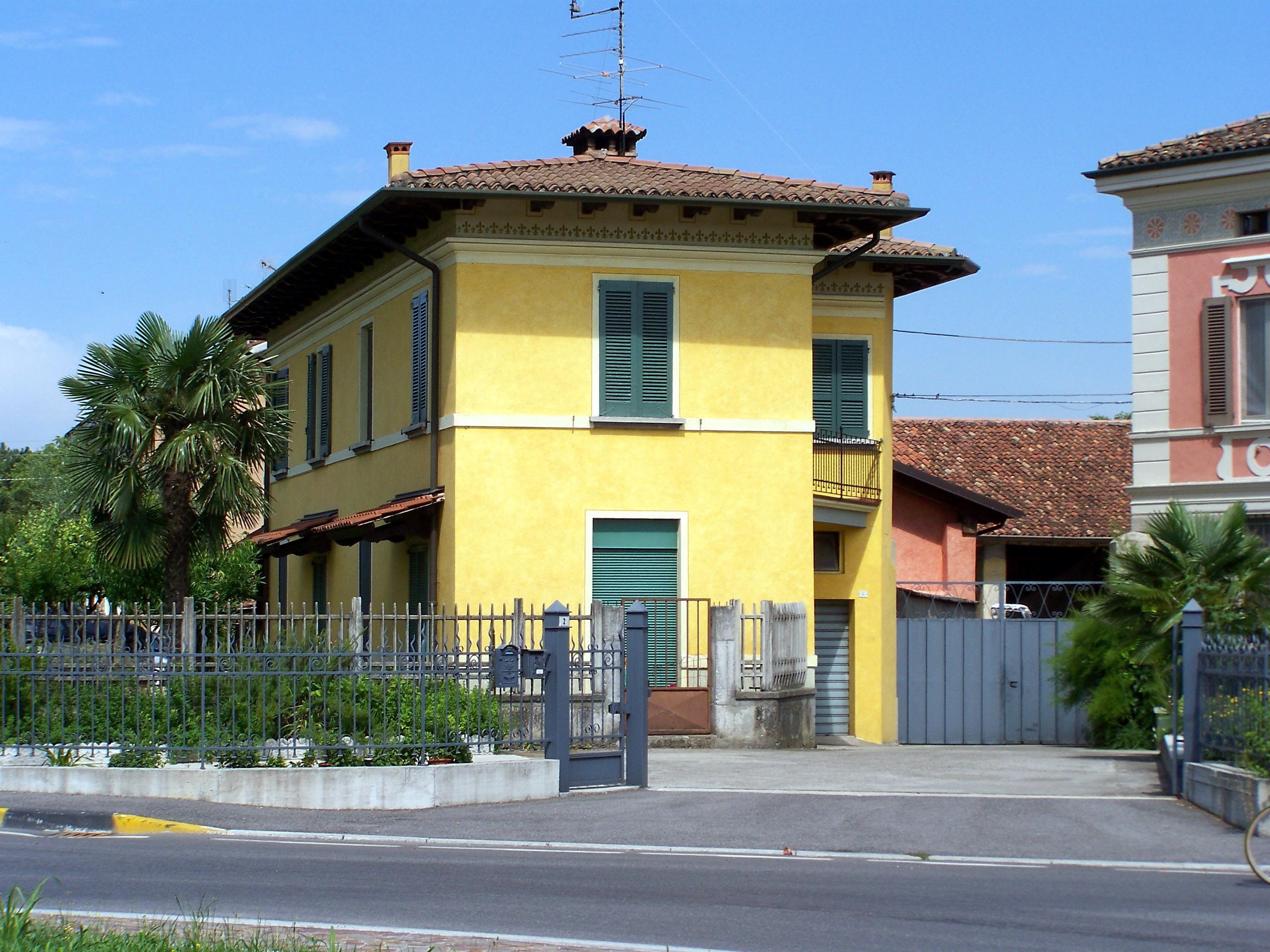
See also
- History of rail transport in Italy
- List of railway stations in Lombardy
- Cremona–Ostiano Tramway
- Trams in Brescia
- Val Trompia Tramway