
Cremona–Asola Tramway
The Cremona–Asola tramway was an interurban tram line that, between 1929 and 1955, connected Cremona to the Mantuan town of Asola.
History
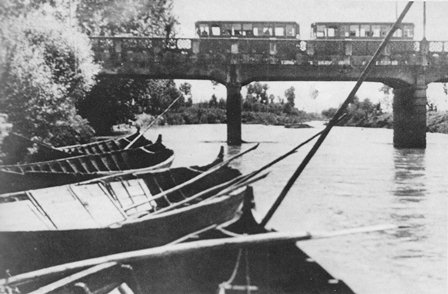
Design and construction
The idea of connecting Cremona to Asola with a tramway had been advanced at the same time as the Cremona provincial council was allocating funds for the construction of the lines to Casalmaggiore, to Ostiano, and to Mezzano. The lack of financial resources available to the provincial authority was the main reason for postponing the Asola line project to a later date. The Deputation considered this interurban line as part of a larger interprovincial project, since it would connect to the line to Mantua, which was under construction at the time. It was therefore decided to postpone its construction to more favourable times, giving priority to two projects that would improve connections between the capital and the province.
When the Società Nazionale Ferrovie e Tramvie (SNFT) took over the management of the provincial tram network, the province revived the idea and committed to requesting the corresponding concession from the Ministry of Public Works. However, the SNFT was not in favour of defining a project, because during the first decade of the 20th century its resources were directed towards the construction of the Iseo–Edolo and Iseo–Rovato railways, as well as the design of another railway between Soresina and Soncino.
The provincial administration subsequently sought an agreement with the Mantuan one, since it too would benefit from the construction of the tramway. The first project aimed to extend the Cremona–Ostiano line to Fiesse, in Brescian territory, where it would connect with the planned Brescia–Gambara–Fiesse–Asola line, which was later partially built following another route. Subsequently, the two provinces agreed on the less expensive Montanara–Isola Dovarese–Asola route. Archival records show that as early as 1888–1889, the municipalities of Ostiano, Volongo, and Casalromano had petitioned for the connection of the Asola–Mantua tramway to the planned Cremona–Ostiano line, and later, between 1900 and 1906, the connection between the Mantua–Asola tramway and the Cremona–Isola Dovarese line was officially discussed.
The design was entrusted to the SNFT, and the Province applied for the concession on 28 January 1914. The Ministry of Public Works raised several objections to the initial project, which was modified accordingly. However, in the following months the company expressed its intention to cease operating the tram network and therefore did not start the works. With the transfer of the network's management to the Tramvie Provinciali Cremonesi (TPC), the latter also obtained the concession for the Cremona–Asola line.
The ambitious modernisation plan for the network devised by the TPC, and the consequent problem of raising the financial means necessary for its implementation, delayed the start of the tramway's construction, which, among other things, was to be electrically powered. At the end of the First World War, the province of Cremona decided to resume the initiative, abandoning electric traction and opening negotiations with the Mantuan administration. In 1924, an agreement was reached between the two territorial bodies, and the following year, with Royal Decree No. 2475 of 10 December 1925, the government approved the fifty-year concession for the construction and operation of a steam-powered tramway between Montanara and Asola. The construction of the track bed and station buildings was contracted to the Società Elettrica Bresciana (SEB) and began in 1926.
The construction of the bridge over the Oglio, 106.32 metres long, was instead contracted to the Officine Savigliano and took a long time, as the project variations had to be approved both by the Civil Engineering Corps and the Compartmental Inspectorate of Concessioned Transport, in agreement with the Ministry of Public Works. For this reason, the section between Montanara and Isola Dovarese—the last station coming from Cremona before the aforementioned bridge—was opened to traffic as early as 26 November 1927, while the entire line was inaugurated two years later, on 18 November 1929.
Operation
In the first years of operation, the service was carried out by steam locomotives suitable for road use, which shuttled between Montanara station and Asola. In order to optimise the use of the Krauss and Henschel locomotives, in the early 1930s it was decided to assign the former to the Cremona–Montanara–Asola route and the latter to the shorter Montanara–Ostiano route. The line was immediately used for cumulative freight services between Cremona, the Piacenza area, and the lower Lake Garda, thanks to the almost simultaneous opening of the short Casaloldo–Medole line, which made possible the tram route Desenzano–Castiglione delle Stiviere–Medole–Casaloldo–Asola–Cremona–Piacenza. This type of traffic lasted only a few years, because in October 1933 the TPM (Tramvie Provinciali Mantovane) decided to suppress its lines.
In 1934, operations with gasoline railmotors were introduced. With the old steam traction, a goods train connecting Cremona to Asola remained active for a few years, then went down to Montanara to join the line to Ostiano and subsequently return to the capital. From January 1935, it was decided to serve the line with four pairs of runs, to which a pair on the Cremona–Isola Dovarese route was added. During the Second World War, it was decided to restore the shuttle service between Montanara and Ostiano and therefore use the Cremona–Asola runs to support both tramways between Montanara and the capital.
After the bombing of 10 July 1944, the line was served by only one pair of runs, which increased to two from the following month, while freight traffic was handled by an occasional goods train, hauled by a methane-powered Badoni locomotive. The bombings of 30 November and 26 December destroyed the bridge at Isola Dovarese. Services were therefore limited to this town until the structure was restored in February 1946.
Closure
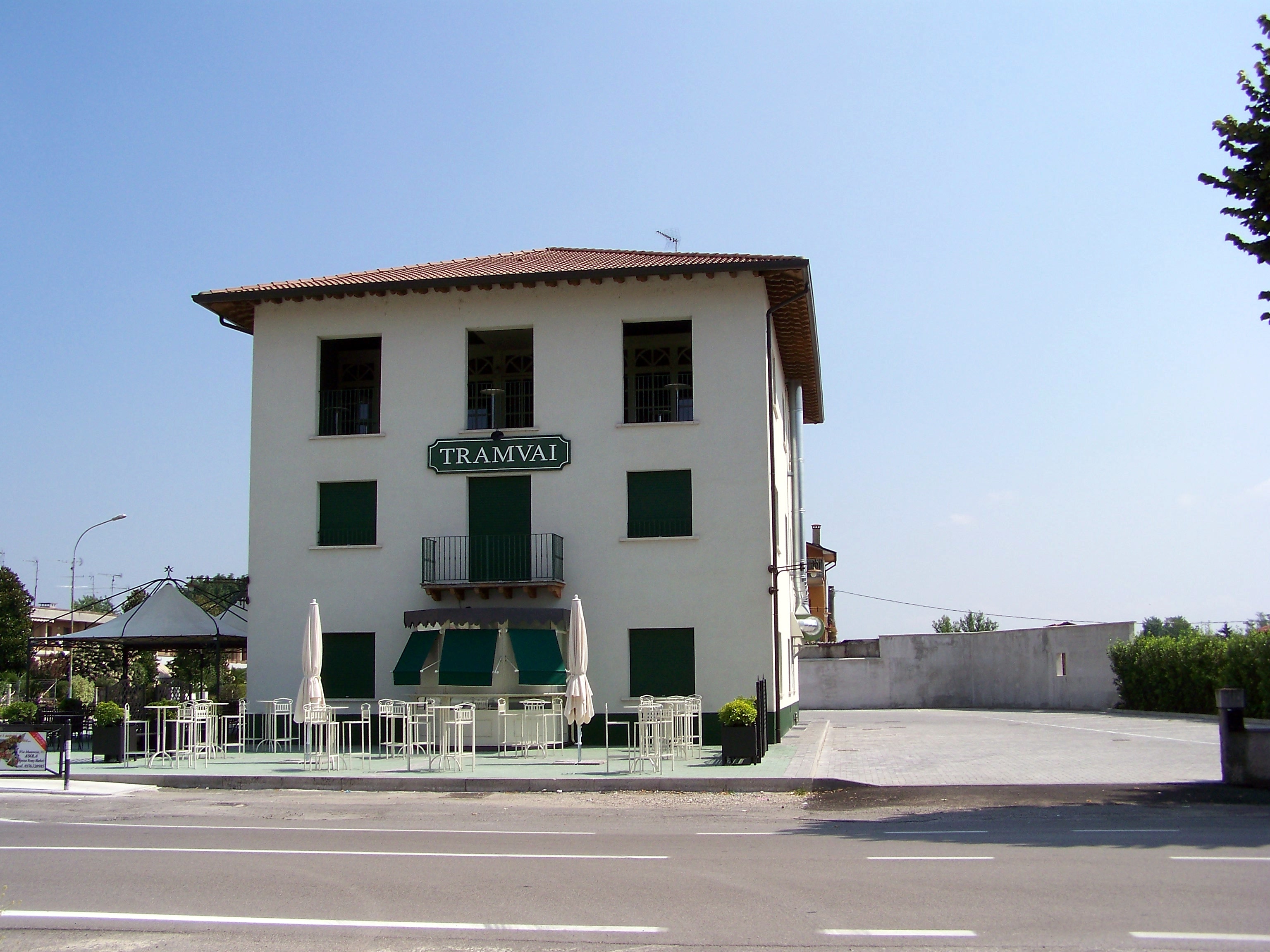
On 1 July 1955, tram service on the line ceased, replaced by a bus service whose travel time was identical to that provided by the railmotors. The tramway was dismantled in the following months; however, ANAS took twelve years to arrange the carriageway occupied by the old line.
The replacement bus line was then sold in 1960 to the Società Azionaria Imprese Autoservizi (SAIA).
Characteristics
The line was a single-track tramway placed on a mixed-traffic trackbed for most of its route. The track was shared with the Cremona–Ostiano line between Montanara and the capital, and with the Cremona–Casalmaggiore line in the urban section up to the Porta Venezia stop. The tramway between Montanara and Asola was 23.25 km long and its operation was regulated by telephone block.
The track gauge adopted was the standard 1445 mm, with Vignoles type rails in 12 m lengths. Rails weighing 27.7 kg/m were used for the track in Cremonese territory, between Montanara and Isola Dovarese, while in Mantuan territory their weight dropped to 23 kg per metre.
Initially employing the usual steam traction, between 1929 and 1934 railmotors with internal combustion engines were put into service, whose fuel remained gasoline until autarky, when it was decided to convert them to methane. The use of these single-direction railmotors necessitated equipping Isola Dovarese, the main station on the line, with a 4-metre diameter turntable for reversing direction, supplied by the Savigliano company. Mixed passenger and freight runs remained entrusted to steam traction until 1936, when Badoni locomotives were purchased, with gasoline fuel and provision for methane conversion.
Rolling stock
On the Asola line, the TPC employed trailer and traction stock from its fleet, standardised across the entire provincial network, to which were added eight carriages built by Carminati & Toselli, specially purchased for this line.
See also
- History of rail transport in Italy
- List of railway stations in Lombardy
- Casalmaggiore–Ponte Majocche Tramway
- Mantua–Asola Tramway