
Messina–Barcellona Pozzo di Gotto Tramway
The Messina–Barcellona Pozzo di Gotto tramway was an interurban tram line active between 1890 and 1932, connecting Messina with Barcellona, a town on the Tyrrhenian coast in the northern part of the province of Messina.
History
 After numerous proposals put forward from various quarters, in 1888 a project was presented by the Société Anonyme des Tramways Siciliens (SATS), a company founded with Belgian capital on 14 November of that year, linked among other things to the Cockerill company of Marcinelle. At the same time, concession contracts were signed with the municipality of Messina and the province for the use of the road sections of respective interest.
The first section of the line, from the Messina fish market to Granatari and Torre Faro, was inaugurated on 19 May 1890, while subsequent sections were opened later; the last section to be opened was that between S. Lucia and Tono on 31 May 1893, completing the entire route between Messina and Barcellona.
The devastating earthquake of 1908 caused heavy damage to the urban section and financial consequences for the operating company, leading to the termination of the contract with the Belgian company on 6 January 1910.
Characteristics
The Messina route included a service connection to the SATS depot and workshops, which stood in the area now occupied by the "Verona Trento" technical institute in via Ugo Bassi, then called orto Mosella. Following the present-day via Maddalena, the trams entered viale San Martino to the port customs house and from there along corso Vittorio Emanuele to the fish-market terminus.
Leaving the terminus and running along the city avenues named after Vittorio Emanuele and Prince Amedeo (now via della Libertà), the track continued along the coast following the route of the present-day state highway 113, along which there were six stops up to Sant'Agata station, which had passing and shunting tracks and a characteristic two-storey passenger building.
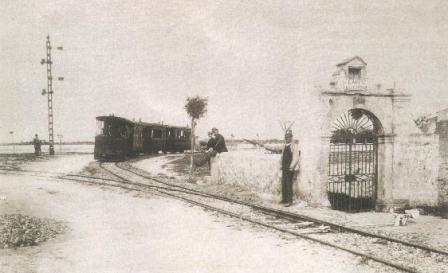 After two further stops the tramway reached Spadafora station; here, according to SATS's original plan, traffic in bricks from local kilns could have developed. The Palermo–Messina railway was crossed via a reserved-track underpass to reach the next tram stop, Santa Lucia, which besides its two-storey passenger building had numerous facilities including a loading platform, water tank and several passing tracks. Freight facilities were also present at the next station, Archi, whose passenger building was later converted into an ENEL substation.
Between the Corriolo stop and Olivarella station (from which, according to the original plans, a branch to Milazzo was to have originated), the tram track changed side of the road, crossing it diagonally, to reach a station also equipped with facilities similar to those at Santa Lucia. After the last stops at Meri and Pozzo di Gotto, the tramway finally reached its western terminus at Barcellona, a true terminal station with numerous facilities for passenger and freight traffic and a shed for locomotive storage.
Rolling stock
For steam operation, the literature reports that the SATS fleet included 18 steam locomotives, all of the cabbed type for tram services, with 2 and 3 axles, certainly built by St. Léonard for machines numbered 1 to 15, and of unknown construction for the remainder.
Steam traction material – summary table
Unit |
Year of construction |
Works number |
Wheel arrangement |
Notes |
|---|---|---|---|---|
1 - Nettuno |
1889 |
818 |
2-axle |
Built by St. Léonard |
2 - Pace |
1889 |
819 |
2-axle |
Built by St. Léonard |
3 - Ganzirri |
1889 |
820 |
2-axle |
Built by St. Léonard |
4 - Faro |
1889 |
821 |
2-axle |
Built by St. Léonard |
5 - Messina |
1890 |
852 |
3-axle |
Built by St. Léonard |
6 - Corsari |
1890 |
853 |
3-axle |
Built by St. Léonard |
7 - Divieto |
1890 |
854 |
3-axle |
Built by St. Léonard |
8 - Spadafora |
1890 |
855 |
3-axle |
Built by St. Léonard |
9 - Merì |
1890 |
856 |
3-axle |
Built by St. Léonard |
10 - Barcellona |
1890 |
857 |
3-axle |
Built by St. Léonard |
11 - Paolo |
1892 |
924 |
3-axle |
Built by St. Léonard |
12 - Giulia |
1892 |
925 |
3-axle |
Built by St. Léonard |
13 - Zaera |
1894 |
963 |
3-axle |
Built by St. Léonard |
14 - S. Stefano |
1894 |
964 |
3-axle |
Built by St. Léonard |
15 - Giampilieri |
1894 |
965 |
3-axle |
Built by St. Léonard |
? |
1878 |
? |
3-axle |
Built by Borsig, withdrawn before 1911 |
? |
? |
? |
? |
Destroyed in the 1908 earthquake |
? |
? |
? |
? |
Destroyed in the 1908 earthquake |
See also
- Railway network of Sicily
- History of rail transport in Italy