
Udine–San Daniele Tramway
The Udine–San Daniele tramway, built in the first half of the twentieth century with characteristics that made it similar to a railway, connected San Daniele del Friuli to the provincial capital Udine between 1889 and 1955. The line was an important transport link between the two centres and proved crucial for the economic and cultural development of a part of Friuli, surviving the wars of that period unscathed.
History
The demand for a direct connection between San Daniele and Udine and the Pontebbana railway led to a tramway project promoted by engineer Karl Neufeldt, the major shareholder of the Udine Ironworks, who already had experience in the railway field; the project was drawn up in collaboration with engineer Giovanni Stampetta.
This project was approved by the Province and the municipalities concerned on 26 July 1888, authorising the start of work. The system was inaugurated the following year, on 29 September 1889.
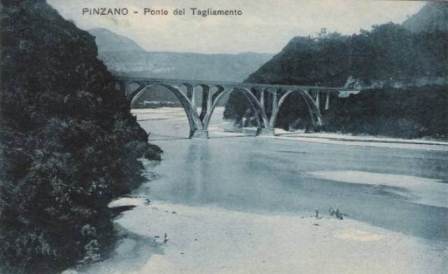
Initially operated by Neufeldt himself, in 1906 the tramway passed to the Società Veneta (SV), which already operated several systems in the area and in whose plans an extension of the line to Pinzano al Tagliamento was envisaged, although this was not built despite the preparatory work already carried out with the new bridge over the Tagliamento.
Between 1920 and 1932, also to tackle unemployment with the construction of public works, work began on the long‑hoped‑for extension towards Pinzano, but it was eventually interrupted and definitively abandoned despite the advanced state of the works, including those at Ragogna station.
In 1924, the management of the line passed from the Società Veneta to the Udine‑born engineer Giacomo Cantoni, who proceeded to renew the rolling stock in order to reduce journey times.
This management was in turn taken over in 1940 by the Società Anonima Trasporti Interurbani (SATI).
In the immediate post‑war period, in 1946, the closure of the urban section was imposed, thus depriving the tramway of its natural interchange with the railway network and severely penalising its traffic. In 1947, a tramway linking the municipality of Buia with San Daniele was planned, but the project never materialised. By now seriously compromised in its functionality and in its operating budgets, the line changed hands again, finally coming directly under the responsibility of the province of Udine in 1950.
Characteristics
The tramway track, laid with rails of 16.6 kg/m, had a metre gauge and curves with radii as tight as 30 m. The section from Udine to Martignacco had maximum gradients of 20 per mille, while the second part of the line, up to San Daniele, featured long stretches with gradients reaching 25 per mille.
The tramway partly followed the route of today's provincial roads 88, 10, 5 and 66; along the route to San Daniele it passed the main localities of Torreano di Martignacco, Martignacco and Fagagna, each served by stations with three tracks; a fourth intermediate station, Rivotta, had a simple passing loop.
For freight traffic, standard flatcars were used, with which it was possible to forward standard‑gauge railway wagons along the tram track, thanks to a dedicated connecting track at Udine station. Among the industrial centres served was the Cotonificio Cormor, a true industrial village built by the Anonima Cotonificio Udinese in 1884, which had a dedicated stop.
Rolling stock
For the operation of the line, in 1889 four new Maschinenfabrik Sigl tramway locomotives, numbered 20–23, and one, numbered 50, built by SLM two years earlier, also three‑axle like the previous ones, were delivered to the Neufeldt management. These units were affectionately nicknamed vacje di San Denêl by the local people.
In 1911, the Società Veneta increased the locomotive fleet with a sixth unit, no. 60, a Henschel three‑axle with the same Cn2kT wheel arrangement as the previous ones.
To replace the locomotives damaged or requisitioned by the Austrian army, in the immediate post‑war period use was made of three cabbed tramway units from the Susegana–Pieve di Soligo tramway, also owned by the Società Veneta, which had been built by the Officine di Saronno to designs and under licence from Maschinenfabrik Esslingen.
Under the management of Giacomo Cantoni, three bogie carriages were converted into electric railcars with accumulator traction, with electrical equipment supplied by Rognini & Balbo; these could haul a bogie carriage and, on more favourable stretches, also a two‑axle one. These distinctive vehicles entered service on 7 October 1924 and allowed a significant reduction in travel times compared with steam traction, although they did not themselves have outstanding performance, as evidenced by the maximum speed of 35 km/h for trains consisting of motor and trailer.
See also
- Susegana-Pieve di Soligo tramway
- Tarvisio–Udine railway
- Udine-Tarcento Tramway