
Greenland South Dockyard
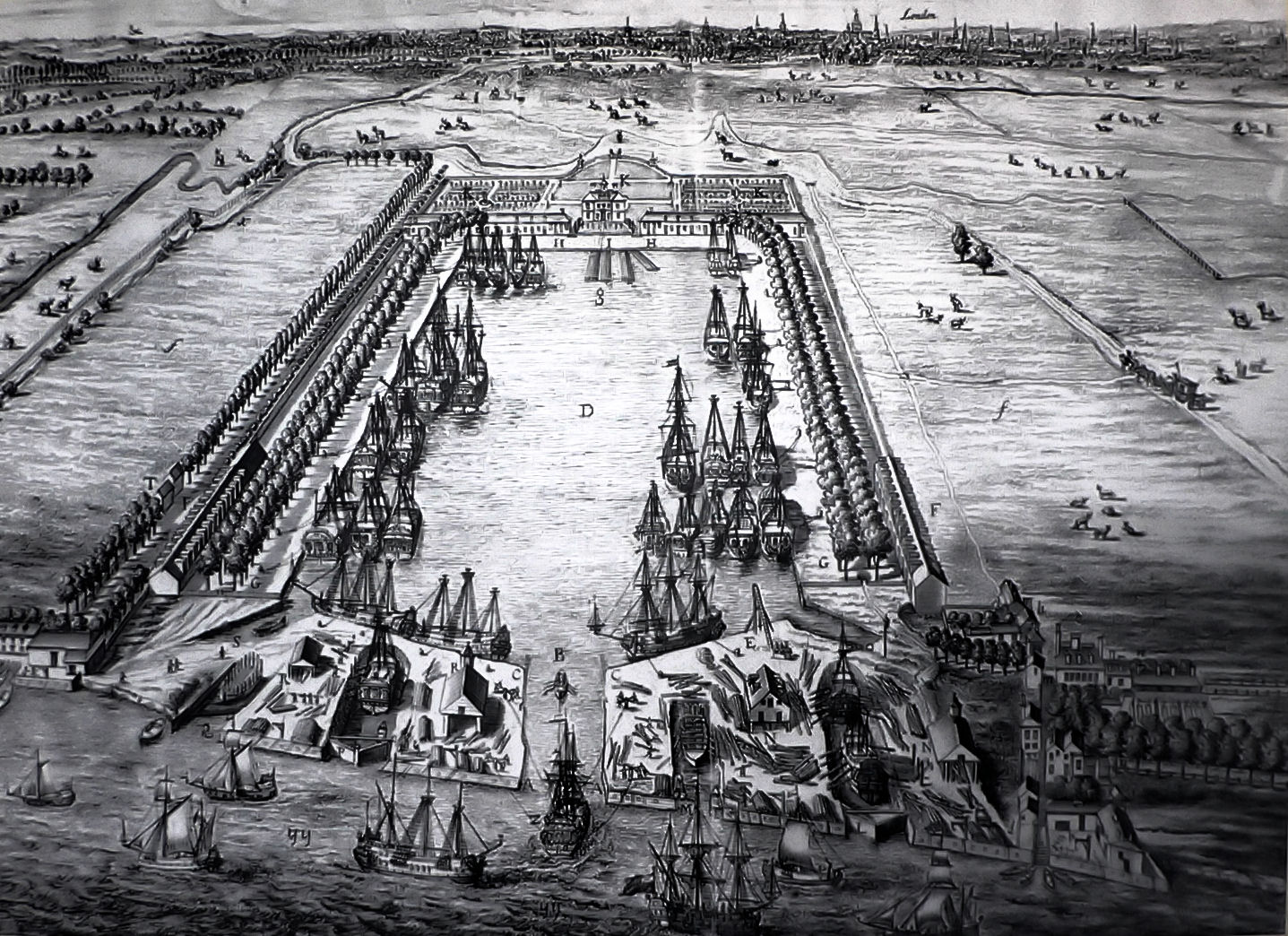 Greenland South Dockyard, also known as "Clyde Dock", "South Sea Dock" and "Ritchie's Dock", in Rotherhithe on the River Thames, London.
In 1695 when Elizabeth Howland was married to Wriothesley Russell, part of the betrothal agreement was that the Howland Great Wet Dock should be constructed. A new drydock and shipyard on the south side of the entrance lock was included in ths project. The dock and yard were probably in use from around 1700, and from the beginning leased to the Burchett family, who rebuilt the 60-gun warship Monck in 1702.
Then from 1725 to 1730, the south shipyard seems to have been included in the lease of Greenland Dock to the South Sea Company during that comapnies venture into whaling. It was at this time, prompted by the extensive usage by the Greenland whaling ships that the Howland Great Wet Dock was renamed Greenland Dock.
In 1760 John Randall the elder leased both this and the Greenland North Dockyard from the Bedford estate. When three years later the Wells family of shipbuilders bought the Greenland Dock complex from the Bedford Estate, they had to let John Randall's lease run its course. John Randall was already in business at what is now Nelson Dock, and would shortly take John Brent into partnership. For nearly 70 years, trading as Randall & Brent, S. & D. Brent and Daniel Brent, this firm would be at the forefront of shipbuilding on the Thames. During the American Revolutionary and Napoleonic Wars their output of warships and East Indiamen was greater than that of the more famous Blackwall Yard. The Randalls and the Brents built many notable vessels including several class prototypes for the Royal Navy, but one of the most famous was Serapis which in 1779 under the command of Richard Pearson was captured by John Paul Jones on the Bonhomme Richard.
In 1802, at a time when yards were hurrying to complete the refitting or building of East Indiamen, in time for them to catch the trade winds in the South Atlantic, the shipwrights on the Thames came out on strike. Any delay, and they could not leave for another year. The Greenland Dock Shipyards were among those affected, and on 22 August 1802 John Randall the younger came down here to try and negotiate with the strikers. One of the workmen lost his temper, and struck Randall with a piece of wood. Much distressed, Randall returned to his house in Great Cumberland Street and threw himself from an upper window, sustaining fatal injuries.
The [...] of John Randall brought an end to the Randall & Brent partnership. Then in 1804, the firm was taken to court by the government over defects in the construction of Ajax, launched in 1798. John Brent was long retired, so Samuel and Daniel Brent found themselves in court. Although the prosecution was politically motivated, some of the materials and workmanship in Ajax were poor, and the case harmed the firm's reputation. Samuel died in 1814, and by 1815, Daniel Brent, running the business on his own, left Nelson Dock and concentrated his efforts at the Greenland Dock entrance yards.
He was to produce a series of early steamships, including The London Engineer (a river steamer on the Margate service of 1818), Rising Star, the world's first practicable steam warship, built for the Chilean fight for independence from Spain in 1822 and Karteria, the first steam warship to see action, built for the revolutionary Hellenic Navy during the Greek War of Independence from the Ottoman Empire in 1828.
See also
- Shipbuilding in Rotherhithe
Further reading
- Shipbuilding in Rotherhithe - An historical introduction by Stuart Rankin, Bib Id 488375
- Shipbuilding in Rotherhithe - Greenland Dock & Barnard's Wharf by Stuart Rankin, Bib Id 482821