
Shipbuilding in Rotherhithe
Shipbuilding in Rotherhithe probably established in the Middle Ages, specialised in high quality vessels, which could be built on the narrow strip of land between Rotherhithe Street and the river Thames. In time the shipbuilders had to gain a few extra yards of space by extending out into the river, and exceptionally, by diversions of Rotherhithe Street. In places Rotherhithe Street was at one time or another called Jamaica Street, Lavender Street, Low Queen Street, Queen Street, Redriff Wall, Redriff, Rotherhithe Wall, Shipwright Street and Trinity Street.
Shipbuilding was far from secure, it was dependant on government contracts, for which payment was often late, or made with bills only maturing in the future, and which could only be turned into ready cash at a discount. It was rare for a family to stay in the business for more than two generations. The usual pattern being for the second generation to either retire as gentry or to go bankrupt. John Randall of Nelson Dock, did well enough to send his son (also called John) to Eton. John Randall the younger had no wish to live "over the shop" and had a house near Hyde Park. Similarly, John Brent, his partner built an elegant mansion at Blackheath. The house at Nelson Dock in which one of his sons lived still exists. The Rotherhithe master shipbuilders were men of the Enlightenment, with the educated and elegant tastes of contemporary gentry.
There being a limit to the length and breadth of hull, which could be made from wood, until the general introduction of wrought iron as a shipbuilding material from the 1840s onwards, vessels had only slowly increased in size from the 17th to the early 19th centuries. The rapid increase in ship size brought AbOUT by the use of iron coincided with an expansion of the docks on the Rotherhithe peninsula. This prevented the shipyards from expanding inland. By the 1860s, Rotherhithe shipyards were no longer able to compete for larger ships at the quality end of the market. In comparison to Scotland, the Mersey or the Tyne costs locally were so high that the building of small ships was uneconomic. The last large ship built in Rotherhithe was the clipper Lothair, launched in 1870. However the building of other craft and ship repair continued. The only shipyard remaining in Rotherhithe by 1940 was Nelson Dock.
Associated trades
In the Age of Sail a wooden sailing ship was an immensely complex machine, demanding many products of skilled trades to function. Several of which were in Rotherhithe, including manufacturers of rope and cable . Some of the long rope walks survived long enough as open spaces to become allotment gardens in the early 19th century and to escape being built over in the massive redevelopment that took place after WWII. There were also mast and spar makers, at least one of whom remained in business supplying wooden scaffolding when few ships required wooden masts any longer. Most glamorous of all were the ships’ carvers, who with a mixture of craft and artistry, produced the intricate wooden decoration and figureheads in demand by ship owners and even the Admiralty, until such things went out of fashion in the middle years of the Victorian era.
During this period a timber yard might be converted to a shipyard, by the simple expedient of constructing a building slip and later, a dry dock for repairs might be added. In Rotherhithe there were several of these, and until quite late in the 19th century almost all constructed of timber. 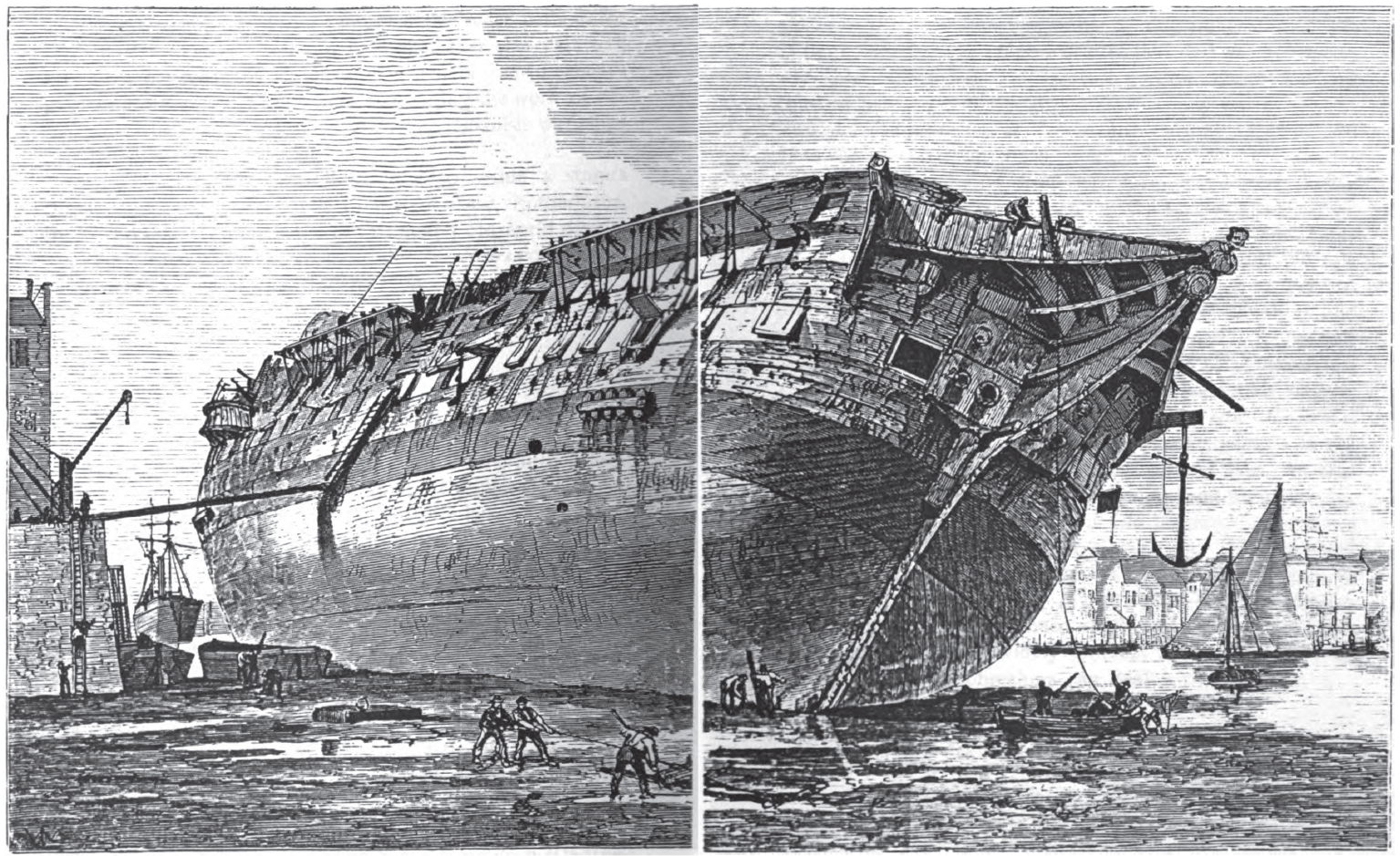 A timber yard could also be the base of a shipbreaker, particularly during the wars of the 18th and early 19th centuries. No special facilities were required, the hull to be demolished was merely moored securely on the foreshore, until breaking up reached the point at which it would no longer float, then the final stages of the work would be carried out at low water. In wartime, timber could be in short supply, especially the scarce curved compass timber used especially for knees, the wooden brace used to strengthen locations where timbers joined or crossed. When a wooden ship reached the end of its working life, there was a great deal of material which could be salvaged for further use, either in ship repair, in building a new vessel, or even on land. As shipbuilding became less profitable, some shipyards turned over to shipbreaking. Some famous vessels met their end in Rotherhithe. The peak time for this activity was from around 1830 onwards, when the last survivors of the massive fleet built up during the Napoleonic wars were broken up.
The Shipyards
Between the Grand Surrey Canal entrance lock and South Dock there were at least 12 shipyards. Some of them active in building or repairing for 200 years or more. The main docks and wharves where shipbuilding took place were: Bull Head Dock; King and Queen Dockyard, which may have been called "Pitchers Point" at one time, and at one time also incorporated Princes Dock; Upper Globe Dock, also known as "Globe Pier Dock"; Globe Dock, also known as "Low Globe", "Lower Globe" and "Globe Stairs"; Horseferry Dock; Lavender Dockyard; The Pageants; Nelson Dock, also known as "Cuckold's Point" and "King's Dockyard; Barnard's Wharf, also known as "Stanton's Yard" and "Mr. Wells' Yard"; Greenland North Dockyard, also known as "Greenland Dock" and "Licensed Victualler's Dock" and Greenland South Dockyard, also known as "Clyde Dock", "South Sea Dock" and "Ritchie's Dock".
Further reading
- Shipbuilding in Rotherhithe - An historical introduction by Stuart Rankin, Bib Id 488375
- Shipbuilding in Rotherhithe - Bull Head Dock to the Pageants Part 1 by Stuart Rankin, Bib Id 594173
- Shipbuilding in Rotherhithe - Bull Head Dock to the Pageants Part 2 by Stuart Rankin, Bib Id 586804
- Shipbuilding in Rotherhithe - Greenland Dock & Barnard's Wharf by Stuart Rankin, Bib Id 482821
- Shipbuilding in Rotherhithe - The Nelson Dockyard by Stuart Rankin, Bib Id 451681