
Milan–Monza tramway
The Milan–Monza tramway was a line of the Milan interurban tramway network that connected Milan with Monza between 1876 and 1966. It was the first interurban tramway built in Italy. Initially horse‑drawn, it was electrified from 1900 onwards.
History
thumb|left|upright=0.8|The horse‑drawn tramway
The presence of the Milan–Monza railway, operated by the Società per le Ferrovie dell'Alta Italia (SFAI), allowed this railway company to oppose the construction of a competing line, even though it was laid on an existing ordinary road. Only thanks to the ruling of the Council of State of 3 June 1874, which established the concept that horse‑drawn tramways or "hippomobiles" were not to be included among the railways contemplated by Article 5 of Law 2248/1865, was it possible to resume the procedure relating to Luè's concession.
However, Luè did not present the necessary guarantees to start the works, so the Provincial Deputation felt released from the legal obligations of the concession and began negotiations with the Società Anonima degli Omnibus (SAO), which managed the omnibus transport in the capital city. The SAO then resubmitted the application for the Milan–Monza line, obtaining the concession on 15 February 1876.
The SFAI, similarly to what it had done with Luè's initiative, turned to the Council of State to challenge the decision of the provincial council. This time, the railway company's initiative also received support from the Società Anonima Ferrovie Milano–Saronno e Milano–Erba (FMSME), concessionaire of the Milan–Saronno railway, which felt damaged by a similar decision regarding a project for a tramway between Milan and Saronno, and from the Ministry of Transport, which contested the right of a provincial public body to grant concessions for "hippomobiles" and "trainways" (the latter with steam traction).
On 5 July 1876, the Council of State rejected the application, accepting the interpretation presented by the Provincial Deputation, according to which the legislative impediment for tramways parallel to railway lines occurred only if the former had their own right‑of‑way. The issue would therefore not concern either the Monza tramway or the Saronno one, since the respective concessions were for hippomobiles whose tracks were laid on the roadway.
Having obtained the green light, the Milan–Monza tramway was inaugurated by the SAO three days after the ruling, as its construction had been completed in the preceding weeks. The ceremony was attended by Prince Umberto of Savoy, SAO President Emilio Osculati, and the mayors of Monza and Milan.
SAO operation
In November 1876, the SAO experimented with steam traction on the line in order to evaluate the possibility of replacing horses. For this purpose, three Brown locomotives were used on some regular runs; however, due to the particular operating regime of the tramway line—frequent runs, single‑carriage trains, and a short route—the SAO decided to retain horse traction. In the following years, a comparison of the operating costs of the Milan–Gorgonzola–Vaprio Tramway with those of the Milan–Monza line justified the SAO's position in favour of horses.
In 1877, the Omnibus Tram Milano Monza was listed on the Milan Stock Exchange. In November of the same year, the SAO obtained an extension of the tracks within the city walls of Milan, so the terminus was moved from Porta Venezia to San Babila. In Monza, a similar measure was definitively adopted in 1883, after a brief period in 1880 when the terminus was moved from Largo Giuseppe Mazzini to Via Carlo Alberto.
The service was operated by the SAO with hourly and later half‑hourly departures. "Extra runs" were also instituted to reinforce the service on the urban section.
In 1893, a short trial was carried out using motor cars with accumulators, initially of the gel type produced by Maschinenfabrik Oerlikon, and later with a "porous diaphragm" system from Gandini & Lodi. This was an attempt by the SAO to curb the advance of Edison, which that year had obtained the concession for the construction of an urban tramway with electric traction. Although the experiment demonstrated the convenience of operating with accumulator cars, the operating company decided to retain horse traction in this case as well.
Edison operation and electrification
After losing the management of the Milan urban tramway network (1895), the Società Anonima degli Omnibus was liquidated and its package of animal‑drawn interurban concessions was passed to Edison, which initiated an electrification programme for them, including the Milan–Monza line. In 1897, the Omnibus Tram Milano Monza stock was delisted.
With Royal Decree 4 March 1900, no. 446, Edison was therefore granted the construction of the electric tramway between Milan and Monza, which was opened for service on 31 December of the same year. The new tramway featured renewed track and several route innovations, such as an overpass over the Milan–Chiasso railway and extensions near the Duomo in Milan and near the Regio Parco in Monza. In the following years, some sections were doubled, such as Molinetto di Monza–Monza Largo Mazzini (1902) and Milan Loreto–Molinetto di Greco.
Due to increased traffic within the Milan ring road, in 1911 the terminus was moved back to Porta Venezia: a new loop was activated running along Via Andrea Doria, Via Settembrini, and Via Vittorio Veneto, while the station, of the through type, was located along the latter street. Interurban trams were nevertheless allowed to reach the Piazza Duomo terminus in the morning and evening.
In August 1913, the Milan–Torretta–Cinisello tramway and its branch Torretta–Sesto San Giovanni were opened; the latter made it possible to start an alternative service connecting Monza to the Pirelli and Breda factories, thereby reinforcing the Milan–Monza line itself, which on the section between Sesto San Giovanni and Molinetto di Greco was at that time single‑track. It was only in 1919, at the end of the First World War, that Edison proceeded to double the track between Molinetto di Greco and the overpass at Cascina Novella; the double track could not be laid on the latter structure as its width was insufficient for the purpose.
STEL and line enhancement
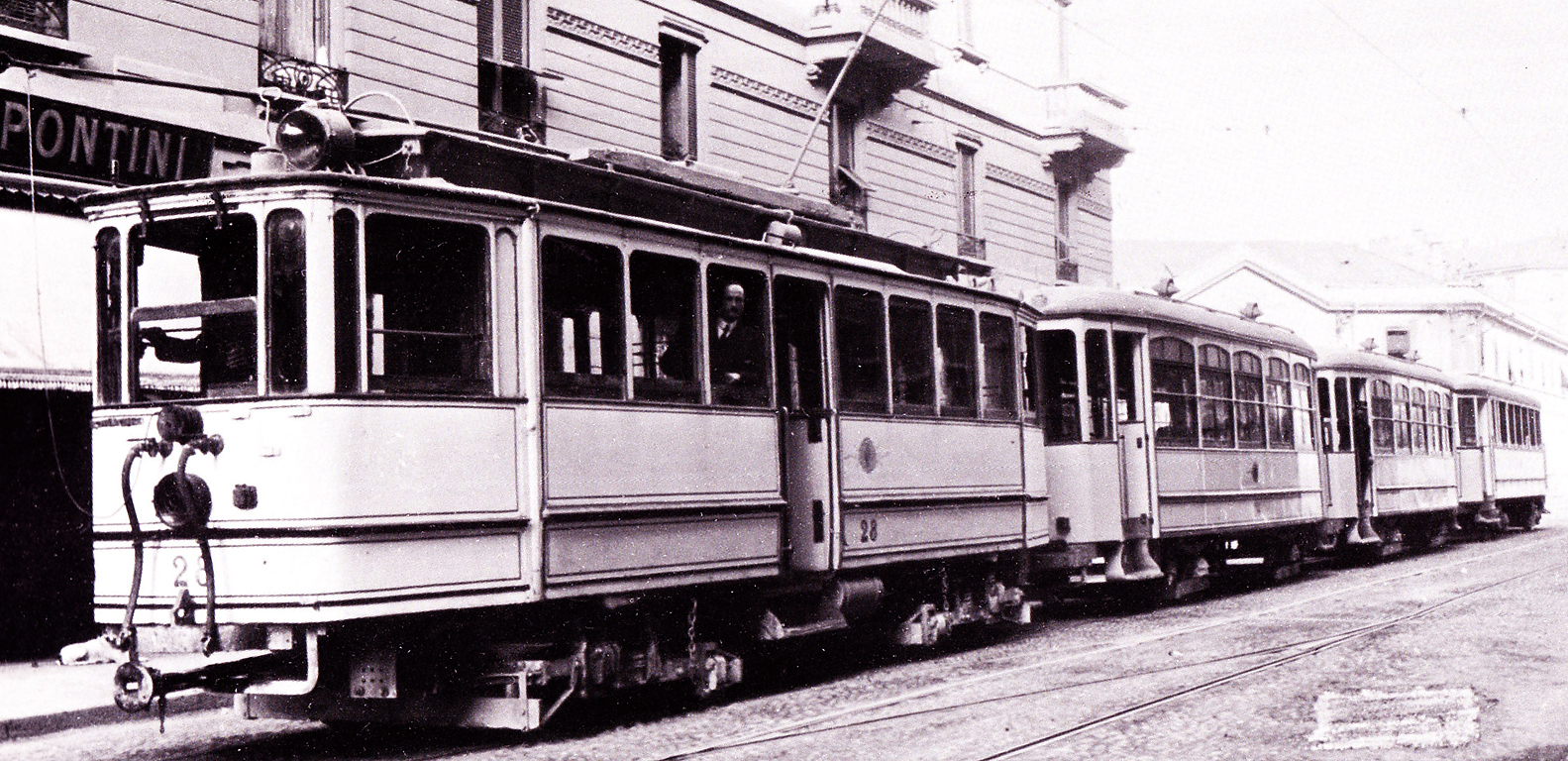 In 1919, STEL obtained from Edison, its parent company, the operation of its interurban lines, and the transfer was subsequently confirmed by Royal Decree 30 December 1919, no. 9835.
In 1922, STEL obtained from the province of Milan an extension of the concession until 1941, later extended to 1951. This made it possible to economically justify investments such as moving the line onto a reserved tram track alongside existing roads and doubling the track on almost the entire route; the work lasted until 1926.
In the same year of 1922, the tram company entered into a new agreement with the provincial authority for a reinforcement line along the route Sesto San Giovanni–Cascina Beraggia–Cascina Robecco–Cascina Bovati (later San Fruttuoso)–Monza, which was inaugurated on 1 September of that year. In Monza, around the same period, tracks were laid along the inner ring road (Via Manzoni and Via Appiani) with the aim of reinforcing the tram route between Largo Giuseppe Mazzini and the Regio Parco terminus, following the request of the Monza municipality to gradually eliminate the use of double‑decker motor cars, which restricted private vehicular traffic.
In 1924, the new Monza Borgazzi depot was built, and a section of track was laid between Sesto Cascina Novella and Sesto San Giovanni railway station near the level crossing gates where the old horse‑drawn tramway crossed the Milan–Chiasso railway. The new branch was built to be used for services terminating at Sesto, freeing the Sesto Rondò stop from the parking of vehicles on this route. In the same year, the section Regio Parco–Vedano was built, with a terminal loop at that location, for the institution of specific services serving the autodrome and the Monza racecourse.
It was thus possible to structure passenger services on several routes to meet the mobility needs of the areas served by the tramway, such as the introduction of direct Milan–Monza runs routed via Sesto–San Fruttuoso–Monza, and the Monza urban service between Regio Parco and Largo Molinetto.
STEL's overall service offering was therefore articulated as follows:
- "ordinary" service Milan–Monza;
- a "direct" service between the two cities, non‑stop and passing through the Sesto–Cascine Bovati–Monza branch;
- the "urban" service within Monza;
- a "local" service Milan–Sesto Cancelli;
- a "local" service Milan–Turro–Gorla;
- a "local" service for the Sesto–Cascine Bovati–Monza section.
Transfer to ATM
 The Second World War delayed the project, which was therefore pursued in the 1950s. Regarding the Milan–Monza line, ATM planned its replacement with a metro, Line 1, which would run underground along the same route as the tramway between Porta Venezia and Sesto Marelli, and with bus services to cover the remaining section. The various services on the line were progressively discontinued, starting with the direct service via San Fruttuoso (1953), the "local" service to Bicocca via Torretta and Sesto, and the Monza urban service, both in 1956. During the same year, the "Celere" was activated: a motor bus service between Monza and Piazzale Cadorna in Milan.
In 1957, the service on the Milan–Cinisello line was suppressed. From 2 March 1958, part of the routes of this tramway and the Torretta–Sesto branch were reused by the Milan–Monza line in order to maintain its operation during the period when the section between Porta Venezia and Sesto was affected by metro construction sites. The new terminus was placed at Piazza IV Novembre: from that point, the tram proceeded uphill along Via Ponte Seveso and entered the old track of the Cinisello line, which was used as far as Torretta, where it was then routed onto the branch to reach Sesto Rondò and then return to the old alignment. The anticipated increase in traffic led to the doubling of the "Cinisello" track between Viale Sarca and Sesto Rondò, and to the construction of a branch, which trams would travel downhill, along Viale Sarca, south of Via Pulci, and along Via Arbe. Together with the activation of the deviation, the local service between Milan and Sesto Cancelli was suppressed.
On 1 November 1964, Metro Line 1 opened, progressively absorbing a large part of the tramway's passenger traffic. ATM therefore decided to close the line, replacing the Sesto Marelli–Monza section with a service covered by articulated buses. The last day of operation was 2 October 1966. The final tram, number 119, departed Monza at 00:20 on that day.
Characteristics
At the time of its inauguration, the length of the original line, designed for horse traction, was 13.630 km. When the Milan terminus was moved from Piazzale Venezia to Piazza San Babila (1877), it increased to 14.560 km, and then grew to 14.9 km when the Monza terminus was also moved to the Arengario.
Electrification was carried out at 600 volts direct current. The overhead line consisted of a contact wire with a cross‑section of 100 mm². In urban areas, this was supported by a transverse suspension anchored to the load‑bearing walls of the buildings, while in extra‑urban areas trees or wooden and lattice poles with a metal supporting bracket were used. Power was supplied by substations of the urban network and by the Sesto San Giovanni substation, built specifically by Edison, which employed a 1000 kVA General Electric converter.
Route
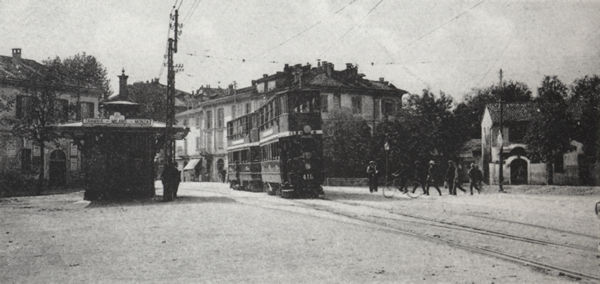
The alignment was single‑track throughout with eleven passing loops for crossings and overtaking; the one at Sesto San Giovanni served as a crew change point. After the inauguration of the Milan–Gorgonzola–Vaprio Tramway (1878), the common section along Via Buenos Aires was doubled.
The section from the Milan terminus to Piazzale Loreto was originally equipped with Marseillon rails 6 m long and weighing 14.1 kg/m for the main rails and 10.9 kg/m for the check rails. At some turnouts and at the crossing near the Porta Venezia barrier, "channel" type rails on a continuous support, very similar to modern Phoenix rails, were instead used. The sleepers were of oak and placed every 1.5 m. On the section beyond Piazzale Loreto, Marteau‑type rails 4.5 to 6 m long, weighing 14.5 kg/m, resting on oak sleepers placed one metre apart, were used. At the end of the 19th century, the Marteau rails were replaced by Vignoles of 17.6 kg/m.
The route of the electrified line was extended to about 17.1 km: the Milan terminus of the electrified line was placed in Piazza Duomo, while the Monza one was at the Regio Parco. In 1910, the Milan terminus was moved back to Porta Venezia, reducing the line length to about 15.5 km.
In the first two decades of the 20th century, the entire line was progressively doubled to meet traffic demands. After its acquisition by STEL, it was reconstructed as a double‑track line, largely on a reserved right‑of‑way protected by a tram track. Some single‑track sections remained for spatial reasons, while on the overpass of the Milan–Chiasso railway, gauntlet tracks were used. The Sesto–Robecco–San Fruttuoso–Monza branch was built as a single‑track line without passing loops; the right‑of‑way was on a reserved tram track between Sesto and Via Cavallotti in Monza, while the remaining part was on a mixed roadway.
Following the route modifications accompanying electrification, the line was re‑laid with Phoenix‑type rails on mixed sections and Vignoles‑type rails on reserved sections. The weight per linear metre of the latter was 25 kg. After the STEL restructuring, Phoenix rails of 48.7 kg/m and five types of Vignoles, differing in weight per linear metre (25 kg, 27.7 kg, 28.3 kg, 30 kg, and 36 kg), were employed.
See also
- List of tram and light rail transit systems
- Monza–Trezzo–Bergamo Tramway
- Milan–Gallarate Tramway
- Milan–Saronno–Tradate Tramway
- Milan–Saronno railway
- Milan–Gorgonzola–Vaprio Tramway
- Milan-Lodi Tramway