
Milan-Magenta/Castano Primo Tramway
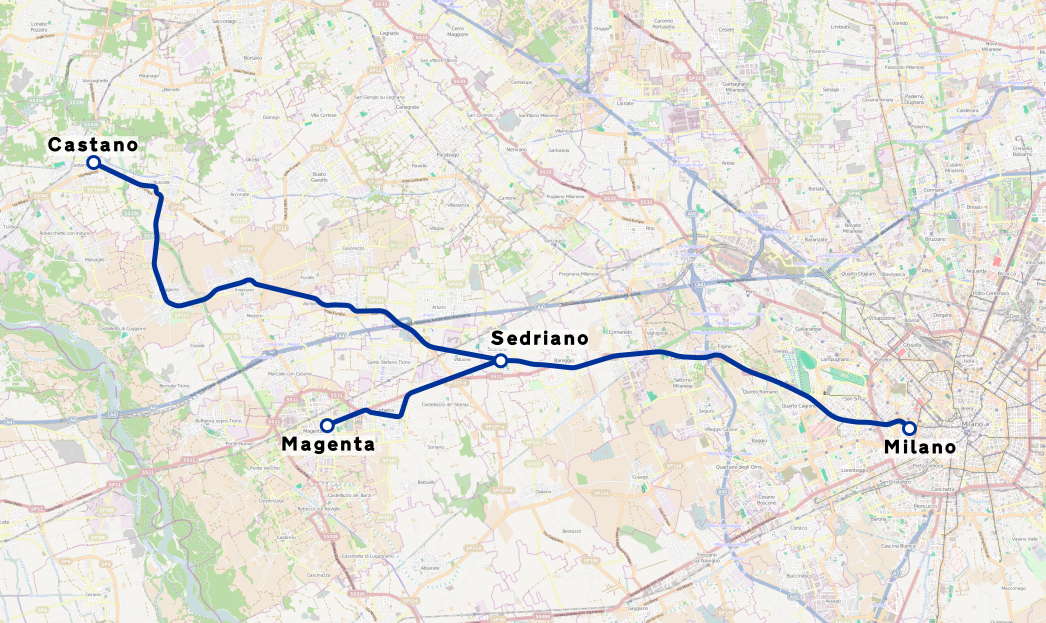
The Milan–Magenta/Castano Primo tramway was a line of the Milan interurban tramway network that connected the Lombard capital with Magenta and Castano Primo.
Like other similar lines, the tramway was colloquially known by the dialectal nickname Gamba de Legn', although this term was initially used for the steam locomotives that pulled the trains.
History
In October 1877, a request for a concession was presented to the province of Milan for an interurban tramway with steam traction that would run along the provincial Vercellese road (now SS 11) to connect Milan to Magenta. The application also requested a concession for a branch from Sedriano to Castano Primo. In the following months, the applicants, including engineer Enrico Horvath and Mr. Amos Mascheroni, formed a company, the Società Anonima del Tramway Milano-Magenta-Castano (MMC), to raise the capital needed for construction and operation of the line.
On September 9, 1878, a fifty-year concession agreement was signed between the MMC and the Milan Provincial Deputation, which launched the construction of the line thanks to the financial participation of a Belgian construction company. The work was completed between 1879 and 1880, also thanks to the design input of engineer Augusto Masetti, who was at the time involved in the design of another tramway, from Lucca to Ponte a Moriano. Specifically, on August 2, 1879, the section between Milan and Sedriano was opened; then, on October 15 of the same year, the line reached Cuggiono, while on November 27, the section between Sedriano and Corbetta was completed. On January 15 of the following year, the line reached Magenta, and on March 8, it reached Castano.
The Gamba de legn was used primarily by commuters and, for freight transport, especially by those involved in silkworm farming, which was widespread in the area at the time. During the First World War, on May 31 1917 a tram convoy carrying soldiers was involved in a serious accident due to the overflowing of the river Olona; throughout the subsequent conflict, the cars carried many displaced persons, who accounted for the line’s heaviest passenger load during that period. Freight traffic was also brisk, thanks in part to the presence of some industrial sidings along the line.
In 1933 the Società per le Ferrovie del Ticino (SFT) entrusted the MMC with the management of two lines of its network, the Milan–Pavia and the Pavia–Sant'Angelo Lodigiano, which were discontinued on March 1, 1936.
Competition from road transport, starting from the bus lines established in 1929, was beginning to be felt, but neither the MMC nor the Azienda Tranviaria Municipale Interurbana (ATM), which took over the service of the provincial network in 1939, implemented the long-discussed plans for the electrification of the line, which by then provided for only five round trips per day , increased to six in the post‑war period.
In 1951, the tramway, by then characterised by an outdated traction system, was the subject of strong criticism directly from Senator Guido Corbellini, inducing ATM, which in the meantime had integrated the ATMI service, to close the line subject to the elimination of the related operating deficit by the State.
On 21 July 1952, the branch line to Castano Primo was discontinued, partly in response to the criticism regarding the continued presence of the level crossing at Vittuone; in 1954, service was reduced to five to Magenta, with the creation of a replacement bus service. In 1957, the service was further reduced and, from 30 August, it was completely discontinued and replaced by a bus service with the creation of the Milan–Magenta–Cuggiono interurban bus line operated by ATM.
Characteristics
The total length of the network was 42.957 km, of which 19.487 were consisted of the branch to Castano Primo and the remaining 23.470 of the Milan–Magenta line. The track gauge was 1,445 mm, with track consisting primarily of 14 kg per meter rails. The maximum speed, initially 15 km/h, was increased to 18 km/h in 1890, allowing the route to Castano Primo to be covered in about two and a half hours and then to 40 km/h in 1921, reducing travel time by an hour.
Route
The original Milan terminus was located in the area that was later renamed Piazza Baracca and consisted of a small station with service facilities and an open-air depot. It was not until 1911 that this facility was moved to number 33 Corso Vercelli, as a result of the extension of the urban tramway network.
After passing through the Porta Magenta area and traveling under the Milan Railway Belt, the steam trams reached the tollgate, near Bettola di Figino, a station equipped from 1931 as the terminus for some supplementary runs; from there, crossing the road with a particularly sharp curve, the trams continued serving the municipalities of Cascine Olona, San Pietro all'Olmo, Sedriano and Corbetta, until arriving at Magenta.
The crossing of the Turin–Milan railway took place at grade, with the trams crossing over the railway tracks thanks to special cut‑outs in the tram rails. In order, the municipalities of Ossona, Inveruno, Cuggiono and Buscate were then served, finally reaching the terminus.
Rolling Stock
As part of its initial fleet, the MMC acquired in 1879 six two‑axle locomotives built by Krauss, followed the next year by a similar model, identical to those already delivered to the Società Anonima del Tramway Milano-Gorgonzola-Vaprio (MGV) for service on its own line and to the Società Anonima dei Tramways e delle Ferrovie Economiche di Roma, Milano e Bologna (STFE) for the Milan–Saronno tramway. In 1885, another unit of this type was added with fleet number 8.
After the subsequent delivery of locomotives 9 and 10, a further "Krauss", more powerful than the previous ones and nicknamed "la gabbia" (the cage) by the staff, was purchased and numbered 2, replacing a locomotive that had in the meantime been scrapped following an accident. Further deliveries occurred in 1906, 1907 and 1910, bringing the total fleet to seventeen units. 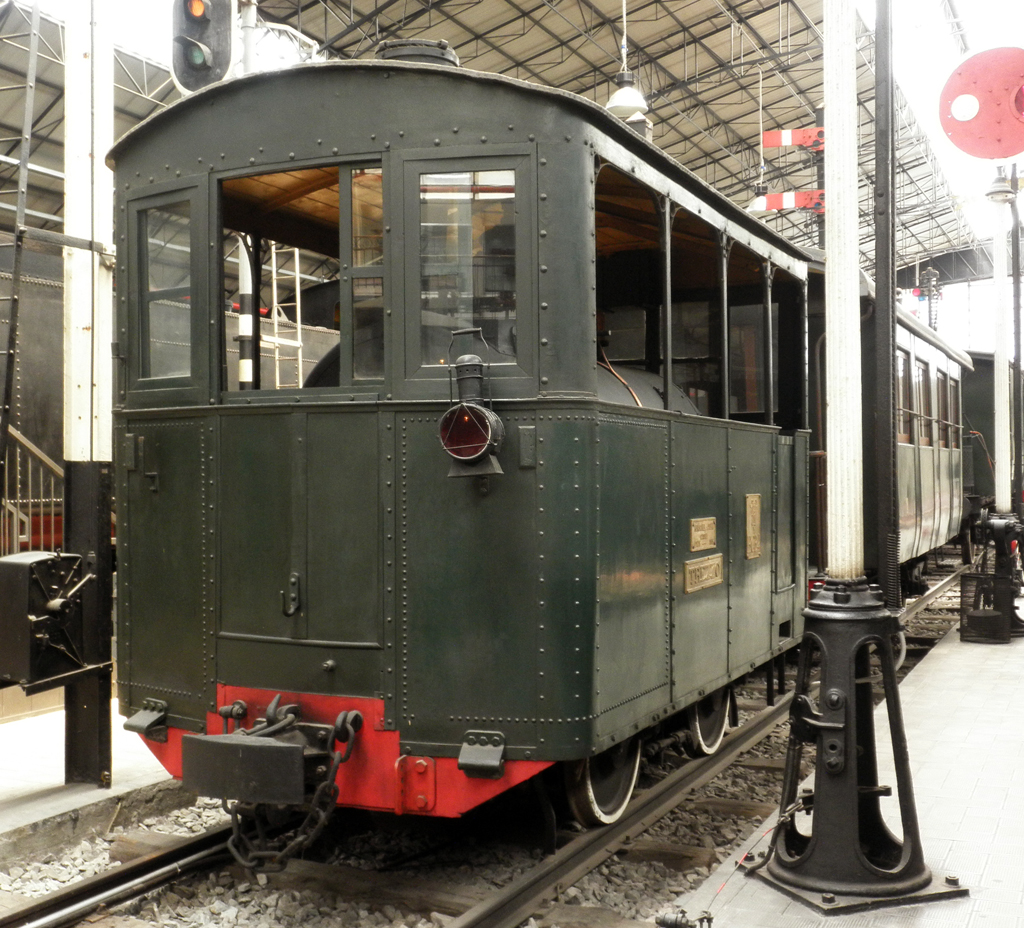 On all the locomotives produced by Lokomotivenfabrik Krauss between 1879 and 1910, the boiler and engine were fully enclosed by the bodywork to ensure maximum safety for the crew. The driver’s cab was located at the front of the locomotive.
To the Krauss locomotives were later joined by others: in 1931, six units of Borsig construction and two of Atéliers Métallurgique de Tubize construction arrived from the Tramways a Vapore Interprovinciali di Milano, Bergamo e Cremona (TIP), while in 1936, it was the turn of the Società per le Ferrovie del Ticino, which ceded to the MMC (which since 1933 had taken over the management of two of its social lines) the four units in the fleet that were in the best condition.
Motor Units – Summary Table
Unit |
Year of acquisition |
Builder |
Construction no. |
Wheel arrangement |
Max speed |
Notes |
|---|---|---|---|---|---|---|
1 - Castano |
1879 |
Krauss |
715 |
B |
15 km/h |
Scrapped in 1931 |
2 - Sedriano |
1879 |
Krauss |
716 |
B |
15 km/h |
Withdrawn following accident in 1904 |
13 - Sedriano |
1904 |
Krauss |
5195 |
B |
15 km/h |
To replace no. 2 |
3 - Inveruno |
1879 |
Krauss |
823 |
B |
15 km/h |
Scrapped in 1931 |
4 - Magenta |
1879 |
Krauss |
779 |
B |
15 km/h |
Scrapped in 1931 |
5 - Milano |
1879 |
Krauss |
780 |
B |
15 km/h |
Scrapped in 1931 |
6 - San Pietro all'Olmo |
1879 |
Krauss |
781 |
B |
15 km/h |
Scrapped in 1931 |
7 - Vittuone |
1880 |
Krauss |
1631 |
B |
15 km/h |
Scrapped in 1931 |
8 |
1885 |
Krauss |
1302 |
B |
25 km/h |
|
9 |
1885 |
Krauss |
1303 |
B |
25 km/h |
|
10 |
1885 |
Krauss |
1631 |
B |
25 km/h |
|
11 - Cuggiono |
1906 |
Krauss |
5410 |
B |
20 km/h |
|
12 - Corbetta |
1907 |
Krauss |
5839 |
B |
20 km/h |
|
14 - San Pietro all'Olmo |
1907 |
Krauss |
5840 |
B |
20 km/h |
|
15 - Milano |
1910 |
Krauss |
6344 |
B |
40 km/h |
|
16 - Inveruno |
1910 |
Krauss |
6345 |
B |
40 km/h |
|
17 - Vittuone |
1910 |
Krauss |
6346 |
B |
40 km/h |
|
65 - Dovera |
1909 |
Borsig |
7370 |
B |
40 km/h |
Acquired in 1931 from TIP |
68 - Martesana |
1909 |
Borsig |
7372 |
B |
40 km/h |
Acquired in 1931 from TIP |
69 - Molino Nuovo |
1909 |
Borsig |
7373 |
B |
40 km/h |
Acquired in 1931 from TIP |
70 - San Donato |
1909 |
Borsig |
7382 |
B |
40 km/h |
Acquired in 1931 from TIP |
64 |
1908 |
Tubize |
1575 |
C |
40 km/h |
Acquired in 1931 from TIP |
82 |
1911 |
Tubize |
1706 |
B |
40 km/h |
Formerly SFT, acquired in 1931 from TIP |
108 |
1908 |
St. Leonard |
1546 |
B |
40 km/h |
Acquired in 1933 from SFT |
110 |
1908 |
St. Leonard |
1548 |
B |
40 km/h |
Acquired in 1933 from SFT |
111 |
1912 |
Tubize |
1683 |
B |
40 km/h |
Acquired in 1933 from SFT |
18 |
1911 |
Saronno |
3610 |
B |
25 km/h |
Acquired in 1933 from SFT |
The original equipment was completed by twenty‑eight open‑platform carriages built by the Grondona company and ten goods wagons built by the same Milanese manufacturer. In 1910, ten open‑platform carriages and four closed carriages were purchased, built by Fratelli Bagnara; in 1931 some carriages from the TIP were added to these vehicles.
See also
- Castano Primo
- Transport in Italy
- Magenta
- Milan