
Monza–Trezzo–Bergamo Tramway
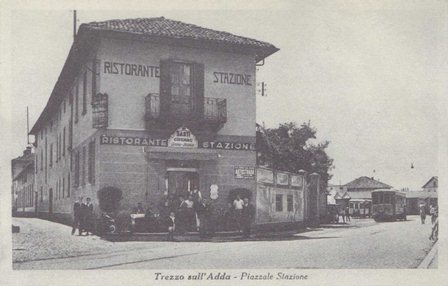
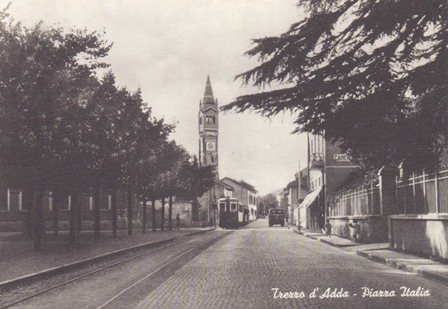
The Monza–Trezzo–Bergamo tramway was an interurban tram line that connected Monza to Bergamo between 1890 and 1958.
After the closure of the , it was the last steam-powered interurban tramway in operation in Lombardy, as well as the last in Italy to employ accumulator trams.
History
 Following the opening of the Milan–Monza tramway in 1877, and of other mechanically powered interurban tram lines in the province of Milan, such as the Milan–Saronno–Tradate and the , several proposals were put forward for the construction of a line between Monza and Bergamo. All projects were, however, conditional on the construction of a bridge over the Adda at Trezzo, which was completed in the second half of the 1880s. Consequently, it was only on 11 November 1888 that the Società Anonima per la Tranvia Monza-Trezzo-Bergamo (MTB) was established; on 15 March of the following year, it submitted an application to both provincial administrations concerned (Bergamo and Milan) to build and operate the eponymous tramway.
The concession application was approved on 10 December 1889. It was to last for fifty years, expiring on 1 July 1939, and was renewable annually thereafter.
The tramway was opened on 1 July 1890. Among its peculiarities: the terminus at Monza was located inside the railway station yard of Monza, between the line to Chiasso and the one to Lecco, while a part of the track between Concorezzo and Vimercate ran alongside the Milan–Vimercate Tramway, operated by the Tramways a Vapore Interprovinciali di Milano, Bergamo e Cremona (TIP). Only an agreement between the two companies in 1903 allowed the installation of a connecting track at Vimercate for the sole purpose of enabling cumulative freight transport.
In order to face competition from the electric tramways of the STEL and from road transport, in 1925 the MTB submitted to the Government a project for the electrification of the Monza–Trezzo section, including some route corrections. However, the authorities requested that the study be extended to the entire line, so a more ambitious project was resubmitted, which contemplated the possibility of cumulative freight transport with the state railways, exploiting the favourable position of the Monza terminus. Both the Government and the local authorities rejected the proposal, considering it too costly.
On 1 July 1939, ATM took over the operation of the line, which the city of Milan had purchased from MTB in the preceding months.
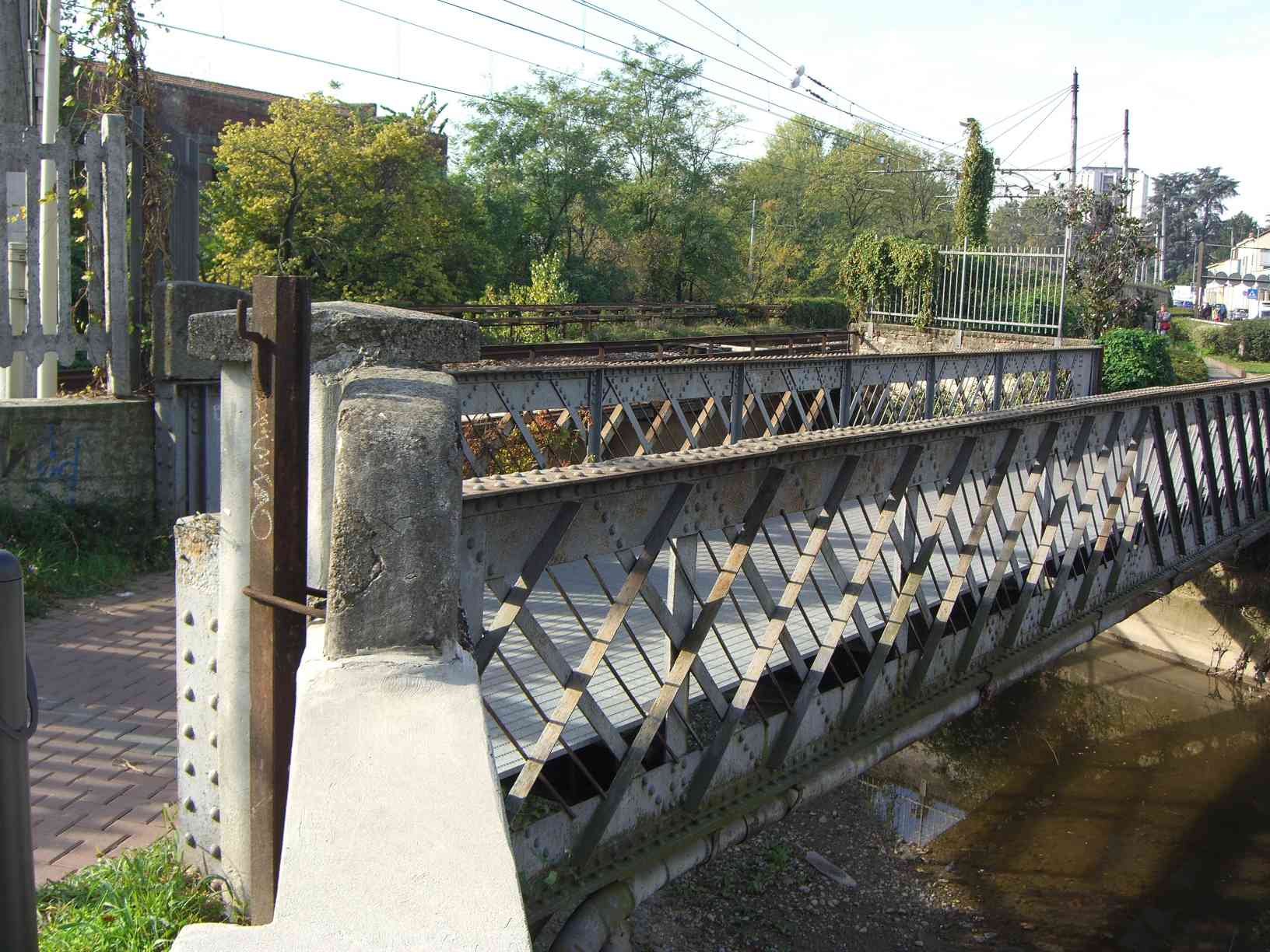
On 28 July 1952, service on the Trezzo bridge was suspended, as the iron structure built in the 1880s was to be replaced by a more modern concrete structure. This was the first step in the line's closure: on 31 January of the following year, service between Capriate and Bergamo was suppressed, as in the last few months operation had been exclusively steam-powered, since the battery charging stations for the railcars were located at Trezzo and Monza. Service on the remaining section was suppressed on 28 June 1958, replaced by bus services the following day.
Characteristics
The line was an interurban tramway with a single track of standard gauge. Its length was . As for the track, Vignoles rails were used with different weights per linear metre for the various sections: the range went from to . 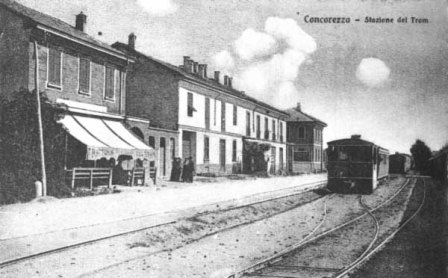
Rolling stock
 Among the locomotives used was the former no. 1 – Como of the Ferrovie Nord Milano, a three-axle locomotive of 1880 built by Maschinenfabrik Esslingen, which had been renamed Massa Marittima in 1904 following its purchase by FMF, the concessionaire of the Massa Marittima–Follonica railway.
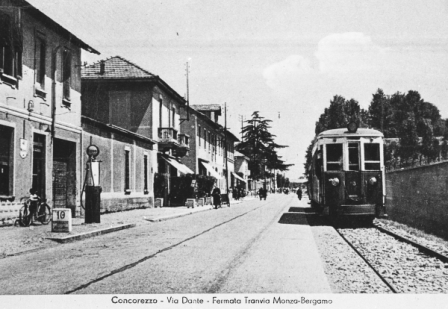
The strong asymmetry of the line's traffic volumes – heavy during peak hours and light off-peak – made steam traction uneconomical. In 1932, in addition to a three-axle Breda locomotive acquired from the Bergamo–Trescore–Sarnico Tramway, accumulator railcars were purchased, which combined the operational flexibility of electric trams with the advantage of being able to maintain the existing infrastructure, avoiding the construction of overhead power supply systems. The first three models were produced by Carminati & Toselli with electrical equipment from TIBB.
Two years later, the closure of the Mantua–Asola tramway and Mantua–Viadana Tramway, which operated with the same system, allowed MTB to purchase four more accumulator railcars built by Rognini & Balbo, which were nicknamed le Mantovane (the Mantuan ones) by the staff. The new vehicles were assigned to off-peak services, while steam locomotives remained for hauling the busiest trains of the day, as well as for freight service.
The steam locomotive no. 34, purchased from the Milan–Gallarate tramway, is preserved at the National Museum of Science and Technology in Milan.
In December 1948, the rolling stock fleet consisted of ten steam locomotives, seven accumulator electric railcars, forty-five passenger cars (four of which were bogie cars), forty-five open freight wagons, twenty-five closed freight wagons, two flatcars with trailers, and one crane.
Summary of motive power
Unit |
Year of construction |
Builder |
Type |
Notes |
|---|---|---|---|---|
1÷4 |
1889–1890 |
Krauss |
2-axle |
|
5 |
1891 |
Henschel |
2-axle |
|
6 |
1893 |
Henschel |
2-axle |
|
7÷8 |
1895 |
Breda |
2-axle |
|
9÷12 |
1909–1910 |
Krauss |
3-axle |
|
6 (II) |
1892 |
Henschel |
2-axle |
ex TIP |
2 (II) |
1913 |
Breda |
3-axle |
ex Bergamo–Trescore–Sarnico tramway |
2 (III) |
Greco |
3-axle |
rebuilt |
|
14 |
1908 |
Krauss |
3-axle |
ex Bologna–Casalecchio–Vignola tramway |
22 |
1903 |
Greco |
3-axle |
ex SFSM of Domodossola, rebuilt by Greco from a Krauss locomotive of |
24÷25 |
1910 |
Henschel |
3-axle |
ex STV |
32 |
1881 |
Henschel |
2-axle |
ex TIP |
34 |
1909 |
Henschel |
2-axle |
ex Milan–Gallarate tramway |
4 (II) |
1880 |
Kessler |
3-axle |
ex STV, originally built for the Como–Fino–Saronno tramway |
21 |
1903 |
Henschel |
2-axle |
ex STV |
64 |
1908 |
Tubize |
3-axle |
ex MMC, originally built for TIP |
80 |
1911 |
Tubize |
3-axle |
ex MMC, originally built for TIP |
82 |
1909 |
St. Léonard |
2-axle |
ex MMC, originally built for the SFT |
65 |
1909 |
Borsig |
3-axle |
ex MMC, originally built for TIP |
68 |
1909 |
Borsig |
3-axle |
ex MMC, originally built for TIP |
70 |
1909 |
Borsig |
3-axle |
ex MMC, originally built for TIP |
71 |
1909 |
Borsig |
3-axle |
ex MMC, originally built for TIP |
A1÷A3 |
1932 |
Carminati&Toselli–TIBB |
accumulator railcars |
|
A4÷A7 |
1927 |
Rognini&Balbo–TIBB |
accumulator railcars |
ex TPM |

See also
- Monza Circuit
- Milan–Gallarate Tramway
- Milan–Monza tramway
- Milan–Saronno–Tradate Tramway
- Milan–Vimercate Tramway
- Mantua–Asola Tramway
- Bergamo–Trescore–Sarnico Tramway
- Mantua–Viadana Tramway
- Bergamo–Soncino Tramway
- Lodi–Treviglio–Bergamo Tramway