
Lodi–Treviglio–Bergamo Tramway
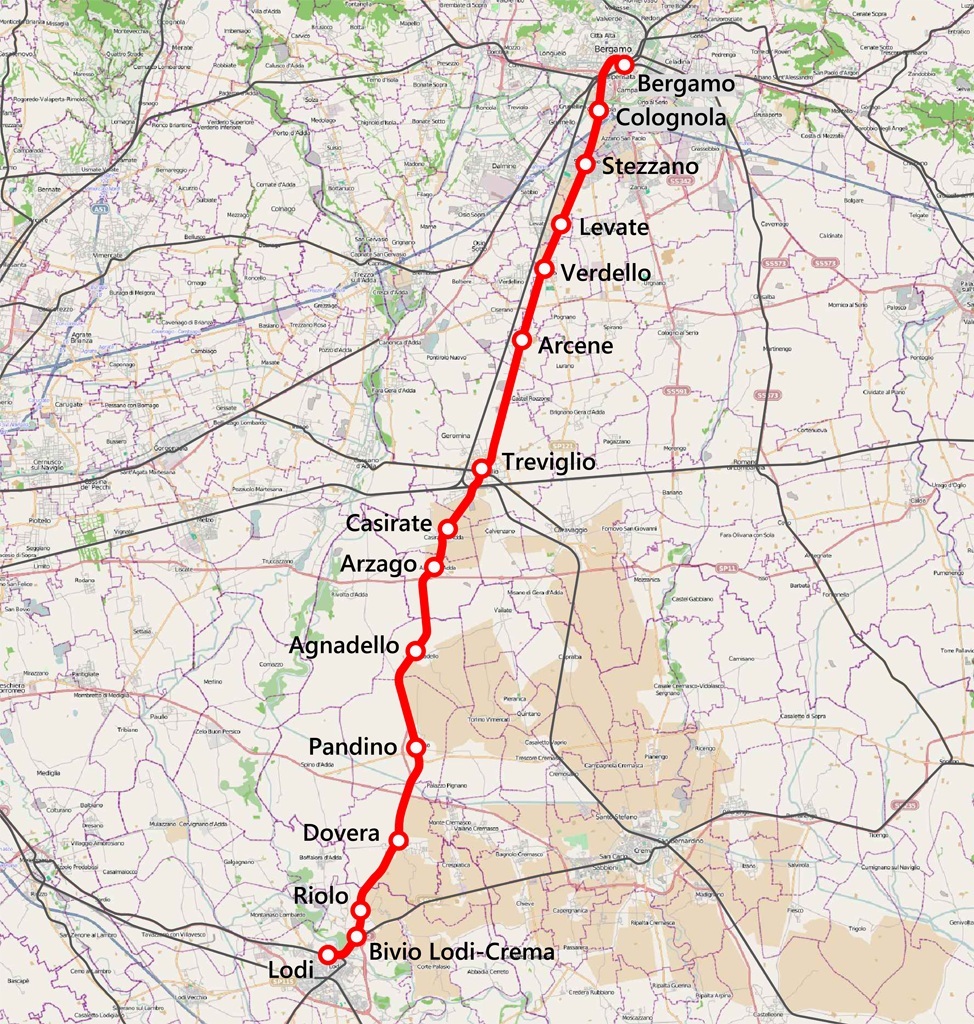
The Lodi–Treviglio–Bergamo tramway was an interurban tram line that connected the city of Lodi to Bergamo between the 1880s and the 1920s.
History
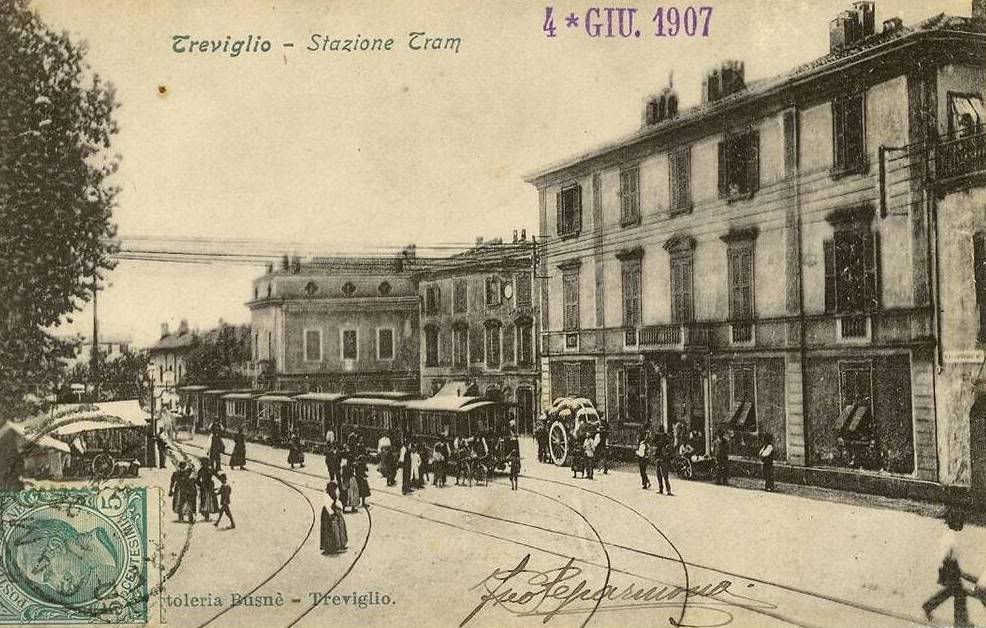
At the end of the 1870s, a group of financiers represented by Ferdinando Pistorius applied for a concession to build and operate a steam railway connecting Lodi to Pandino, Treviglio and Bergamo, using the routes of the Bergamina and the provincial road to Bergamo. The application was submitted to the competent provinces of Bergamo, Cremona and Milan.
The Provincial Deputation of Bergamo was the first to grant the concession for the section under its jurisdiction (21 June 1879), followed nine days later by that of Milan. The last to grant the concession was the Cremona authority, which did so only on 31 July.
One month later, on 31 August, the Treviglio–Bergamo section was opened to service, while Lodi was reached on 15 June of the following year.
On 6 June 1883, Cavalier Pistorius ceded the concession to the Società Anonima delle Tramways a Vapore Interprovinciali di Milano, Bergamo e Cremona (TIP).
Passenger service was organised on two separate routes: Bergamo–Treviglio and Treviglio–Lodi. The first route was served by eight pairs of daily runs, while on the second these were reduced to six. The steam locomotives authorised for road use were allowed to haul up to a maximum of four carriages. The province of Cremona granted, for the Agnadello–Dovera section under its jurisdiction, the use of six-carriage compositions.
Freight service was instead provided by two daily pairs of trains that ran the entire line.
The concession, of fifty-year duration, was due to expire in 1929; however, TIP had already suspended service on the line at the end of 1920, replacing it with buses. This service, entrusted to vehicles that were experimental at the time, was not considered satisfactory by the Cremona municipalities concerned, which repeatedly requested the restoration of tram service in the following years. The requests were rejected, and the Cremona section was dismantled in 1927. Similar initiatives were promoted by the province of Bergamo and the municipality of Treviglio, but lack of funds halted everything.
On the Bergamo section, meanwhile, in 1919 work had begun on extending the Bergamo urban tram network to Colognola, which partly used the route of the steam tramway and was inaugurated on 3 May 1925. The following 13 June, the tramway was extended to Stezzano, with terminus in the main square.
Characteristics
The line was a single-track tramway. The track length was 45.625 kilometres, of which 28.028 km were in Bergamo territory, 15.048 km in the province of Cremona, and only 2.550 km in the province of Milan.
The route ran along the provincial roads Bergamina and Treviglio–Bergamo, on a mixed or reserved track separated from the carriageway by a tram rail curb. The track gauge adopted was the standard Italian tram gauge of .
Route

The tram line was the direct continuation of the , which was built and operated by the same company.
From the tram station of Lodi Porta Milano, the tramway ran along the ring road, later named Via Defendente Lodi, to reach the area near the bridge over the Adda. At this point, it connected with the line destined for Soncino, initially operated by different concessionaire companies – first the Tramways and General Work, then The Lombardy Road Railways – until 1898, when it was taken over by TIP.
The common section between the two tramways was about long, after which the line for Bergamo entered the Bergamina road, while the one for Soncino continued along the provincial Brescian road.
The tramway climbed the Bergamina to reach Treviglio, where it connected with the and its branch for Caravaggio, operated by the same concessionaire company. With the construction of the connection between Treviglio railway station and Treviglio Ovest station (1908), a flyover was built to avoid the level crossing of the railway by the tram line.
After Treviglio, the line entered the provincial road to Bergamo. Upon reaching the Bergamo city, it ran along the ring road (current Via Don Palazzolo and Via Tiraboschi), then entered the avenue of the station, up to the terminus located between the stations of the Brembana Valley and Seriana Valley railways. In the Porta Nuova area, the line crossed the urban electric trams, while on the station avenue it crossed the line for Trescore and Sarnico.
From 1884, the line was connected to the station of the Seriana Valley line, both for freight and passenger traffic.
Notes
See also
- History of rail transport in Italy
- List of railway stations in Lombardy
- Monza–Trezzo–Bergamo tramway
- Bergamo–Soncino Tramway
- Bergamo–Trescore–Sarnico Tramway
- Milan-Lodi Tramway
- Fornaci–Treviglio–Caravaggio Tramway