
Milan–Gallarate Tramway
The Milan–Gallarate tramway was an interurban tramway line that connected the city of Milan to the main municipalities of the Alto Milanese (Legnano, Busto Arsizio, and Gallarate) between 1880 and 1966.
Later on, two branch lines were activated from Gallarate to Cassano Magnago and Lonate Pozzolo.
History

A committee for the realization of a connection between Milan and the municipalities of the Alto Milanese was founded in January 1878 in order to overcome the limitations of the horse-drawn carriage service, known as velociu in the Legnanese dialect, which at that time ran along the Sempione road.
Granted by act on 17 March 1880, the new steam tramway was inaugurated on 15 September 1880 on the first section, Milan–Legnano, by the Belgian Società Anonima delle tramvie e delle ferrovie economiche di Roma, Milano e Bologna (STFE), founded in 1877. The line had a total length of approximately 25 km.
Given the high degree of industrialization of the area served, traffic was heavy right from the start, making the line profitable.
On 25 April 1881, the tramway service was extended to the city of Gallarate, and the tramway thus assumed its full name.
In 1913, the Società Trazione & Imprese Elettriche (STIE) acquired the concession from the Belgian company, obtaining permission from the Italian government to electrify the line following Royal Decree 6 November 1913, no. 1340.
The new operating company decided to adopt a direct current supply system with a voltage of 750 volts. Electrification of the Milan–Busto Arsizio section took place during 1915, with testing held on 12 June of the same year. The remainder of the line was electrified on 31 December 1927.
In the early 1930s, the line extended to other municipalities in the Alto Milanese: on 10 July 1931, the Cassano Magnago–Gallarate–Samarate section opened, which was extended on 11 February 1933 with the opening of the Samarate–Lonate Pozzolo section.
On 1 October 1951, the section between Legnano and Gallarate and the two branches to Cassano Magnago and Lonate Pozzolo were closed, while final closure took place on 18 January 1966. The Milan–Gallarate was the last privately operated concession tramway in Lombardy.
Characteristics
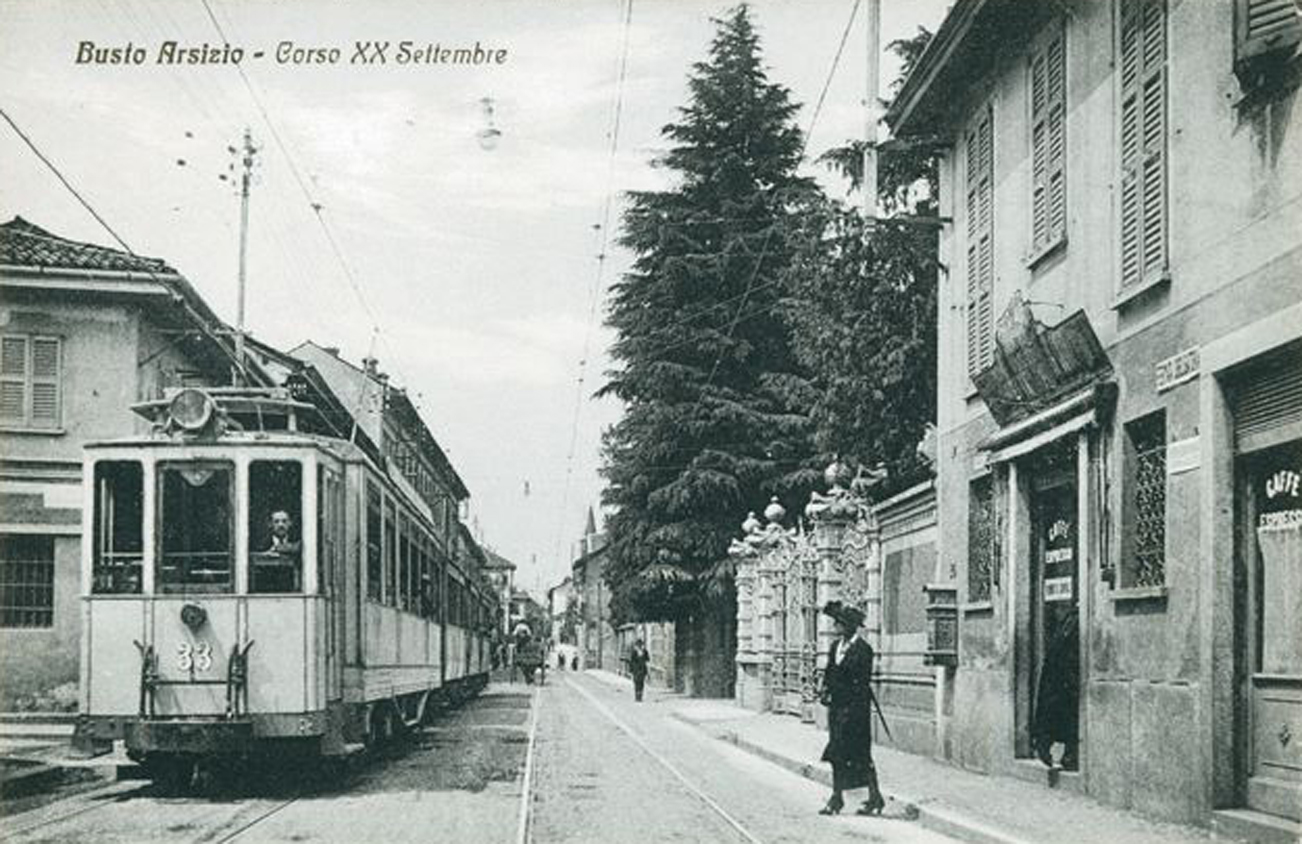
 The line was a tramway with mostly single track, of standard gauge (1,445 mm): trams passed each other at specific passing loops determined by the timetable. In Busto Arsizio, there were two double-track passing points: one located on Via XX Settembre and the second on Piazza Manzoni. The length between Milan and Gallarate was 38.861 km, of which 2.5 km was shared from 1933 with the Milan tram network, while the Cassano Magnago–Gallarate–Lonate Pozzolo section measured 12.485 km.
Service was originally provided by steam locomotives pulling first- and second-class carriages. Trams had a maximum speed, granted by the Province of Milan on interurban sections, of 15 km/h, while in urban areas the train had to proceed at a walking pace, accompanied by a "notifier" with a bell responsible for clearing people from the tracks.
For the line's trackage, 26 kg/m Vignoles rails were originally used. After electrification, these were replaced with rails weighing 30 kg/m; in certain sections, 36 kg/m rails were also used. The minimum curve radius, with curves totaling 8.3 km, did not drop below 40 meters. 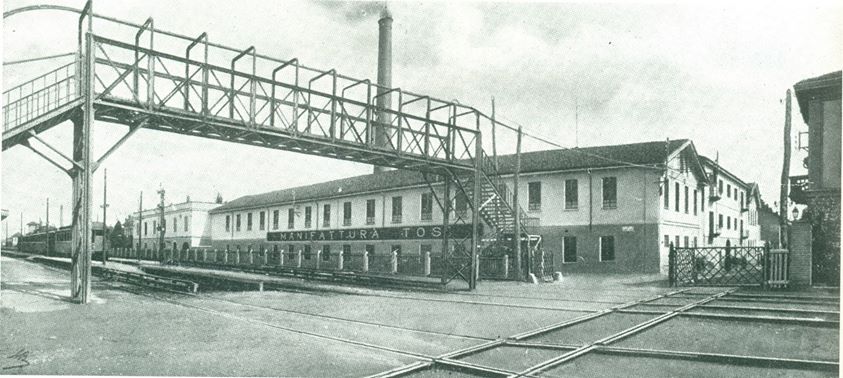
Route
The Milan terminus was located on Via Cusani and was shared with the Milan–Saronno–Tradate tramway, whose route was shared with the Gallarate line up to Via Plana; in Piazza Firenze, at the time called rondò della Cagnola, at the corner with Corso Sempione, there was a depot for company rolling stock. The tracks of the Rete Mediterranea were crossed in the section between the original Central station and the Scalo Sempione freight yard, and shortly thereafter it crossed the FNM line to Saronno; at Piazzale Accursio, the track for the Alto Milanese turned into Via Gallarate to follow the Gallaratese road, passing through Pero, Rho, Nerviano, San Lorenzo, San Vittore, and Legnano, where the original temporary terminus was located in Legnanello. 
The traversal of Legnano took place via city streets, with the tramway reaching Corso Sempione only at the entrance to Castellanza, where there was a private right-of-way section approximately 550 meters long.
The Milan terminus was moved back in 1902 to the Arena Civica, and two years later to the beginning of Corso Sempione, near the Arco della Pace. In 1933, the terminus was set back further to the corner of Corso Sempione and Via Prina, and the line between Via Procaccini and Piazzale Accursio ran along the tracks of the Milan urban tramways.
Rolling stock
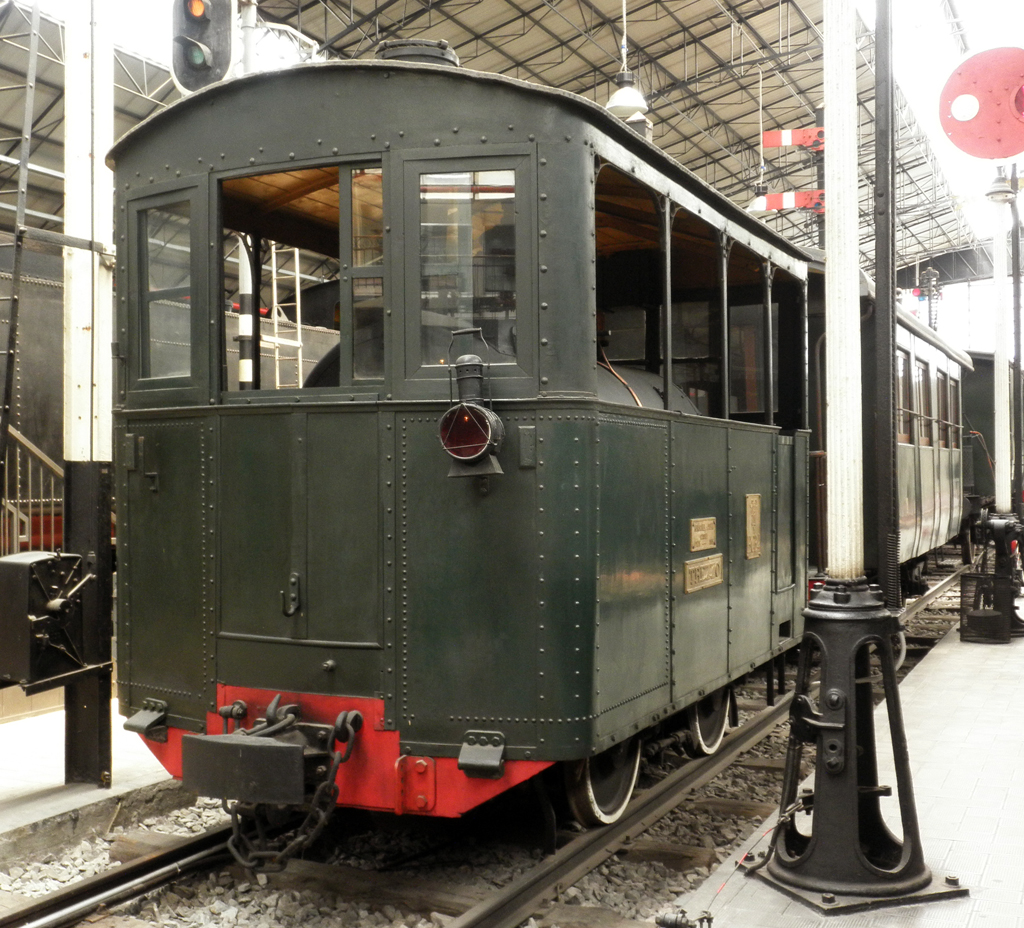 Originally, seven two-axle steam tram locomotives built by Henschel & Sohn and thirty two-axle passenger cars were acquired; the locomotives, imported into Italy in 1881 by Cerimedo & C., had construction numbers 1061, 1064, 1065, 1073, 1074, 1223, and 1224.
Additional rolling stock was added, reaching thirteen locomotives, forty carriages, and four luggage vans by 1913. In 1915, the first electric vehicles were put into service: five bogie passenger motor cars and six small two-axle locomotives intended to haul freight and "workers'" passenger trains. All vehicles were built by Breda with electrical equipment by TIBB.
With the activation of the Busto Arsizio–Gallarate section on 29 December 1927, five additional passenger motor cars were put into service (two in 1925 and three in 1927, built by Magliola with TIBB electrical equipment), accompanied by about ten bogie trailers. The entire fleet adopted the cream color scheme required for interurban vehicles at that time. A final tram was acquired in 1932 on the occasion of the extension in the Gallarate area, along with locomotive 7, which was also fitted with coupling hooks and buffers for hauling railway freight cars, both built by Carminati & Toselli.
Steam locomotive no. 34, which was transferred to the Monza–Trezzo–Bergamo tramway, is preserved at the National Museum of Science and Technology in Milan.
See also
- Monza–Trezzo–Bergamo tramway
- Milan tram derailment
- Milan–Monza tramway
- Milan–Saronno–Tradate Tramway
- Milan–Saronno railway
- Milan–Gorgonzola–Vaprio Tramway
- Milan-Lodi Tramway