
Plasma Fusion Preface
The Saha equation states
$\frac{n_i}{n_n}=2.4*10^{21}\frac{T^{3/2}}{n_i}\exp-(\frac{U_i}{kT})$
Where ni is the ion density and nn is the neutral atoms density and Ui is the ionization energy of the gas.
Putting for ordinary air
nn = 3 * 1025m−3
T = 300K
Ui = 14, 5eV(nitrogen)
gives
$\frac{n_i}{n_n}=10^{-122}$
which is ridiculously low.
And the ionization remains low until Ui is only a few times kT.
So there exists no plasmas naturally here on earth, only in astronomical bodies with temperatures of millions of degrees.
Basic considerations
When we have a moving particle of charge in a magnetic field the following equation apply
$m\frac{dv}{dt}=qvXB$
Solving this differential equation yields
$w_c=\frac{|q|B}{m}$
and
$r_L=\frac{mv}{|q|B}$
where wc is called the cyclotron frequency and rL is called the Larmor radius.
What this means is that a particle will gyrate around the lines of force with the cyclotron frequency and the Larmor radius.
This is the most fundamental reason why a plasma can be confined by a magnetic field.
Energy and temperature of a plasma
It will later on be shown that the average energy may be written
$E_{AV}=\frac{1}{4}mv^2=\frac{1}{2}kT$
where there is an additional kT/2 for each degree of freedom (whatever that means).
The speed is then
$v=\sqrt{\frac{2kT}{m}}$
The above energy equation can be derived while using the Maxwellian velocity distribution function
$f(v)=A\exp{(-\frac{mv^2/2}{kT})}$
where the volume particle density can be calculated using
n = ∫−∞∞f(v)dv
which gives us
$A=n\sqrt{\frac{m}{2\pi kT}}$
What this means is that while the most probable speed is when
$\frac{mv^2}{2}=kT$
there are particles with both lower and higher speeds that has the same temperature (my guess).
Some ITER calculations
According to Francis F. Chen physicists use
kT = eV
to avoid confusion.
Let's state some constants:
k = 1, 38 * 10−23
e = 1, 6 * 10−19
mp = 1, 67 * 10−27
μ0 = 4π * 10−7
With the thankful aid of the_wolfman I also have some actual data for the ITER tokamak
kT = 10keV
B = 5T
R = 2m
IDC = MA
The temperature of the plasma is then
$T=\frac{10^4*1,6*10^{-19}}{1,38*10^{-23}}$
or some 100MK.
Using EAV which is repeated here for convenience
$E_{AV}=\frac{1}{4}mv^2=\frac{1}{2}kT$
and the fact that Deuterium consists of one proton and one neutron while the neutron mass is almost the same as that of a proton we may use
m = 2mp
We then have
$v=\sqrt{\frac{2kT}{2m_p}}=\sqrt{\frac{kT}{m_p}}$
or some 1000 km/s
And B=5T gives
$r_L=\frac{2m_pv}{|2q|B}=\frac{m_pv}{|q|B}$
or 2mm(?)
and
$w_c=\frac{|2q|B}{2m_p}=\frac{|q|B}{m_p}$
or 480Mrad/s
If the fusion products are protons and of some 10MeV of energy then
v = 50, 000km/s
and
rL = 0, 1m
Where rL still is quite small...
The magnetic flux density of a short solenoid is
$B=\mu_0\frac{NIA}{2\pi r^3}=\mu_0\frac{NIR^2}{2r^3}=\mu_0\frac{NI}{2R}$
which using R=2m and B=5T gives
$I=\frac{2RB}{\mu_0N}=16MA/N$
Considering some 10 turns per coil for minimum resistive losses we have some 2MA which verifies the above.
Deriving the magnetic flux density of a current loop
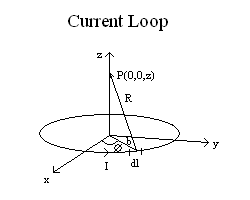
From Maxwell's Equations we have
∇ ⋅ B = 0
which may be rewriiten as
B = ∇XA
where A might be an arbitrary vector.
Using the vector magnetic potential
$A=\frac{\mu_0}{4\pi}\int_v{\frac{J}{R}dv}$
and realising that
Jdv = JSdl = Idl
we have from Biot-Savat Law
$B=\frac{\mu_0I}{4\pi}\oint_c\frac{dlXa_R}{R^2}$
Defining
dl = bdϕaϕ
and
R = azz − arb
and
dlXR = aϕbdϕX(azz−arb) = arbzdϕ + azb2dϕ
and realising that the r-part cancel out we get
$B=\frac{\mu_0I}{4\pi}\int_{0 2\pi}a_z\frac{b^2d\phi}{(z^2+b^2)^{3/2}}$
or
$B=\frac{\mu_0I}{2}\frac{b^2}{(z^2+b^2)^{3/2}}=\frac{\mu_0I}{2}\frac{b^2}{R^3}$
Drifts in a plasma
Using
$m\frac{dv}{dt}=q(E+vXB)$
and realising that
F = qE
we could set
$v_{force}=\frac{1}{q}\frac{FXB} {B^2}$
where F might be
FE = qE
due to an E-field or
Fg = mg
due to gravity or
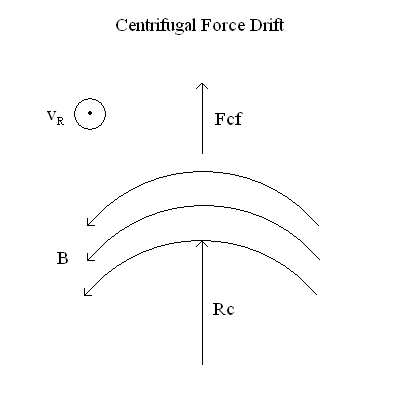
$F_{cf}=a_r\frac{mv_{//}^2}{R_c}$
due to the centrifugal force while a particle is moving along the lines of force.
Then the drift due to E will be
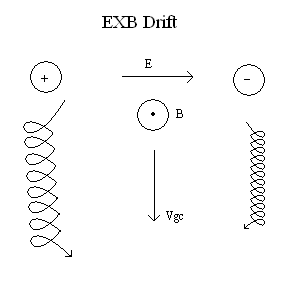
$v_E=\frac{EXB}{B^2}$
and the drift due to gravity will be
$v_g=\frac{m}{q}\frac{gXB}{B^2}$
and the drift due to a curved B-field will be
$v_R=\frac{1}{q}\frac{F_{cf}XB}{B^2}=\frac{mv_{//}^2}{qB^2}\frac{R_cXB}{R_c^2}$
It is interesting to note that
$|v_E|=|\frac{E}{B}|$
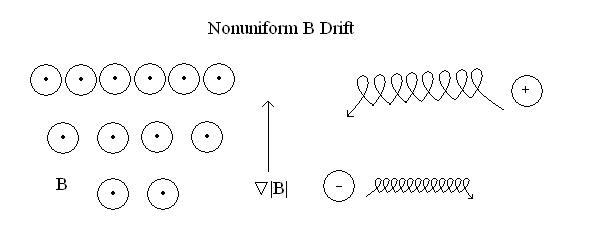
It is harder to derive and explain the drift in a nonuniform B-field where the force may be written
$F_y=-/+\frac{qv_pr_L}{2}\frac{dB}{dy}a_y$
where vp denotes speed perpendicular to B.
Which put into the force-formula above gives the guiding center drift
$v_{gc}=\frac{1}{q}\frac{FXB}{B^2}=\frac{1}{q}\frac{F_y}{|B|}a_x=-/+\frac{v_pr_L}{2B}\frac{dB}{dy}a_x$
which can be generalized to
$v_{\nabla B}=-/+\frac{v_pr_L}{2}\frac{\nabla BXB}{B^2}$
which is the grad-B drift or the drift caused by inhomogeneities in B.
It can therefore be shown that the total drift in a curved vacuum field is
$v_{cv}=v_R+v_{\nabla B}=\frac{m}{qB^2}\frac{RcXB}{Rc^2}(v_{//}^2+\frac{1}{2}v_p^2)$
Here I quote Francis F. Chen:
"It is unfortunate that these drifts add. This means that if one bends a magnetic field into a torus for the purpose of confining a thermonuclear plasma, the particles will drift out of the torous no matter how one juggles the temperature and magnetic fields"
The plasma as a fluid
If we consider a plasma as a fluid we have
$mn[\frac{dv}{dt}+(v\cdot \nabla)v]=qn(E+vXB)-\nabla p$
where it can be shown that the two terms to the left may be omitted.
If we then take the cross product with B we have
0 = qn[EXB+(vpXB)XB] − ∇pXB
or
0 = qn[EXB−vpB2] − ∇pXB
where one term has been deliberatelly omitted.
Rearranging the above yields the total perpendicular drift in a plasma considered as a fluid
$v_p=\frac{EXB}{B^2}-\frac{\nabla pXB}{qnB^2}=v_E+v_D$
where the so-called diamagnetic drift is
$v_D=-\frac{\nabla pXB}{qnB^2}$
where the force is
$F_D=-\frac{\nabla p}{n}$
meaning the gradient of the pressure
p = nkT
to volume particle density.
For an isoterm plasma we have
∇p = kT∇n
Inductance Calculation
The definition of inductance, L, is:
N∫BdS = LI
Using
$B=\mu_0 \frac{NI}{l_m}$
for a long solenoid
or
$B=\mu_0 \frac{NI}{2R}=\mu_0 \frac{NI}{D}$
for a short solenoid it is clear that the adequate formula depends upon diameter versus length. But in many cases the reality is somewhere in between.
Anyway, the inductance of our short solenoid is:
$L=\frac{NBA}{I}=\mu_0 \frac{N^2A}{2R}$
Estimating A to be circular then
$L=\mu_0 \frac{N^2\pi R}{2}=\mu_0 \frac{N^2\pi D}{4}$
And with N=10 and R=2m this yields
L = 0, 4mH
Visualising some ten coils around the tokamak which may be connected in series yields some
L = 5mH
and to make things complete
$e=-L\frac{di}{dt}$
This inductance does however only affect power-on. With a smoot onset of voltage (read Amps) the inductance does not matter so much as the resistive losses. But it is interesting to keep this in mind anyway. After all, we are talking MAs here...
I will get back to this later on.
Drift considerations in a plasma
Getting back to our general B-formula for a short solenoid which is repeated here for convenience
$B=\mu_0 \frac{NIR^2}{2r^3}$
we can see that the magnetic flux density diminishes as
1/r3
along the
z − axis
which in our case is "almost" equal to the
ϕ − axis
This howewer creates a gradient in B but this gradient is mostly along the B-field.
So even though B lessens with distance to the next coil the grad-B drift might be negligible due to the curl of grad-B with B.
The tokamak current
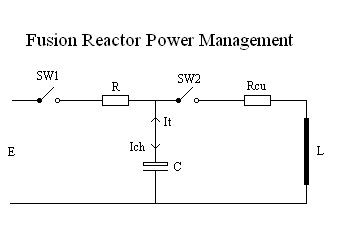
It is preliminary considered that SW1 and SW2 are closed at different times and in such a way that they never are closed at the same time. The voltage source E is preliminary considered stable as a battery.
For the tokamak current, It, we may write
$q/C=R_{cu}i+L\frac{di}{dt}$
[where the charge q stored by C has been converted to an equivalent voltage because of C=Coulomb/Volt=As/Volt]
Putting
$i=-\frac{dq}{dt}$
[The sign of this one is a bit hard for me to understand but maybe we can view it like the current coming out of the capacitor is leaving the capacitor, therefore the minus sign]
and derivating once more we get
Li″ + Rcui′ + i/C = 0
or
$i''+\frac{R_{cu}}{L}i'+\frac{1}{LC}i=0$
Putting
b = Rcu/2L
and
$w=\frac{1}{\sqrt{LC}}$
gives the characteristic equation
(r2+2br+w2)i = 0
where
$r_{1,2}=-b+/-\sqrt{b^2-w^2}$
And if
b > w
the solution may be written
i(t) = C1er1t + C2er2t
Using the initial values
i(0) = 0
and
i′(0) = E/L
[This initial value is however a bit hard to understand. But it must come from
$E=-L\frac{di}{dt}$
where E is the capacitor voltage at t=0 and not the induction of the current derivate. In short, E/L forces the current direvate at t=0 in this case and the valid sign comes from the schematic above.]
then
i(0) = C1 + C2 = = 0
yielding
C2 = − C1
so now we have
i(t) = C1(er1t−er2t)
Derivating this while putting t=0 yields
i′(0) = C1(r1−r2) = = E/L
thus
$C_1=\frac{E/L}{r_1-r_2}$
and finally
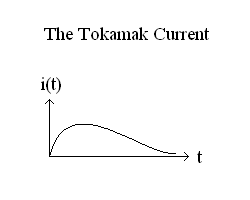
$i(t)=\frac{E/L}{r1-r2}(e^{r_1t}-e^{r_2t})$
If we derivate this and put it equal to zero in search of maximum we get:
r1er1t = r2er2t
or
$ln(\frac{r_1}{r_2})=t(r_2-r_1)$
or
$t_{max}=\frac{ln(r_1/r_2)}{r_2-r_1}$
The strange thing here is that while r1 needs to be greater than r2 for making the current above positive, my result actually indicates that only if r1 is less than 2,71 times r2, tmax is positive.
Here we could put tmax into i(t) to calculate maximum current. We won't however do that because that is just plain algebra. It is however interesting to view i(t) in another way referring to the definition of r1 and r2 above
$i(t)=\frac{E/L}{\sqrt{b^2-w^2}}e^{-bt}\frac{e^{\sqrt{b^2-w^2}t}-e^{-\sqrt{b^2-w^2}t}}{2}$
To make things complete regarding solutions for second order differential equations we have two more conditions to regard. If
b = w
then
i(t) = (C1t+C2)e−bt
If
b < w
then
$\gamma=\sqrt{w^2-b^2}>0$
and this makes
r1, 2 = − b + / − jγ
which gives the solution
i(t) = Ce−btsin(γt+α)
Here we can see that the current is attenuated sinusoidally by the frequency γ and the "amplitude" Ce−bt
To summarize, all the above solutions are based on the critical condition that
$b=R_{cu}/2L\frac{1}{\sqrt{LC}}=w$
where b should be equal or greater than w to yield a stable response.
Finally, let's do calculate Imax just for fun :)
$i_{max}=\frac{E/L}{r_1-r_2}(e^{\frac{r_1}{r_2-r_1}ln(r1/r2)}-e^{\frac{r_2}{r_2-r_1}ln(r1/r2)})$
Using
e4ln5 = 54
we get
$i_{max}=\frac{E/L}{r_1-r_2}((\frac{r_1}{r_2})^{\frac{r_1}{r_2-r_1}}-(\frac{r_1}{r_2})^{\frac{r_2}{r_2-r_1}})$
The supply current
This basic part doesn't really need a mathematical derivation because we could easily write
uc(t) = E(1−e−t/RC)
But it is fun to derive equations :)
We all know that
$i=C\frac{du}{dt}$
The differential equation of first order may be written
$E=Ri+u_c=RC\frac{du}{dt}+u$
Now we know the solution but we could pretend that we doesn't and guess
uc(t) = Ae−kt + B
Then
u′ = − kAe−kt
Boundary values say that
u(0) = 0
and
u′(0) = E/RC
this one is however somewhat tricky but comes from
$i=C\frac{du}{dt}$
where
$\frac{i(0)}{C}=\frac{E/R}{C}$
While we have three unknowns we need a third condition which is
u(∞) = E
If you think about it...
Using these boundary conditions we first get
u(0) = A + B = = 0 = > B = − A
and
u(∞) = B = E
Then we have
u(t) = E(1−e−kt)
Derivating this yields
u′ = Eke−kt
and
u′(0) = Ek = = E/RC
which gives
k = 1/RC
thus
uc(t) = E(1−e−t/RC)
Finally, derivating this and using the capacitor formula for the current gives
$i(t)=C\frac{du}{dt}=\frac{E}{R}e^{-t/RC}$
The standard model
1) electron and positron ("anti-electron")
2) muon and anti-muon
3) tau and anti-tau
Along with these comes their neutrino and anti-neutrino which gives six distinct types of particles or:
1) electron
2) electron-neutrino
3) muon
4) muon-neutrino
5) tau
6) tau-neutrino
The neutrinos being preliminary mass-less and thus very hard to detect.
The dominant three of these are fundamentals and consist of quarks. For our purposes it is enough to recognize two types of quarks namely the up-quark and the down-quark. This is due to the fact that a neutron consists of two down-quarks and one up-quark while a proton consists of two up-quarks and one down-quark.
As Mentors at PF so kindly has explained to me a neutron can undergo weak interaction (transmutation) and be converted to a proton releasing an electron and an anti-neutrino. This has to do with the fact that a quark can change its type/flavor. In this case one down-quark "only" has to change to one up-quark to make the change of the particle.
It has also been explained how a proton can be changed to a neutron in a similar manner.
This is the basic reason for all those protons at the birth of a star like our Sun can generate neutrons and thus Deuterium to actually start the fusion process to Helium.
Radiation particles
1) Beta-particle (electron)
2) Alpha-particle (ordinary Helium_4 nuclei)
3) Gamma-rays (high energetic photons emitted from the nuclei)
4) X-rays (slightly lower energetic photons emitted when electrons are decelerated or accelerated)
The Bohr Model
The other day I came to the conclusion that in the solar plasma, there are both protons (==ionized Hydrogen atoms), neutrons and excited as well as neutral Hydrogen atoms.
The different kinds of Hydrogen are being hit all the time by high energetic particles such as the protons and probably, by collision, even the neutrons.
This in turn excites the Hydrogen to different levels, as well as being ionized to a proton.
Omitting the fact that the proton itself also may recombine with an electron to form Hydrogen again, it is fair to say that the different levels of excitation (i.e. different orbits) gives rise to several possibilities for quantum leaps.
If we for instance have three orbits (n=1-3), the leaps could be made from 3->2, 2->1 and 3->1.
And while the orbital energy for Hydrogen may be written:
$E_{tot}=-\frac{ke^2}{2r}$
and
r ∝ n2
this means that the first leap has the smallest energy difference, the second the next smallest and the third the highest.
This also means that several kinds of color/photons is sent out from the Sun.
I don't know how many excitation levels Hydrogen has, but the above leads me to two conclusions:
1) n is large, giving several orbital energy states and lots of "recombination possibilities" and thus emitted colors all over The Spectra making the Sun "yellow".
2) Excited Hydrogen atoms as well as neutral Hydrogen atoms is abundant in the Sun. Because if they were not, no light would appear.
The above is however not true (but the mechanism is). A colleague of mine told me that the visible light from the Sun is due to heat only. I asked him why and he said that heat itself emmits light in a totally different manner.
I recognize a formula like this:
Ps ∝ T4
which I think is a derivate of the Stefan-Boltzmann radiation law.
I actually used this relationship when I did a rough but rather accurate estimation of the Sun's temperature.
Anyway, I asked my colleague what made the radiation then. He answered that it was due to the electrons being decelerated due to collisions while being heated up. Which may be compared to how X-rays above are generated.
Copied from Wikipedia:
"Thermal radiation is electromagnetic radiation generated by the thermal motion of charged particles in matter. All matter with a temperature greater than absolute zero emits thermal radiation. When the temperature of the body is greater than absolute zero, interatomic collisions cause the kinetic energy of the atoms or molecules to change. This results in charge-acceleration and/or dipole oscillation which produces electromagnetic radiation, and the wide spectrum of radiation reflects the wide spectrum of energies and accelerations that occur even at a single temperature."
The question now is however how charge-accelerations or dipole oscillations actually makes light.
Here I'm simply stating Planck's Law:
$B= \frac{2hf^3}{c^2} \frac{1}{e^\frac{hf}{kT} - 1}$
Where B is the spectral radiance.
Viewing the beautiful picture at Wikipedia of this function it is amazing, to say the least, that it fits so perfectly with the temperature of the Sun.
And to make things complete, the Wien Displacement Law:
λmaxT = b
where b˜3*10−3 [mK]
Being the amateur that I am I would say that this equation is used to determine the temperature of stellar objects.
Thermal radiation
I have understood that there are more ways to generate light. The mechanism I am thinking of is thermal radiation and reading about this in Wikipedia took me so far as to charge-acceleration and dipole oscillation.
While surfing around in Wikipedia I got to remember that light is a TEM-wave.
Being an electrical engineer, I began to think:
$U=-L\frac{dI}{dt}=-jwLI$
where
I = I0ejwt
which both means that jw is a derivation operator for any stationary signal and that the current and the voltage is 90 degrees out of phase in an inductor.
If we consider the Bohr Model and the Bohr Radius rB we have an orbiting moving charge (at a constant speed) which by definition is equal to current.
Now, the magnetic flux through a coil of area S may be simplified to
ϕ = ∫Bds = BS = μ0HS = μ0NIS/lm[Wb]
Where N=1 for our orbiting electron and lm is the length of the magnetic path.
The Faraday Law
$e=\oint Edl=-\frac{d\phi}{dt}=-jw\phi[V]$
states the emf-induction due to magnetic flux change.
And the relationship
Nϕ = LI
takes us back to my first formulas.
Viewing these equations we have both B and E 90 degrees out of phase.
Considering the differential version of Faraday's Law we have
$\nabla XE=-\frac{dB}{dt}$
which also states the direction of it all.
But we all know that for induction to happen the moving conductor has to cut the lines of force.
So this is by definition a TEM-wave.
The speed of the (circulating) charge need however to be non-constant (otherwise no induction can be made) which means that we have to accelerate the charge by for instance heat.
Considering
mvrB = ℏ
from below we note that v is constant within the Bohr Radius.
So the only way of increasing the speed of the electron is to move it up to another shell.
In other words, linear thermal radiation cannot be achieved by heating.
Planck's Law of radiation must be due to another phenomena which probably is vibration of the nuclei and/or electron.
Or perthaps the Bohr Model is just too simple?
Apart from the Bohr restriction the conclusion must be that every accelerated charge like above give rise to TEM.
A free accelerated or decelerated charge might suit even better for this reasoning. In this case it is more obvious that there are no spectral lines when it comes to thermal radiation and this is because of the "linear" speed states while adding kT.
Bohr Model derivation
While I love to simplify things as much as possible the Bohr model suits my way of trying to understand.
It has been proven that
nλ = 2πr
which means that the length of the electron orbit has to be an integer number of times the wavelength.
With the use of the de Broglie wavelength
λ = h/p
and
ℏ = h/2π
the above equation may be rewritten as
mvr = nℏ
Referring to the basic force relationship where the centrifugal force is equal to the electromagnetic force we may write
$\frac{mv^2}{r}=\frac{ke^2}{r^2}$
Solving for v yields
$v=\sqrt{\frac{ke^2}{mr}}$
Integrating the electromagnetic force gives the potential energy as
$E_p=-\frac{ke^2}{r}$
The kinetic energy may as usual be written
$E_k=\frac{mv^2}{2}$
Adding Ep with Ek with the use of the expression for v above then yields
$E_{tot}=E_p/2=-\frac{ke^2}{2r}$
Now,
$mrv=mr\sqrt{\frac{ke^2}{mr}}=\sqrt{ke^2mr}==n\hbar$
Solving for r yields
$r=\frac{n^2\hbar^2}{ke^2m}$
For n=1 this is called the Bohr Radius and for Hydrogen it can be shown that this is some 0,5Å.
Proton-proton fusion
1) Protons fuse
2) One proton is transmuted into one neutron forming Deuterium (releasing one positron and an electron-neutrino).
3) Deuterium fuses with another proton (which also releases gamma-rays)
4) Two of the resulting Helium_3 neclei fuse
5) An Alpha particle (Helium_4) forms with the energetic release of two protons to complete the process.
A fun quote by Arthur Eddington:
"I am aware that many critics consider the stars are not hot enough. The critics lay themselves open to an obvious retort; we tell them to go and find a hotter place."
Pressure
I have come to know two types of pressure
1) Gravitational pressure (GP)
2) Plasma pressure (PP)
Gravitational pressure may be written
pp = ρgh[N/m2]
and plasma pressure
p = nkT[J/m3]
There is actually no difference in units here but I like to keep them separated.
ρ is the density with regard to weight per cubic meter, n is the density with regard to ''number of particles per cubic meter.</I]>
It is important to state that difference because density will be used for both cases.
Pressure in practice
Normal air pressure (1atm) is
1atm = 105Pa = 105N/m2 = 104kg/m2 = 1kg/cm2
This only means that we humans have adapted to 1 kg/cm2 and nothing else (except that it all implies an actual atmosphere).
This fact was very strange to me but if you think about it, there are fishes that live and survive deep down in our seas.
And while pressure increases with 1atm for every 10m of water depth, it is amazing that they can survive down there.
But it is equally strange for the fish.
Neither of us can survive in our disrespectively pressurized environment.
And what we actually feel is not this ambient pressure but the difference.
Water depth aside we may also create a pressure difference by moving an object in a fluid:
pk = 1/2ρv2
This equation tells us that as soon as we have a fluid we will create a pressure on it simply by moving it.
While we do not feel one whole kg/cm2 we feel as little increasement as 1m under water (+1hg/cm2).
And we only have to dive a couple of 10m below the water surface before we get drunk due to Nitrogen "poisoning" which is the reason why scuba divers breath Helium instead of Oxygen at these depths.
The pressure at the deepest part of our sea is about 1000atm but this is only felt if we as humans (needing 1atm) would want to visit that place (which some have done in spite of all). The interesting part is that the vessel hull will have to withstand the above pressure equal to an elephant standing on a dime.
The Barmetic formula
p = p0 − ρgh
reflects the air pressure at different hights (p0 being 1atm)
This formula is approximately accurate up to some 10 km (where it actually equals 0).
Anyway, [itex]\rho[/itex] is not linear above some 5 km where
$p=p_0e^{-\frac{mgh}{kT}}$
should be used instead (m simply is the molecular weight).
The atmosphere is not uniform. There are four districtive layers or spheres (defined by temperature):
4) Thermosphere (80 km-Karman Line)
3) Mesosphere (50–80 km)
2) Stratosphere (10–50 km)
1) Toposphere (<10 km)
Where the Karman Line is 100 km. Specified as the hight where a vessel need to fly as fast as orbital speed to keep hight.
Orbital speed means the speed where the centrifugal force equals the gravitational force.
It is very interesting that the atmosphere is as high as 100 km. I have always thought some 10 km :smile:
Tokamak pressure
Below follows an attempt in calculating the ITER Tokamak pressure based on data so thankfully given to me by the_wolfman.
$F=m\frac{dv}{dt}=q(vXB)$
v = = v0ejwt
jwm = qB
using this imaginary part
$w_c=\frac{qB}{m}$
v = = wcrL
$r_L=\frac{mv}{qB}$
and the area is thus
A = 2πrL * Citer
where C is some 10m(?) which would give
A = 20πrL
And the magnitude of F above is
F = qvB
Playing with protons only with a B of 5T and a kT of 10keV
$E_k=\frac{m_pv^2}{2}=kT$
we have
$v=\sqrt{\frac{2kT}{m_p}}=1400km/s$
and thus
$r_L=\frac{m_pv}{eB}=m_p\frac{\sqrt{2kT/m_p}}{eB}=\frac{\sqrt{2kTm_p}}{eB}=3mm$
Now,
$p=F/A=evB/A=e\sqrt{2kT/m_p}B/(2\pi r_L C_{iter})=e\sqrt{2kT/m_p}B/(2\pi C_{iter}\sqrt{2kTm_p}/eB )$
$p=e^2B^2\sqrt{2kT/m_p}/(2\pi C_{iter}\sqrt{2kTm_p})=e^2B^2/(2\pi C_{iter}m_p)=6pPa$
Which also is independent of T :)
I wonder what I do wrong.
Plasma pressure
From the Ideal Gas Law we have
$p=\frac{N_{mol}}{V}RT=\frac{N}{V}kT=nkT$
where n is the (particle) density.
Listening to the skilled guys in PF forum I would however like to rearrange this law somewhat
$\frac{(PV)}{N}=kT=E_k$
While we all know that P has the magic unit J/m3 multiplication with V gives Joule and thus energy.
Work to the gas may defined as the increasement of the PV-product because then temperature and thus Ek increases.
Work done by the gas may be defined as the decreasement of the PV-product because then temperature decreases.
It is also interesting to note that the work divided by N gives the work done to, or made by, one single molecule. Which in turn gives the temperature and thus speed of that single molecule.
The first law of thermodynamics seems to be
Q = ΔU + W
Where Q is the total energy, U the internal energy and W is the work which is positive if work is done by the gas or negative if work is done on the gas.
The internal energy is defined by
U = KE + PE
Where KE is the kinetic energy and PE is the potential energy.
Now, we know that the kinetic energy is closely related to temperature but what I didn't know is that potential energy is inversely related to pressure.
I got this latter knowledge from Andrew Mason. Simply stated it comes from the fact that low pressure means that the molecules are furher apart and as they are furher apart they do have higher potential energy.
To me this sounded crazy because the (gravitational or electromagnetic) force is stronger the closer molecules are and this would mean a higher potential energy.
But using the simple relationship
W = ∫Fdr
made me understand that work actually has to be done to move an object a certain distance against f.i gravity and this in turn tells me that that object then must have a higher potential energy (like mgh or Fx).
It is actually the same when it comes to the Bohr Model but then the potential energy of that certain electron is negative close to the nuclei and zero at infinity. Which only is a definition of coordinates.
Plasma heating
Quoting the_wolfman:
There are 5 ways we commonly heat a plasma relevant to fusion :
1) Ohmic heating. You run a current through a plasma and this creates heat due to electrical resistance.
2) Wave heating. We use antennas to inject electromagnetic waves into a plasma. The plasma absorbs these waves and converts their energy into heat. Similar to a how a microwave heats leftovers.
3) Neutral beam heating. We inject beams of high energy neutral particles into the plasma. As the particles collide with the plasma they slow down and their kinetic energy is converted into heat.
4) Compressive heating. When you compress a plasma you do pdv work on it just like any other fluid. This work in turn heats the plasma.
5) Alpha particle heating. If you get fusion to occur, high energy alpha particles are produced. They then heat the plasma as they slow down.
References
1) David K. Cheng, Field and Wave Electromagnetics
2) Francis F. Chen, Plasma Physics and Controlled Fusion
3) Jan Petersson, Matematisk Analys, Del 2
4) http://hyperphysics.phy-astr.gsu.edu/hbase/hframe.html
5) https://en.wikipedia.org/wiki/Bohr_model
6) https://en.wikipedia.org/wiki/Thermal_radiation