
Olona River Consortium
The Olona River Consortium (Consorzio del fiume Olona) is a private entity of public interest and a nonprofit organization that aims to manage the waters of the Olona river and to preserve and rehabilitate the surrounding river environments. Headquartered in Castellanza, in the Province of Varese, it is the oldest irrigation consortium in Italy.
Objectives
 Originally, the sole objective of the consortium was to equitably divide the waters of the Olona river among the inhabitants of the territory. Upon its foundation, the waters of the river were used for fishing, washing places, livestock farming, driving the wheels of watermills, operating machinery for craftsmen, food purposes, and irrigating fields.
Subsequently, with the advent of the first factories, the consortium also began to manage requests aimed at exploiting the motive power of the river on an industrial scale. Prior to the invention of the steam engine and electricity, machinery in factories was driven by water wheels installed along the banks of the Olona.
Later, additional objectives were added to these. In addition to those mentioned, the consortium also aims to preserve and rehabilitate the Olona river and the surrounding river environments.
History
Background
 The origins of the consortium date back to the Middle Ages. The first association of users of the river was founded in 1235. This association was formed by the wealthiest and most powerful users and was led by a delegate whose task was to interface with the Podestà of Milan.
The earliest documented regulation of the waters in the Milanese area dates to 1346. In that year, the "Statutes of the roads and waters of the countryside of Milan" were signed. This document was later updated in 1396.
These statutes regulated the use of water and roads of "[...] the boroughs, places, farmhouses, mills, and houses of religious people of the contado of Milan [...]" specifying, among other things, the procedures for "[...] drawing water in favor of the mills and conveying it to irrigate the meadows [...]" and establishing that "[...] in the public river no dam or obstacle shall remain or be kept by which the water cannot run freely [...]". Irrigation was also regulated, as it was not supposed to impede the operation of the mills by withdrawing too much water. The statutes state that "[...] from the public or private river anyone may convey water to irrigate meadows, provided it can be done without harm to anyone and especially to the mills, whose use according to our law is favorable and public [...]". Furthermore, the statutes regulated the periods of the year during which water could be drawn, governed dams, quantified fines for offenders, decreed measures to be taken in case of abuses, and established the ways in which riverbanks could be altered. In these centuries, however, water distribution was not equitable, as the wealthiest and most powerful users took advantage over the poorer and defenseless ones.
The Novae Constitutiones
 A more equitable and detailed regulation was not established until August 27, 1541, when the Novae Constitutiones (the "New Constitutions") were signed. In this case, the new public contract, promulgated by Emperor Charles V, also provided for the creation of several offices to monitor the use of the Olona's waters. Specifically, the Novae Constitutiones established the position of Regius Judex Commissarius Fluminis Olona ("Royal Judge Commissioner of the Olona River"), tasked with supervising the users of the Olona's waters and enforcing regulations by penalizing abuses. In addition to the river commissioner, the Novae Constitutiones provided for the "conservator of the river" (tasked with promulgating decrees and imposing penalties for major abuses), the "chancellor of the Olona" (functioning as a notary), the "engineer of the Olona" (technical duties), the "syndics of the Olona" (advisory role), and the "fiscal intendant" (financial duties). The river commissioner was assisted by two "field guards" (campari) based respectively in San Vittore Olona and Rho. The Novae Constitutiones also began regulating the specific hours during which water could be drawn from the Olona.
Generally, the role of river commissioner was held by a member of the Senate of Milan, usually belonging to the Milanese nobility. All the mentioned officials were regularly salaried (the judge commissioner received 120 gold coins annually). The only unsalaried position was that of the conservator of the river, which was a political role elected by the Senate of Milan. The conservator reported directly to the Senate and usually belonged to the Milanese nobility. The Novae Constitutiones, and their associated offices, remained in force until 1797.
Among the rivers of the Duchy, a document of this type was drafted only for the Olona. In 1548, an important decree (grida) was issued requiring water users to provide written documentation proving the details of their various uses. On that occasion, the fee that users had to pay for each Milanese oncia of water extracted was fixed at 10 scudos. At the beginning of the 17th century, irrigation withdrawal rates were: from the sources to Vedano Olona, 3 soldi per Milanese pertica of watered land; from Castiglione Olona to Rho, 6 soldi; while from Rho to Milan, the rate was 4 soldi. The provisions were reluctantly accepted by long-standing users.
The Novae Constitutiones laid the groundwork for the creation of the Olona River Consortium and for the agreements signed in the following century.
The birth of the consortium
The consortium was established in 1606 as a private association of users of the Olona river waters. Monitoring the use of the river's waters continued to be assigned to the judge commissioner established by the Novae Constitutiones. The founding of the consortium thus continued the long associative tradition of the river's users. Originally, the consortium had strictly private purposes. It was no coincidence that it was founded in Milan, where the users with the largest financial interests resided.
The reasons for establishing the consortium stemmed from attempts to resolve disputes between users and the Spanish government, which then ruled the Duchy of Milan, and the government's need to collect taxes from water users in the most organized and systematic way possible. Having historically used the water free of charge, long-time users contested paying taxes to the government, while the Spanish maintained that taxes were due because of the public status of the water. Two attempts were made to resolve the issue. The first occurred in 1610, when the government received a one-time payment of 6,000 scudi, and the second in 1666, through a payment of another 8,400 scudi. Specifically, the first contract transferring water rights was signed on May 7, 1610, by notary Giuseppe Grassi. The document stated that users could "[...] freely and without any exception make use of the waters and the river [...]". On May 18, 1666, an agreement was signed requiring an additional payment linked to disputes prior to the first contract. With this second agreement, the Spanish government definitively relinquished its rights to the river and officially recognized the consortium, which henceforth managed the Olona's waters.
The first systematic census of Olona river users was conducted two years after the consortium's founding, in 1608, by engineer Pierantonio Barca. This document included a series of drawings detailing the course of the river and pinpointing the location of various users. Preserved in the State Archives of Milan, this census was commissioned to quantify the taxes applicable to each individual user. The document also noted irrigated meadows, bridges, and, with good accuracy, buildings along the river, though omitting the headwaters and exact property measurements. Only a portion of Barca's census survived into the 21st century, with the rest lost.
The Raggi and Verri report
 In 1772, river conservator and senator Gabriele Verri and engineer Gaetano Raggi carried out a new census of the river and its users. In addition to a detailed description of past and current activities, the document listed several measures that, in the rapporteurs' view, needed to be taken to make water usage more equitable and efficient. For example, the two authors suggested updating the Novae Constitutiones by increasing the number of field guards from two to three. Furthermore, each field guard was to be assigned a specific stretch of the river and a salary. Verri and Raggi's census, which began on June 27 and lasted 22 days, was more comprehensive than Barca's. Gabriele Verri described the map compiled by his predecessor as "[...] imperfect, because it lacked the springs, measurements, and, most importantly, the description [...]". The written report was completed on September 27, 1772.
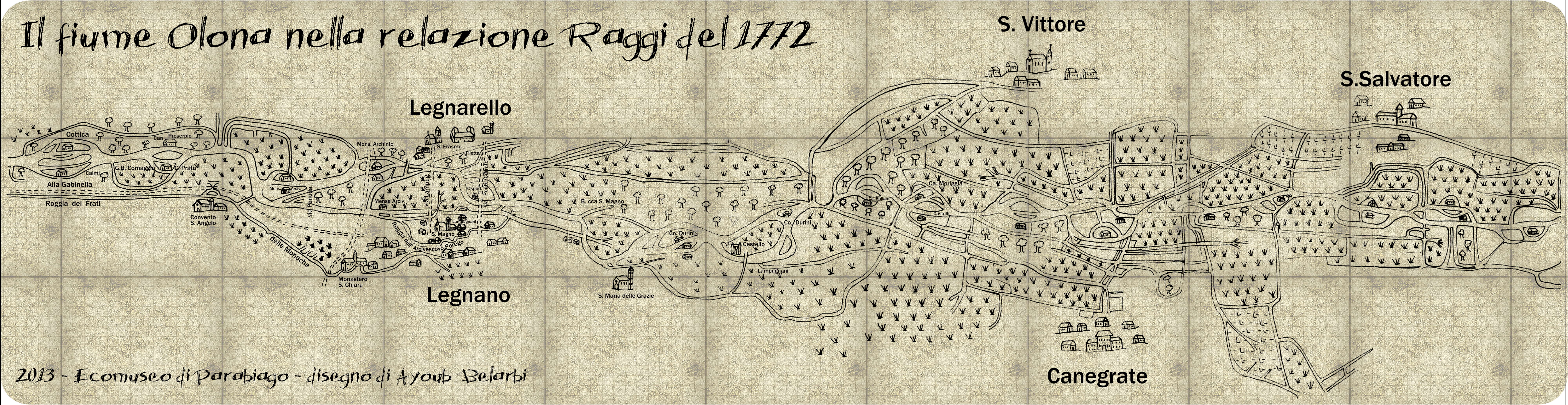 During this inspection, violations accumulated over time were identified. For instance, the authors noted that in the section up to Castellanza "[...] waters easily return to the river after irrigating surrounding meadows [...]", whereas downstream the opposite occurred: contrary to the Novae Constitutiones, water was not returned to the river after irrigation, preventing mills from operating at full capacity. This was critical for the government: its priority was optimizing mill operation, as mills supplied flour to local populations. More broadly, violations were evident: at times, the Olona's water level was so low that mills in the river's lower stretch could not operate. Other abuses identified by Raggi and Verri were so-called scannoni—temporary, illegal water intakes common especially in the Rho stretch. This document was the first precise assessment of the economic and social condition of users along the river. In addition, Verri and Raggi identified many non-compliant water intakes. These and the scannoni were subsequently closed. The two rapporteurs also uncovered abuses by millers. Verri wrote: "[...] It was common practice among millers to keep their floodgates lowered or completely closed. Their goal was to hold back flowing river water, sometimes to benefit neighboring meadows, sometimes to irrigate their own, causing a dramatic depletion of the Olona to the detriment of all users downstream [...]". Another abuse was keeping intake gates partially open to draw water outside permitted days and hours. These abuses had accumulated over time due to frequent transfers of land and mill ownership that were never registered with authorities.
From a legal standpoint, Verri and Raggi's report represented a milestone in river water regulation. It laid the groundwork for reorganizing the consortium and updating regulations in the following century.
19th-century regulations
In 1791, a dedicated judge appointed by the court of Milan was added to the offices established by the Novae Constitutiones. This made river jurisdiction more efficient in resolving disputes. Additionally, the Austrian government granted users the right to nominate an inspector, an independent figure who would intervene at the users' request.
On May 11, 1812, the consortium adopted formal regulations for the first time, and on July 8, 1816, it changed its name to "Amministrazione del Consorzio del Fiume Olona" ("Administration of the Olona River Consortium"). Article 1 of the regulations stated that "[...] The body of users and interested parties in the Olona river united in a social Consortium is governed by the provisions of the law of May 20, 1806, and the sovereign decree of July 8, 1806 [...]", while Article 2 specified "[...] The administration of social affairs is entrusted to nine individuals appointed by the consortium by majority vote. One serves as president for one year, and one administrator is renewed every two years [...]". On this occasion, the organization was modernized. The ancient offices of judge commissioner and river conservator were abolished and replaced by the president and the administrator of the consortium. They were supported by a chancellor, an engineer, a record keeper, an accountant, a cashier, an attendant, and four river wardens (five from 1877). Furthermore, the consortium gained authority to report major abuses to the courts.
In 1869, new regulations were proposed. Following an update on January 10, 1819, water regulations had become biased toward Milan, leaving other municipalities without representation even when needed. Consequently, emerging industries—especially in Varese and the Alto Milanese—pressed the consortium to modernize rules heavily focused on Milan and traditional users (farmers, millers, etc.). On February 22, 1877, the consortium transformed into a private association with public purposes, and the draft regulations prepared in 1869 came into force. Under these rules, the consortium comprised "[...] all users whose property and rights are registered under their name in the river cadastre [...]". The board of directors again consisted of nine members who appointed the president. A new body established by the statute was the Assembly of Delegates of the Olona, consisting of 60 members. The river course was divided into three districts ("riparti"), each electing 20 members to the assembly. The district seats were Varese, Legnano, and Milan. This assembly included local nobility as well as the emerging entrepreneurial class. On February 22, 1881, the regulations were updated again.
The Olona waters become public property
As noted, in the 17th century the Olona's waters were transferred by the Spanish government to users belonging to the consortium, which was a private association. In October 1921, the Olona's waters became state property (public domain). Consequently, on February 28, 1923, an agreement was signed between the Italian Government and the consortium, transitioning water administration from private to public.
As a result, the consortium's role changed to mediating between water users and the Italian state. The transition was not without conflict; members resisted legally before the status was officially confirmed in 1923. Other consortium duties included collecting license fees (which went to the State), routine maintenance of the river and its tributaries, and submitting new license applications (granted by the State). Policing along the banks was entrusted to the Genio civile. On August 31, 1940, the regulations were updated.
Until 1982, the consortium was headquartered in Milan. That year, headquarters moved to Castellanza to provide a more central location. Located straddling the provinces of Milan and Varese, the new site lies mid-course along the Olona.
See also
- Olona
- Olona valley
- Province of Varese