
Battle of Dortmund
Battle of Dortmund was major battle of World War II in the Western Front European theatre between the Allied forces and [...] Germany. The part of the larger Ruhr Pocket encirclement. It started with a major bombing of the City of Dortmund on 12 March 1945 and ground troops taking the city on 18 April 1945. In 1945, the city had many forced laborers living in concentration camps in [...] Germany's coal and steel industries. The forced laborers were from Poland, Soviet Union, Belgium, France, and other occupied territories. At the end of the battle, 4.070 prisoners of war from 13 nations were liberated.
Bombing
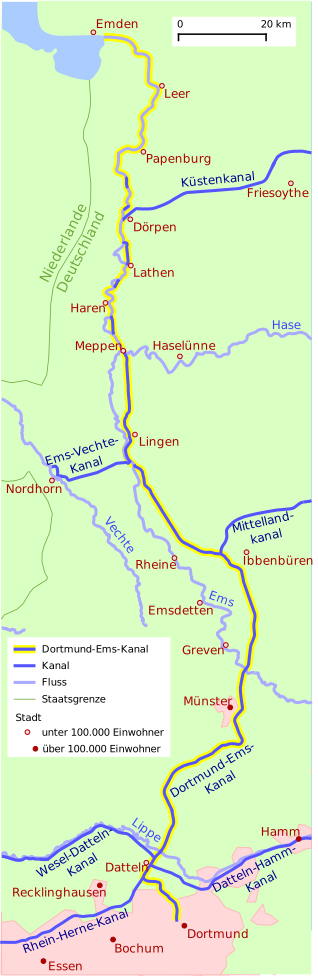
The battles start with the bombing of Dortmund, in North Rhine-Westphalia of Germany on 12 March 1945. The Royal Air Force (RAF) dropped 4,851 tonnes of bombs using 1108 aircraft. The bombing raid used 748 Lancasters, 292 Halifaxes, and 68 Mosquitos. The raid destred 98% of The Downtown of the city. The bombing started at 4.30 pm, and lasted 29 minutes. The city was bombed repeatedly, including bombing of the Dortmund-Ems canal and coking plants, which limited Germany's fuel production.
Ground Assault
The US 95th Infantry Division took the Dortmund on 13 April 1945. The battle was part of the encirclement of German Army Group B under Field Marshal Walter Model. Model put up strong resistance along the Dortmund–Ems Canal. The capture of the City of Dortmund and the Ruhr region was completed 18 April 1945. The Ruhr Pocket encirclement led to over 300,000 German soldiers being taken prisoner.
Forced laborers camps
Hoesch AG, Harpener Bergbau AG, Deutsche Edelstahlwerke AG, Gewerkschaft des Steinkohlenbergwerkes and Concordia Bergbau-Aktien-Gesellschaft operated Dortmund mines and steel production with forced laborer camps. The Dortmund prison inmates or concentration camp inmates were to be used for the dangerous work of uncovering and disposing of unexploded bombs. When the US 9th Army troops entered Dortmund, Germany on 14 April 1945, they liberated 4,070 prisoners and slave laborers of 13 nationalities–men, women and children. The Americans discovered many of prisoners-of-war and workers too weak from starvation, malnutrition and disease to move. Camps at Dortmund: Kommando 5005 and Kommando F756.
See also
- Falaise pocket
Bibliography
- Littke, Peter (2026), Major Dunker und das Kriegsende 1945 in Beckum [Major Dunker and the end of war 1945 in Beckum], Münster: Aschendorff Verlag, ISBN 978-3402142943 [in German, especially interesting for events prior to the immediate closing of the Ruhr pocket].