
Walter Ungerer
Walter Ungerer was born in Harlem, New York City in 1935 of German immigrants, the oldest of three children. His childhood until age eight was spent in New York City and West Haven, Connecticut. In 1943 the family moved to Lynbrook, New York, then Grant Park, New York. He graduated from Woodmere High School in 1963, then enrolled in the architecture program at PRATT Institute. After one year he transferred to the graphic arts program where he received a Bachelor of Fine Arts degree in 1958. Ungerer then did graduate work at Columbia University where he received a Master of Arts degree in 1960.
Simultaneously with his educational studies at Columbia University in the 1960s, Ungerer worked as a freelance cameraperson and editor. In 1964 he turned to independent personal filmmaking after a several month stay in Nigeria, where he was the cinematographer for a television “special”. Between 1964 and 1969 he produced five films: The Tasmanian Devil (1964), Meet Me, Jesus (1966), A Lion’s Tale (1968), Introduction To Oobieland (1969), and Ubi Est Terram Oobiae? (1969). The last four films were produced in a commercial flower district loft space on 28th Street in New York. In ‘69 Ungerer moved to Vermont and a teaching position at Goddard College. He had been teaching film production courses at Columbia University (1966 to 1969).
In 1976 Ungerer formed Dark Horse Films, Inc. a Montpelier, Vermont non-profit company under which he produced four features: The Animal (1976), The House Without Steps (1979), The Winter There Was Very Little Snow (1982), and Leaving The Harbor (1992). Another activity of the company for several years was showcasing independent films of Vermont filmmakers as well as other parts of the United States and Canada Showcased filmmakers were Jacques Drouin, Derek Lamb, Norman McLaren, Ishu Patel, and Anne Clair Poirier. American filmmakers that were profiled included Randall Conrad, Christine Dahl, Jacques Drouin, David Ehrlich, Ellen Hovde, John Karol, Manny Kirchheimer, Doreen Kraft, Robin Lloyd, Derek Lamb, Theodore Lyman, Ed Pincus, Dorothy Tod, and Walter Ungerer. These presentations occurred once a year for a week at the Pavillion Auditorium in Montpelier including the appearance of each filmmaker.
Then came a period of exploration with the computer using the computer to not only edit but to create the entire film without the use of a camera. This period produced Birds 2/93 (1993), Anna’s Amazing Moving Animals (1994), Relatives In X, Y, & Z (1996), The Window (1997), Kingsbury Beach (1999) and Untitled 2.1 (2001); all short films no longer than ten minutes long. These were an opportunity for Ungerer to draw, paint, and experience putting colors and shapes together, not since being an art student and young artist working on newsprint paper or canvas. A retrospective exhibit of drawings, paintings, videos and computer graphics occurred at the TW Wood Gallery and Art Center in Montpelier, Vermont in 1996 (March 16 - April 16). Included was a six monitor video installation titled The Syracuse Tapes based on his stay in Syracuse University as a visiting artist. 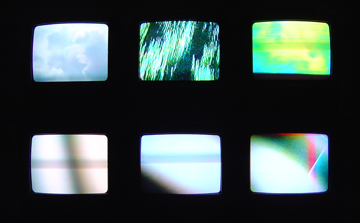
In 2001 Ungerer returned to documentary filmmaking to produce and all this madness (2002), a film about the September 11, 2001 attack on the NY World Trade Center. Once before he had made a film based on political motivation, and his criticism of American government policies. Keeping Things Whole (1974) was an interview docudrama that recorded people’s views of the Viet Nam War; at the same time weaving in a fictional story about a young man about to be drafted. and all this madness is a more straightforward investigation into the causes of the 9/11 attack.
Down The Road (2005), one of Ungerer’s more recent films, is very much an autobiographical compilation of his filmmaking life. Friends of Ungerer, present their views of him. Included are clips from his earlier films as well as his “home movie” clips (as when the camera plays hide-and-seek with his three year old daughter). This material is woven together in the form of a tapestry of memories and present day occurrences to give an impression of the artist’s life. The film was included in the 2005 Syracuse International Film Festival and the 2005 Athens International Film and Video Festival.
In 2005 Ungerer produced 91 Le Grand, a four months study of the movement of light through a space in Ungerer’s home in Maine. The camera simply records, programmed to take still pictures between intervals of being shut down. It is a meditation in time, space and place. An outgrowth of 91 Le Grand is a video installation titled Inside-Outside. Using two projectors, it incorporates still photographs with video to illuminate a series of hanging curtains in an interior space. It was installed at the Space Gallery, Portland, Maine in 2005, and was also on exhibit at the Brattleboro Museum and Art Center, Brattleboro, Vermont in 2008.
In July and August of 2006 retrospectives of Ungerer’s computer works were at the Alamo Theater, Bucksport, Maine, and Farnsworth Art Museum, Rockland, Maine. That year additional retrospectives occurred in Kiel, Hamburg and several other northern Germany cities, culminating in a November tour to the area by Ungerer.
Ungerer's works have been shown at film festivals and competitions throughout the world including the Florence International Film Festival, Florence, Italy; the Tours International Film Festival, Tours, France; the Athens International Film Festival (Best Feature Film for The Animal (1976), Merit Award for The House Without Steps (1978), and 91 Le Grand (2005); the Houston International Film Festival (Bronze Award for The Winter There Was Very Little Snow (1982); Atlantic Film and Video Festival, NS, Canada (Critics' Choice Award for The Winter There Was Very Little Snow) and the Black Maria Film Festival (Jurors' Award for Leaving The Harbor (1992) and 91 Le Grand). He has also had exhibitions at the Museum of Modern Art, New York City; Everson Museum, Syracuse, New York; Filmmuseum, Amsterdam, Holland; the Athens Film Society, Athens, Greece; the Hong Kong Cultural Centre, Kowloon, Hong Kong; and the Fleming Museum, Burlington, Vermont. Among other grants and awards, he has received an American Film Institute Independent Filmmaker grant in 1977, and a National Endowment for the Arts Media grant in 1983. He has also been the recipient of several Vermont Council on the Arts fellowship awards.
Since 2005 Ungerer has often used a small, inexpensive digital prosumer {between consumer and professional) camera capable of recording short bursts of video or video clips to produce the material for his works. Because of the camera’s diminutive size, Ungerer has been able to record unnoticed at crowded public places such as the underground subway systems in London, and Washington, DC; and the airports at Boston, Los Angeles and Frankfurt, Germany. Results are Random Bits Of Unknown Significance (2007), and Such As It Is (2007). Other works made during this time are Epitaph (2008), Inalienable (2008), The Bird Feeders (2008) and The Salt Shaker And The Moon (2009). This shift from comparatively large Arriflex cameras and Nagra tape recorders in the 60’s, 70’s and 80’s to the use of inexpensive self-contained digital cameras, is due in part to its appeal as inconspicuous equipment. Additionally, the cost factor using cheap prosumer cameras cannot be ignored. Past reliance on grants and individual supporters for his work has been lessened. Ungerer’s output during this period has been significantly greater than the years of his feature length films from 1976 to 1992. Though the recent works average 10-12 minutes compared to 70-90 minutes for the features, still they are produced much more quickly than earlier films. The Winter There Was Very Little Snow (1982) took six years to complete. Leaving The Harbor (1992) took nine years.
Notes
Lynn Garafola “Independ features at a crossroads” Independent features at a crossroads, Jump Cut no. 28, pp 35-37, April 1983
Meredith Goad 1 September 11, 2006
Amy Roeder “A Diaogue on the Unimaginable”, New England Film.com, October 1, 2002
Steven Bissette 2 Black Coat Press
Gerald Peary article http://www.geraldpeary.com/festivals/new_england_2000.html
Wikipedia 3 Walter Ungerer’s 1965 film called “The Tasmanian Devil”
Judy Holmes 4 Syracuse University News, April 6, 2001
Mike Everleth“Underground Yearbook: 1972” Bad Lit The Journal of Underground Film, November 23, 2008
Cullen Gallagher[http://cinema-journal.blogspot.com/2006/06/concentric-ambiguities-walter-ungerers_16.html “Concentric Ambiguities: Walter Ungerer’s The Animal (1976)” Cineholla Collective: Cullen’s Blog, 2005
Chris Pearson “Los Angeles Filmforum” p1.