
Tower of Hercules, Villajoyosa
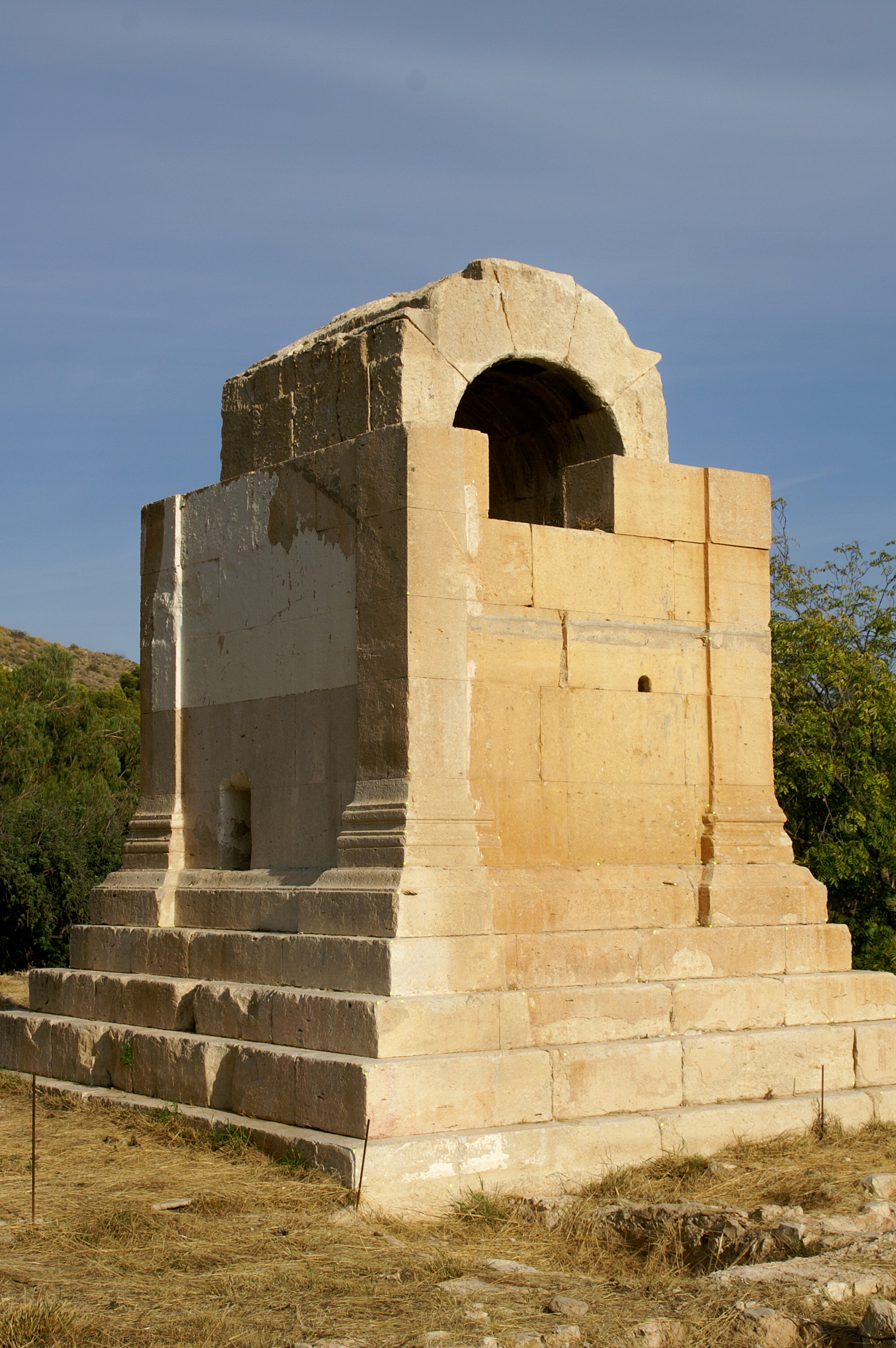 The Tower of Hercules is a Roman funerary tower that is located three kilometers northeast of Villajoyosa (Valencian Community, Spain), ancient Roman city of Alonis (Hispania Tarraconensis) . It has been declared an Bien de Interés Cultural since 1990. It was formerly known as Torre de San José. It is one of the main icons of Roman archeology in the Valencian Community.
History
The first historian who gives news about the monument is Gaspar Juan Escolano (1610). In the 18th century the first Alicantean archaeologist, Antonio de Valcárcel, Count of Lumiares, made excavations in the area. At the end of the 18th century, Alexandre de Laborde visits and describes the monument in his work Voyage Pittoresque et Historique de l'Espagne, published in 1806 and illustrated with splendid engravings of the monument, the work of François Dequevauviller.
Lorenzo Abad and Manuel Bendala published the first detailed study of the monument in 1985, and recently the first of them published a review and update of it. According to these researchers, it was built around the 2nd quarter of the 2nd century AC. These monuments used to be located next to the causeways, like all the Roman tombs. However, the Torre de San José is exceptional because it seems to have been erected not to be seen from a dirt road but from the main road of antiquity: the sea. In fact, it is located on a slope in the first line of coast, in the cala del Torres beach, so that it clearly stands out in the landscape when you sail in front of it. It is the largest of the three best-preserved Roman turreted funerary monuments of the Iberian Peninsula, together with the Torre dels Escipions (Tarragona) and the Torre Ciega (Cartagena).
The year 2007 was very important in the history of the tower: the City of Villajoyosa, within the urbanization of the area, undertook the demolition of the modern upper body built on the tower and the house attached to the monument. Excavations were also undertaken, already municipal property, within the Proyecto Villajoyosa Romana: from the Republic to Late Antiquity, developed by Vilamuseu (Municipal Section of Archeology, Ethnography and Museums) and the Area of Archeology of the University of Alicante, under the co-direction of Lorenzo Abad, Sonia Gutiérrez and Ignacio Grau (University of Alicante), and Diego Ruiz, Amanda Marcos and Antonio Espinosa (Vilamuseu).
In 2011, the restoration project of the tower was taken up by the General Directorate of Heritage of the Generalitat Valenciana and the City of Villajoyosa. The original project, the work of the architect Santiago Varela, is being revised and adapted to recent discoveries and research, for a future execution. In 2012, guided visits to the monument have begun, as well as recreation events with the collaboration of the recreationalist group Legio VIIII Hispana of the Asociación Hispania Romana, for its valorization even before its restoration.
Architectural features
It is a turriform monument (that is, in the shape of a tower), of the so-called "closed edicula", that is, that its interior had no access at all. It is built with rectangular ashlars. It has a stepped base, on which, after a molding straight cyma, sits the main body, which is also rectangular, with the major axis oriented E-O. It is decorated with corner pilasters with its base, shaft and simple Corinthian capital. The upper third was probably dismantled in the 16th century with the intention of taking advantage of the stone in the walls of Villajoyosa, although many sillares were in its environs, and among them elements of all its parts, like a corner capital; fragments of architrave, frieze and cornice; and even an ashlar with a rectangular front recess that could hold a plaque with the inscription of the deceased. According to L. Abad and M. Bendala, the monument could be crowned by a pyramidium, or pyramid-shaped topped, as many similar towers, although no remains of it. In the third row of the faces E and O of the monument there are two orifices of section inclined towards the interior, to make the libations (funerary offerings of liquids, especially wine) to the deceased.
The tower is very similar to that of Daimuz (Valencia), which was dismantled in the 19th century.
The tower was declared of cultural interest with its most recent name, Tower of Hercules, derived from the surname of one of its last owners. However, for centuries it became known as the Torre de Joseph and later this name was derived in that of San José, by a sanctification of frequent place names in popular culture when the explanation of the origin of a name is lost. It has been thought that José could have been a former owner, although recently it has also been proposed that Gaspar Escolano's proposal (1610) that José's name derived from that of Josa does not go uncharted, because in the Early-Modern Age the Valencian name of Villajoyosa (Vila Joiosa) appears frequently contracted in the form Vilajosa, with which the old name could have been Torre de (Vila) Josa, and from there to derive to that of San José.
Apparently in the 14th century, after the conquest by the Crown of Aragon, a wicket was practiced on the north side to pillage the interior. In the excavations of 2011 it has been found different ditches of pillage, until the middle of 20th century. There was no trace of the deceased or its trousseau, except two human teeth with no trace of having been burned, which suggests the possibility that it is one of the first towers with a burial ritual in the Iberian Peninsula, since during the 2nd century the change of the funerary rite of the cremation of the corpse to its unburned burial takes place.
External links
- "The Roman legions return to Alonis", in www.villajoyosa.com
- Link to the Facebook page of Vilamuseu, with updated information on events at the monument
- Digital article in Diario Información, February 2, 2012
- Print edition in Diario Información, February 2, 2012, through www.hispaniaromana.es
- Agenda of historical recreation activities in the Torre de San José on the website of the Asociación Hispania Romana