
Timi Olagunju
Timi Olagunju (also known as Timithelaw) is a lawyer, technology policy expert, and writer.
Biography
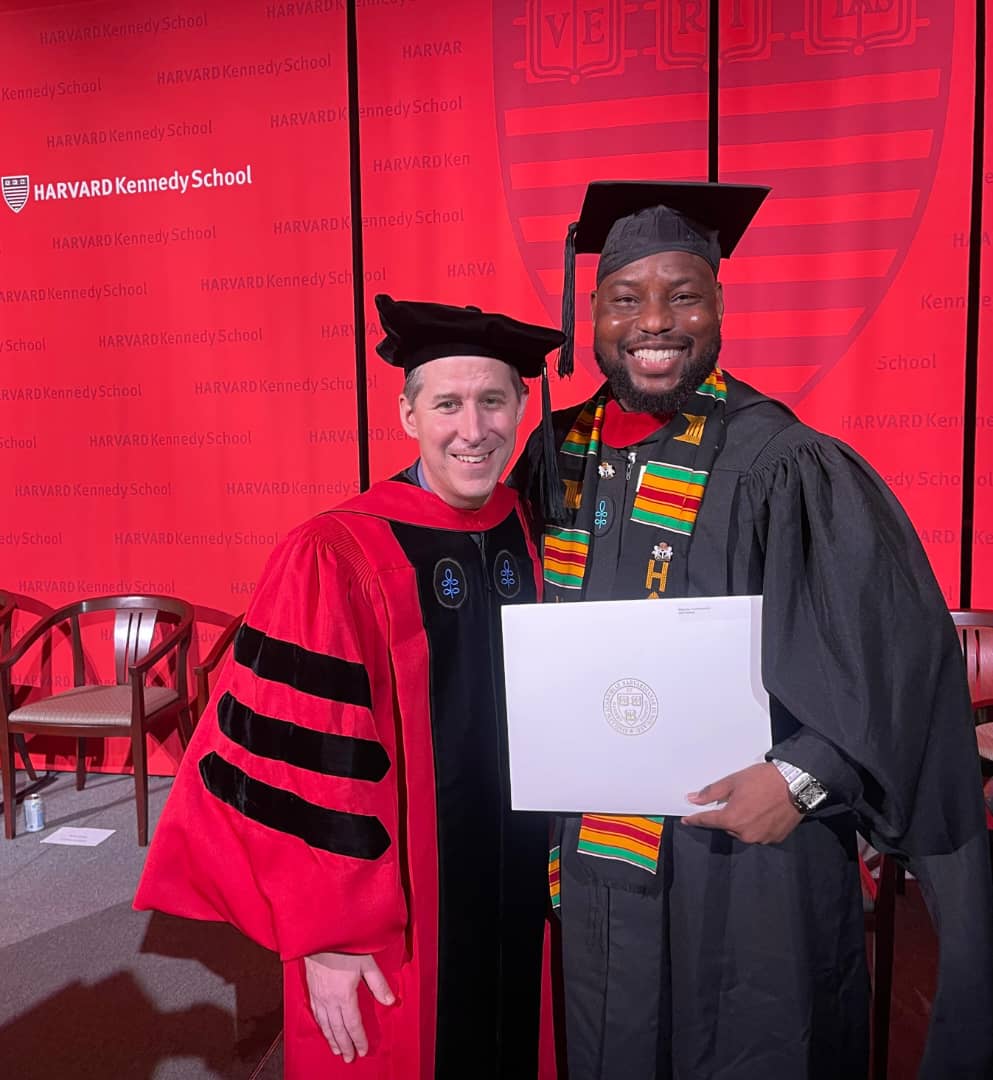 Olagunju was raised in Lagos and Ibadan, Oyo State, Nigeria. He graduated in 2009 from the University of Ibadan with a Bachelor of Laws degree, attended the Nigerian Law School at the Agbani campus in Enugu, and was called to the Nigerian Bar in 2011.
He later studied at Harvard University’s John F. Kennedy School of Government, where he completed a Master of Public Administration degree as an Edward S. Mason Fellow. Olagunju also attended a programme on strategic leadership at the University of Virginia’s Darden School of Business in 2015, and an AI and Society programme at the Massachusetts Institute of Technology in 2024.
As a writer, his work has appeared in YourCommonwealth, HKS Student Policy Review, The Punch, TheCable, Irish Tech News, The Africa Report, and BusinessDay, among others. His commentary on internet governance includes the 2025 article "Who controls Nigeria's internet?" for TheCable.
Beyond his writing, Olagunju is the founder of the AI Literacy Foundation and Youths in Motion, and has served on the boards of organisations such as Feed to Grow Africa and the Slum and Rural Health Initiative.
In 2018, he was profiled in The Guardian in an article titled "Advocates for Positive Change". Olagunju is a recipient of several awards and fellowships, including the Mandela Washington Fellowship and a fellowship at the Presidential Precinct (2015), where he was recognised by U.S. president Barack Obama; the Friend of Lead City University Award for education and youth development in Ibadan (2015); and selection as one of 100 global young leaders to participate in the design and launch of the Obama Presidential Library in Chicago (2019). He was later listed on YNaija's Power List in 2020, received the Ooni of Ife Royal Award for Impact as part of the Royal African Young Leadership Forum (2020), and was selected as an Internet Society Early Career Fellow in 2024. In 2025, he was named a Public Voices Fellow on Technology in the Public Interest, a programme of The OpEd Project supported by the MacArthur Foundation.
His work has been cited by the United States House Committee on Foreign Affairs, and highlighted by the U.S. embassy in Nigeria and BellaNaija.
In 2016, he was interviewed by Macon Phillips, then White House Director of New Media under President Barack Obama, for the YALI Voices podcast. He has since been interviewed by platforms including Wazobia TV, Channels TV, TVC News Nigeria, and in conversation with Big Brother Naija host Ebuka Obi-Uchendu.
In 2021, he was appointed global vice president and Africa’s representative of Generation Democracy, a youth initiative organised by the International Republican Institute. The same year, he served as a research contributor at the Berkman Klein Center for Internet & Society at Harvard Law School on a project on digital self-determination. As a speaker, Olagunju has appeared at the Nigerian Internet Governance Forum, MKAI in the United Kingdom, the Nigerian Institute of Chartered Arbitrators, and TEDx events, among others.
Writing and publications
 Olagunju’s writing focuses on technology policy, digital rights, and governance, including issues of internet access, data protection, blockchain regulation, online courts and artificial intelligence. His essays and commentary have addressed topics such as Free Basics and net neutrality in Nigeria, biometric databases and privacy, blockchain and cryptocurrency regulation, court digitisation and virtual hearings, Africa’s position in global digital trade, and competition and content moderation policy in the Nigerian technology sector.
Books
- The Hustlers' Mentality (2009), a book on youth leadership and personal resilience.
- Yes, Africa Can: Lessons from Mandela Washington Fellows (2015), an edited collection of essays by Mandela Washington Fellows on leadership and development.
- Leading From Within, a co-authored book on leadership and governance.
Selected articles and policy papers
- "The actual cost of Free Basics in Nigeria", YourCommonwealth (2016), critiquing Facebook’s Free Basics zero-rating proposal in Nigeria and its implications for net neutrality.
- "If Nigeria is to get serious about ICT, here are a few things that need to be done", Techpoint Africa (2016), outlining policy and institutional reforms for Nigeria’s ICT sector.
- "Nigerian Government should prioritise data protection over building a biometric vehicle database", Techpoint Africa (2016), arguing for comprehensive data protection safeguards before expanding biometric databases.
- "The important legal agreement to protect Startups and Founders in Nigeria", Techpoint Africa (2016), explaining vesting agreements and founder equity arrangements in Nigerian startups.
- "3 recommendations for policy makers as Nigeria moves to regulate blockchain technology", Techpoint Africa (2018), proposing a regulatory approach to blockchain and cryptocurrency in Nigeria.
- "Three Recommendations to Nigeria's Policymakers on Blockchain Technology and Regulations", Irish Tech News (2019), on frameworks for blockchain adoption and oversight.
- "Why remote, virtual court hearings in Nigeria are constitutional", Techpoint Africa (2020), a legal analysis of virtual court sittings in Nigeria, later cited in commentary on judicial practice during the COVID-19 pandemic.
- "African Continental Free Trade Area (AfCFTA): Ensuring Africa's Data Security in a Unified Digital Market", US–Africa Business Bridge (2024), discussing cross-border data flows and digital trade under the AfCFTA.
- "Why [...] OPT Hurts American Workers More Than It Helps", HKS Student Policy Review (2025), analysing U.S. immigration and work-visa policy for international students.
- "Smarter Than Sanctions: The Case for AI Diplomacy Over Export Bans" (2024), a policy paper submitted to the U.S. Office of Science and Technology Policy and the National Science Foundation as part of a request for information on a national AI action plan.
- "Ethical Challenges in AI-Driven Personalized Learning Platforms" (with Jumana Asrar), presented at the MIT AI and Society programme (2024), examining privacy, consent and algorithmic bias in AI-powered education platforms.
- "Who controls Nigeria's internet?", TheCable (2025), discussing telecoms, platform power and internet governance in Nigeria.
- "₦352bn fine: What FCCPC and Meta must do next", The Punch (2025), analysing a record fine against Meta Platforms by Nigeria’s competition regulator and its implications for digital markets and consumer protection.