
Swarm electrification
Swarm electrification is a three step, bottom-up rural electrification process developed at MicroEnergy International GmbH that focuses on non-electrified households, or minimal energy access households, and small businesses in developing areas to form a common micro-grid which can eventually be connected to the national grid in its final step. In January 2014, Medici Engineering GmbH, a Swiss based company, also announced to work on a swarm electrification approach for Tanzania.
Swarm electrification aims at providing enhanced opportunities for productive use of energy, by increasing network stability, whilst offering multiple financing options. The term "swarm electricity" was first introduced by the German company Lichblick as the energy for the future. The same concept, although not coined as swarm electrification, came up in an IEEE conference contribution in 2012 in Montreal. 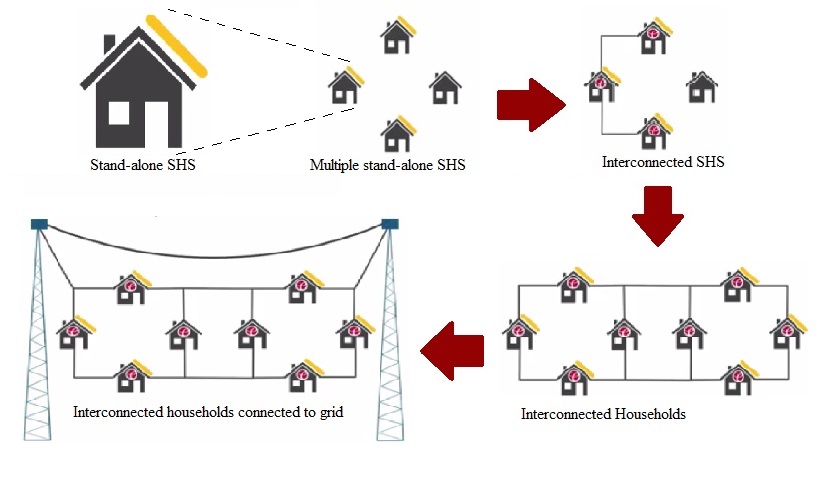
The Concept
The idea of swarm electrification is motivated by the large, and growing, number of stand-alone, small-scale energy systems, usually micro-financed to low-income households enabling access to electricity, mostly through solar home systems (SHS). Even though small-scale energy systems allow users to connect small home appliances, such as light bulbs and charge their mobile phones, they are still constrained by several energy availability limitations. These limitations are, on one side, due to efficiency loss of photovoltaic panels and to the fact that batteries degrade with time. Another factor decreasing the efficiency of SHSs is caused by the individual use of the system, since, as Boldt states, "Many households do not fully use the electricity stored in their batteries resulting full batteries by midday limiting the generation potential of their systems". On the other side, despite the large number of off-grid households that have a SHS, or another individual energy generator, not all of them can afford the purchase, or require electricity beyond what the system can supply.
Swarm electrification suggests interlinking multiple households with individual stand-alone energy systems and households with no energy access, creating a growing micro-grid where interconnected participants can buy and sell energy to each other, or to a local or national grid, according to their necessities, becoming energy consumers and producers, so-called prosumers. Thus, swarm electrification advocates for a bottom-up, demand-driven electrification approach with decentralized generation and storage, compatible with micro-finance, and therefore reducing the barriers rural electrification usually has to deal with, such as elevate capital expenditures, end-users ability to pay, or significant maintenance and safety measures for the power station, commonly related to top-down, supply-driven electrification approaches.
As Jopp states, "this approach can be linked to the concept of swarm intelligence, where each individual node brings independent input to create a conglomerate of value even greater than the sum of its parts".
In order to successfully implement the concept of swarm electrification, a number of aspects have to be taken into consideration. On the one hand, it is important to build on existing resources, such as previously purchased SHSs, diesel generators, batteries, or other small-scale energy devices, to include all stakeholders that may possess some type of electrical equipment, as well as to ensure their commitment and acceptance. On the other hand, since a wide variety of electricity sources might be used, they have to be compatible with the intelligent control units (e.g. biomass gasification, liquid fuel generators, micro-hydro, small-scale wind, etc.). For these reasons the process is presented in three phases, starting from a small-scale distributed generation scenario for individual use, in the second place this is interconnected into a community micro-grid, to finally connect the micro-grid to a regional or national grid.
Swarm Electrification in three steps
Phase 1 - Isolated small-scale distributed generation
Swarm electrification starts in rural and peri-urban off-grid areas where residents access electricity through individual energy systems. Thus, the first scenario consists of a location where there is no electrical grid connection available, and households either consume electricity from an individual energy system or do not receive any kind of energy supply. In this phase, according to Bardouille and Muench, a tier 2 of electricity access is associated to such community, since they can run "basic household needs", including a Small number of lights, mobile charger, and often but not always other small appliances, such as a fan or a radio.
Phase 2 - Autonomous micro-grid as the interconnection of distributed generation systems
The second phase consists of interconnecting all nearby households and small businesses by creating a swarm micro-grid. In a swarm micro-grid scenario, all potential users previously connected to individual generation systems, or households and small businesses without electricity access, can now interconnect and trade with energy. Thus, users are able to purchase the excess of energy that other users will not consume, and May Be willing to sell. The swarm network increases usage flexibility and reliability, at the same time that enhances productive and efficient use of energy by allowing users to easily access to small productive appliances power appliances, such as water pumps and refrigerators. This is, according to Boldt, because hidden resources of SHSs can be now used. Interconnections between nearby swarm micro-grids to create a bigger one are also included in the second phase.
Phase 3 - Swarm micro-grid connecting to central grid
Once the autonomous swarm micro-grid has grown in size and in demand, it can be connected to the main national grid. The last step of the swarm electrification process not only benefits rural electrified householders by connecting them to the main grid, preventing overloading risks, but it can also benefit national utility companies. Implementation of Phase 3 means connecting a medium to large number of users with a comparatively low investment.