
Gaelic football rankings
The Gaelic football rankings is an unofficial ranking system for men's county teams in Gaelic football. The county teams are ranked based on their game results, with the most successful teams being ranked highest. The point system used is based on that used by the IRB with some modifications.
In this exchange-based point system, points are awarded based on the results of National Football League and All-Ireland Senior Football Championship games, with more recent results and more significant matches being more heavily weighted to help reflect the current competitive state of a team. The rankings have been computed based on results from the 1st of May 1994 and were presented for the first time in March 2014.
Uses of the rankings
The rankings are used by the followers of the GAA counties to rank the progression and current ability of their team. To date, the rankings have not been officially used by the Gaelic Athletic Association.
Current calculation method
The point system is calculated using a 'Points Exchange' system and is based on that used by the IRB with some modifications. Teams receive points from each other based upon the match result – whatever one side gains, the other loses. The exchanges are based on the match result, the ranking of each team, and the margin of victory, with an allowance for home advantage. As the system aims to reflect current team strengths, past successes or losses will fade and be superseded by more recent results. Although matches often result in points exchanges, 'predictable' results lead to very minor changes, and may result in no change to either side's rating.
Rules
The system ensures that it is representative of the teams' performance despite playing differing numbers of matches per annum, and the differing strength of opposition that teams have to face. The factors taken into account are as follows:
- Match result
- Match status
- Opposition strength
- Home advantage
Match result
For each match played, points exchanges are awarded for the following five outcomes:
- a win or loss by more than 5 points
- a win or loss by up to and including 5 points
- a draw
Match results dating from the 1st of May 1994 were used to complete the ratings from which the ranking system is derived.
Match status
Different matches have different importance to teams, and the ranking system has tried to respect this by using a weighting system, where the most significant matches are in the Championship. Points exchanges are currently doubled during the All-Ireland Senior Football Championship to recognise the importance of this event. Prior to 2009, points exchanges were tripled during the All-Ireland Senior Football Championship and this was reduced in order to take into account the increased competitiveness of the League since 2009. Matches played in the winter season (O'Byrne Cup, Dr McKenna Cup, McGrath Cup, FBD Insurance League), challenge matches or other secondary competitions are not included.
Opposition strength
A win against a very highly rated opponent is a considerably greater achievement than a win against a low-rated opponent, so the strength of the opposing team is a factor. Thus match results are more important than margins of victory in producing accurate rankings. This is because when a highly rated team plays a lowly rated team and manages to beat them by over 15 points, it does not necessarily indicate how either team will perform in the future. The IRB ranking system proposes that if the rating point spread between teams is 10 or greater, the higher rated team will not gain any rating points should they win (conversely, if the lower rated team were to win, the maximum possible points would be exchanged). For the GAA Football Rankings, the rating point spread has been extended to 15 in order to take into account the fact that teams with a rating 15 points inferior occasionally beat the higher-rated team, a circumstance which rarely occurs in rugby.
Home advantage
When calculating points exchanges, the home side is handicapped by treating them as though they are three rating points better than their current rating. This results in the home side gaining fewer points for winning and losing more points for losing. This helps to cancel out any advantage that a side may have by playing in front of their home crowd.
New and dormant counties
All counties initially stated with 80 points, with the exception of New York who started on 60 points to allow for their limited game experience every year. Kilkenny, who have not competed in either League or Championship since May 2012 have been temporarily suspended from the rankings until they rejoin either competition. Their rating point score on suspension was 48.52, and they were ranked in 34th position.
Rank leaders
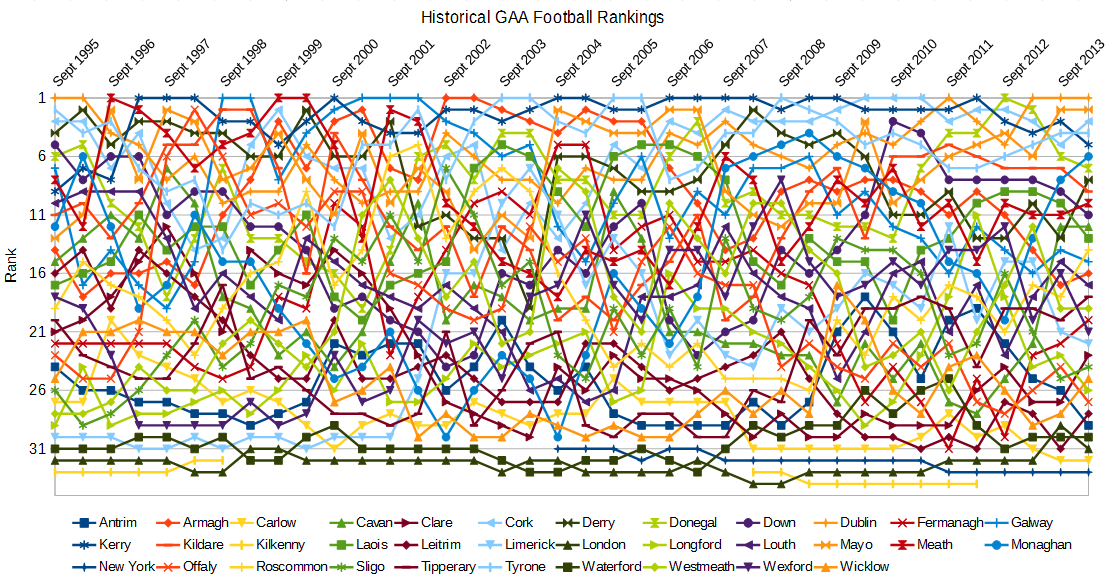 In keeping with the common belief that the team which wins the All-Ireland championship is the best team at that particular moment in time, the All-Ireland winners have always occupied the number one ranking position immediately following their success.
Kerry have been the most consistently highest-ranked team from 1995 to present, occupying the leaders position following 4 consecutive competitions, from the 2006 Championship to the 2008 Championship while remaining either 1st or 2nd between the end of the 2004 League until the end of the 2012 League.
Appearances in the Top 5
The following counties have entered the top 5 at least once since September 1995.
Team |
Best |
|
|---|---|---|
Rating |
Year(s) |
Rating |
Armagh |
1 |
2002, 2003 |
Cork |
1 |
2010, 2011 |
Derry |
2 |
2000, 2008 |
Donegal |
1 |
2012 |
Down |
3 |
2010 |
Dublin |
1 |
1995, 1996, 2011, 2013, 2014 |
Fermanagh |
5 |
2004, 2005 |
Galway |
1 |
1998-1999, 2001-2002 |
Kerry |
1 |
1997-1998, 2000, 2004-2009, 2012 |
Kildare |
2 |
1998-1999 |
Laois |
5 |
2003, 2006 |
Mayo |
2 |
1996, 1997, 2004, 2006-2007, 2013-2014 |
Meath |
1 |
1996, 1999-2000 |
Monaghan |
4 |
2009 |
Offaly |
2 |
1998 |
Roscommon |
5 |
2002 |
Tyrone |
1 |
2003-2004, 2005-2006, 2008 |
External links