
Serpens X-1
Serpens X-1 is an astronomical X-ray source in the Serpens constellation. It was the first X-ray source found in the constellation.
On June 16, 1964, an Aerobee rocket flight discovered the first X-radiation source in the constellation Serpens, designated Serpens X-1 (Ser X-1). The closest visual counterpart is MM Ser. Positions for Ser X-1 are 2S 1837+049, 4U 1837+04, and 1H 1837+049, among others.
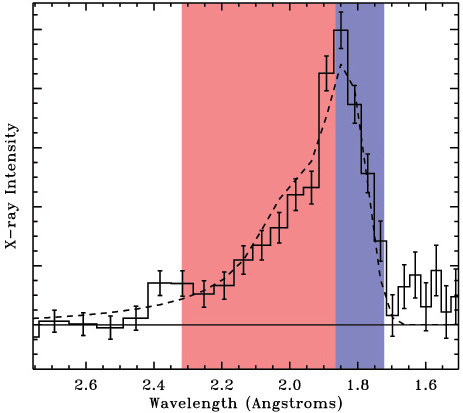
As of August 27, 2007, discoveries concerning asymmetric iron line broadening and their implications for relativity have been a topic of much excitement. With respect to the asymmetric iron line broadening, Edward Cackett of the University of Michigan commented, "We're seeing the gas whipping around just outside the neutron star's surface,". "And since the inner part of the disk obviously can't orbit any closer than the neutron star's surface, these measurements give us a maximum size of the neutron star's diameter. The neutron stars can be no larger than 18 to 20.5 miles across, results that agree with other types of measurements."
"We've seen these asymmetric lines from many black holes, but this is the first confirmation that neutron stars can produce them as well. It shows that the way neutron stars accrete matter is not very different from that of black holes, and it gives us a new tool to probe Einstein's theory", says Tod Strohmayer of NASA's Goddard Space Flight Center.
"This is fundamental physics", says Sudip Bhattacharyya also of NASA's Goddard Space Flight Center in Greenbelt, Maryland and the University of Maryland. "There could be exotic kinds of particles or states of matter, such as quark matter, in the centers of neutron stars, but it's impossible to create them in the lab. The only way to find out is to understand neutron stars."
Using XMM-Newton, Bhattacharyya and Strohmayer observed Serpens X-1, which contains a neutron star and a stellar companion. Cackett and Jon Miller of the University of Michigan, along with Bhattacharyya and Strohmayer, used Suzaku's superb spectral capabilities to survey Serpens X-1. The Suzaku data confirmed the XMM-Newton result regarding the iron line in Serpens X-1.
Discovery
On June 16, 1964, an Aerobee rocket flight discovered the first X-radiation source in the constellation Serpens, designated Serpens X-1 (Ser X-1).
Continuing their search for discrete X-ray sources, the team of researchers from the US Naval Research Laboratory loaded their X-ray detector on board an Aerobee that was launched from the White SandS Missile Range in New Mexico on June 16, 1964. "The galactic plane was mapped from the southern region of Scorpius, through Cygnus, to the northern part of Perseus." The rocket reached a peak altitude of 127 km and rolled with a period of ~8.5 s. Scan 1 did not detect Cas A but did detect source A; scan 3 detected source B, scan 4 detected source B; scan 5 detected source B, source C, source D, source F, and source H; scan 6 detected source D, source E, source F, source G, and source H; scan 7 detected source D, source E, source F, source G, and source H; scan 8 detected source G; scan 9 detected source I; scan 10 detected source I. Source A is Cyg X-2, B is Cyg X-1, C is Ser X-1, D is Sgr X-2, E is Oph X-1, F is Sgr X-1, G is Sco X-2, H is Sco X-3, and I is Sco X-1. So, the order of detection is Cyg X-2, Cyg X-1, Ser X-1, Sgr X-2, Sgr X-1, Sco X-3, Oph X-1, Sco X-2, and Sco X-1.
Observation
Long-term observations of Ser X-1 have been conducted over the period 1969-1976 using the 3-12 keV detector on the Vela 5B satellite. The Uhuru catalog (4U) places Serpens X-1 at 4U 1837+04, with Galactic longitude of 36.1°, latitude 4.8°, and an X-ray flux of 110-320 counts/s. Ser X-1 is a steady galactic bulge source about which little is known, and it is also a burst source. The optical counterpart is a faint blue object, which has been observed to show optical bursts simultaneous with X-ray bursts. The galactic bulge sources show a soft X-ray spectrum, as does Ser X-1. Observations with the Ariel 5 Rotating Modulation Collimator experiment have suggested a period in the range of 3.22-3.55 d.
Time history of X-ray flux shows no major variation at long time scales; i.e., the source does not stray far from its mean flux of 6.9 cts/s, Lx ~ 3.5 x 1037 ergs/s. The persistent X-ray flux from Ser X-1 has been analyzed for the presence of eclipses and pulsations without result.
Location
Ser X-1 (also designated Ser XR-1 and GX+36.3) has been located by Uhuru at 3U/4U 1837+04. Other satellite observations have placed it at MXB 1837+049, 2S 1837+049, HEAO 1 1H 1837+049, XRS 18374+049, CGS 1837+049, and 1M 1837+049. Using the rotation modulation collimator (RMC) system on SAS 3, a precise position was found with a 20" error radius around 2S 1837+049.
Visual counterpart
A faint star of spectral type B with an ultraviolet excess was suggested as the visual counterpart to Ser X-1. Later, an absorption spectrum with very strong Hβ, Ca II, H and K absorption lines cast doubt on the identification. The uncertainty in identification was removed when the star was resolved into two stars, separated by ~2.1". The star MM Ser identified with the X-ray source is blue, and its spectrum exhibits He II (468.6 nm) line emission. The ratio of X-ray to visual luminosities is Lx/Lv ≥ 100.
X-ray bursts
X-ray bursts from within a circle of 5° radius containing Ser X-1 were first observed in October 1975 with the OSO 8 satellite. In July and August of 1976 during observations with the SAS 3 X-ray observatory, 22 X-ray bursts were detected. The ratio γ of the persistent X-ray flux to the average maximum burst flux is ~0.3. The burst recurrence intervals are irregular, between ~1 and 38 h.
In September 1978, a coincident visual and X-ray burst was detected from Ser X-1 (the only one up to 1983 from Ser X-1). The ratio of integrated visual to integrated X-ray flux was 2.8±1.2 x 10⁻⁶ (not corrected for interstellar extinction), for a delay of visual burst relative to X-ray of ~1.4±0.5 s. Previous simultaneous visual and X-ray observations failed to detect any visual bursts, although > 10 X-ray bursts were observed with SAS 3.
Simultaneous IR/X-ray and microwave/X-ray observations of Ser X-1 have been performed, wherein no IR or radio bursts were observed at times of X-ray bursts.
X-ray bursts can occur be described as type I or type II as defined. Type I bursts can be characterized by the integrated burst flux, Eb, maximum burst flux, Fmax, and effective burst duration, Eb/Fmax. For 57 bursts from Ser X-1, the mean values: for Eb is 1.3 x 10⁻⁷ ergs cm-2 with a 1σ spread of 0.4 x 10⁻⁷ ergs cm-2, Fmax is 1.9 x 10⁻⁸ ergs cm-2 s-1 with a 1σ spread of 0.8 x 10⁻⁸ ergs cm-2 s-1, and Eb/Fmax is 6.8 s with a 1σ spread of 2.1 s. No periodicities in Eb or Fmax are apparent.
See also
- X-1 X-ray source
- X-ray astronomy
- Sounding rocket X-ray astronomy