
San Antonio de la Eminencia castle
San Antonio de la Eminencia castle is a colonial castle built in the seventeenth century by the Spanish monarchy in Cumaná, Venezuela, to protect the city from the constant raids by English, French and Spanish pirates. Originally called Careacus, its construction began . The fort has underwent several renovations due to damages caused by violent earthquakes that have shaken the city in the last centuries. A minor fort in 1668, Don Juan de Urtarte, governor of the Province of Cumaná, requested the stone walling of the structure around 1670.
In 1682, governor Juan de Padilla y Guardiola completed the draft reform of the new castle mimicking a quadrilateral shape with bastions at the corners. The next governor, Francisco de Ribero y Galindo, modified the quadrilateral shape plane by a four-pointed star design, built after the earthquake of 1684. José Antonio Páez was detained in the castle in 1849 by taking up arms against president José Tadeo Monagas after being ordered an assault on the Congress in January 1848. Paez remained on the castle until May 24, 1850 when he is expelled from the country. The castle was declared a National Monument in 1965.
Description
The San Antonio de la Eminencia castle was built in the seventeenth century to protect the city of Cumaná from constant raids by English, French and Spanish pirates. Originally titled Careacus (derived from the taín word Careacuro, which means "Caribbean") the castle was built by the inhabitants of the city, and its construction began —82. The fort has underwent several renovations due to damages caused by violent earthquakes that have shaken the city in the last two centuries.
Built in coral stone, its walls are thick. It has powerful artillery as well as a dungeon and several culverins (a type of cannon). The castle is connected to the city via several tunnels and passageways and its strategic position at the top of the mountain gave it the possibility to establish full control of the sea and the city. Although, the castle is now far from the sea, placed at the center of Cumaná. Such distance is the result of sediments from the Manzanares River and successive uprisings of terrain because of the different tectonic events that have occurred in the region.
Origins
The government of Spain was under a compelling need to secure and strengthen the defense of their possessions in the Caribbean Sea, and as a result, the need to build defensive fortifications throughout the coasts from Florida to Guyana arose. In the enclave of the eastern mainland coast of the caribbean, fortifications able to protect the recently founded cities were needed. An entire building construction system that would ensure a proper defense against the constant attack of the organized forces of England, France and Holland, which for almost two centuries lived in constant war with the Spanish monarchy, was necessary. As a result of an attack suffered on the city by French pirates, Saavedra (then governor of the Province of Cumaná) ordered the construction of a fortress in 1660.
On November 22, 1668, Don Juan de Urtarte, who governed the province from 9 June 1668 until 26 July 1669, wrote a memorandum to the King of Spain stating that the "fort Santiago and San Antonio, with eight pieces of artillery, was not a steady construction ... because its roundness and occupying circuit is mud and stone," adding that it was not fit for defense. On the letter, Utarte was requesting the stone walling of the fort, but the Spanish monarchy was not used to invest considerable amounts of money in the construction of forts for small towns like Cumaná. Don Sancho Fernando de Angulo y Sandoval (who governed during 1670-1675), faced the same situation raised by his predecessor Urtarte: the lack of an effective defense system on the city where the main fort, the San Antonio de la Eminencia (then titled Santiago y San Antonio) was not suited for efficient counterattacks.
Angulo y Sandoval then started, without proper authorization nor prior favorable opinion from the war council, the construction of a new fortress under the excuse that the fort of San Antonio did not cover the expected requirements; Angulo y Sandoval considered that due to its location at the top of a hill, far from the city and the coast, as well as the lack of proper water supply, the San Antonio castle was not suitable for defense. The governor claimed that under these disadvantages, along with the lack of accommodation facilities for the soldiers, the building was rendered unable to resist prolongated sieges. Unlike its predecessor Urtarte, who requested economical support to supply and improve San Antonio's condition, Angulo y Sandoval decided to build a new castle more prepared to defend the city than the two existing fortifications. The resulting fortress was entitled Santa María de la Cabeza, and the governor requested the demolition of the older two structures as inoperative.
Cauchin Reverend priest Fray Francisco de Tauste noted the existence of three different fortresses in Cumaná by 1678. In his memoirs, the reverend commented that of those three structures, the Santa María de la Cabeza castle held greater strength and endurance. The Santa Catalina castle was impaired due to its location (close to the river mouth and the sea) and the effects of constant ocean waves. The original San Antonio fortress, built in mud and straw above some hundreds of stalls, did not resist the constant effect of the rain. As a result, and during the governorship of Juan de Padilla y Guardiola (1686-1690) the need to build a more effective defensive system to protect the city arose again. Guardiola completed his report in 1682 and attached the draft reform of the new castle of San Antonio to the correspondence of February 25, mimicking the layout of the plan used by Angulo y Sandoval in the construction of the Santa Maria castle: a quadrilateral shape with bastions at the corners. The war council approved the project on July 31, 1682, authorizing the demolition of the previous structure, as well as the edification of the new building according to the plan by Guardiola.
Earthquakes and remodeling
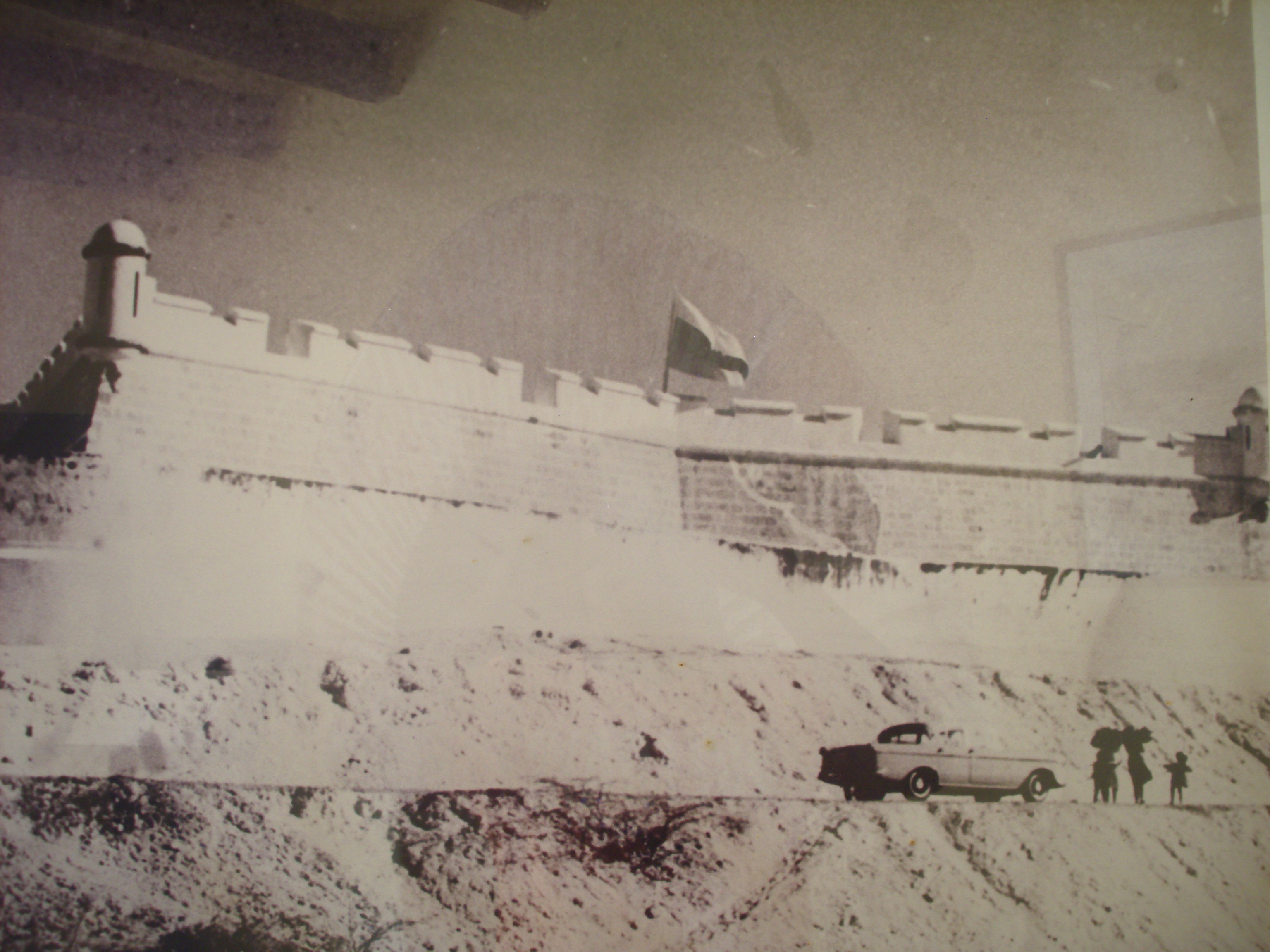 The following governor, Francisco de Ribero y Galindo, made a modification to the plan, replacing the quadrilateral shape by a four-pointed star design. On 4 May 1684, an earthquake devastated the city, then located at the foot of the San Francisco hill. The effects of this earthquake are recounted in several items of correspondence sent to the King of Spain, and collected in an documentary investigation completed by J. Grases (1979). The quake had destructive effects on the castles of Cumaná and Araya and halted construction of the San Antonio castle; it also forced Ribero y Galindo to make urgent repairs to the Santa Maria castle, which was damaged by the quake. Despite Guardiola's protests about having his project changed by Ribero y Galindo, construction continued with Ribero y Galindo's design and by the end of the year, the stone walls were ready.
Gaspar Matheo de Acosta succeeded Ribero y Galindo. He found the inhabitants of the city divided into two factions: the followers of the initial project by Guardiola, and the supporters of the modifications by Ribero y Galindo. Acosta continued with Galindo's modifications due to the building's advanced phase of construction. A plan of the castle, drawn by Bernardo Prenelete, was referred in 1688 to the King of Spain; it showcased the star-shaped design of Ribero y Galindo. New plans submitted in 1733 by engineer Pablo Diaz Fajardo, also followed this design. The section that housed the garrison's bedrooms and the tunnel that connected the castle with the fortress of Santa María (a former official residence of the governors during the colonial era) were destroyed by another earthquake in 1929.
José Antonio Páez was detained in the dungeons of the castle on 8 November 1849 after turning against the president José Tadeo Monagas in a revolt supported by Convervative members of the Congress. Paez remained on the castle until 24 May 1850, when he was expelled from the country. The castle served as a military institution until 1945, when the Antonio José de Sucre quarters replaced the building. The castle was declared a National Monument in 1965.
Gallery
]] ]] ]] ]] ]] ]]