
Realistic STA-240
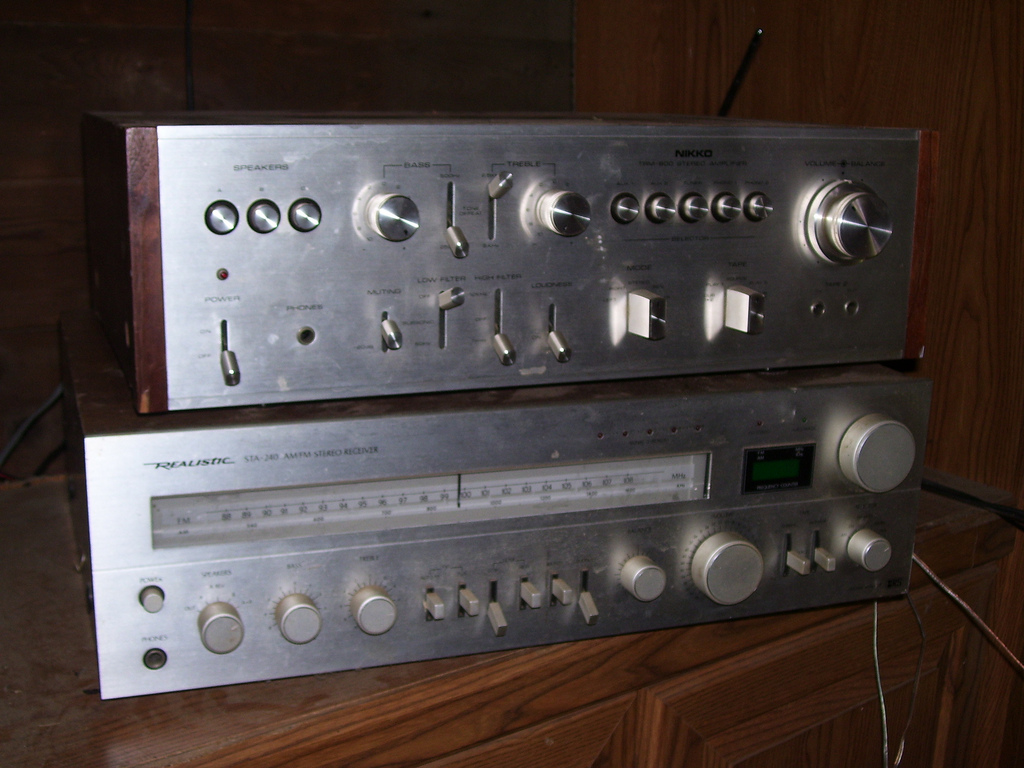 The STA-240 was a receiver/amplifier made by Realistic, a defunct division of Radio Shack. It was introduced in 1979. The tuner on this model features an Auto-Magic setting which makes it self-tune automatically to the nearest strong signal. The STA-240 was the only receiver made by RadioShack with a digital readout and an analog display. The STA-720 had an analog tuner but only the digital display. The STA-240 is a fairly rare model and it sells for over 400 dollars.
Amplifier
The STA-240 is a two channel amp that puts out 60 watts R.M.S. into an 8 ohm load. This May Be a conservative rating; however, as its power consumption is 340 watts. It has low and high frequency filters and two sets of speaker connections. Which speakers are powered can be selected by a knob on the front. The available selections are sets A, A with L+R reversed, B, and A+B.
FM 25 µS De-Emphasis
An unusual feature of the STA-240 is the FM 25 µS equalization switch. When activated, this changes the FM de-emphasis from the normal value of 75 µS to 25 µS. When the STA-240 was marketed, a small number of FM stations were experimenting with transmitting Dolby B-encoded signals (a form of noise reduction). A signal encoded with Dolby B sounds very "bright" as its high frequencies are boosted. For this reason, at the FM transmitter, the pre-emphasis time constant is reduced from 75 µS to 25 µS for such transmissions. A normal FM receiver would de-emphasize at 75 µS which would compensate somewhat for the overly-"bright" Dolby B encoded signal.
The 25 µS switch allows the STA-240 to emit the Dolby B encoded signal in its purely-encoded form. This would allow recording of the pre-encoded signal directly to an audio tape without having to be re-processed through a Dolby B encoder. This was thought to be advantageous in that it would tend to reduce noise introduced along the transmission path from receiver to recorder, as well as providing a more-accurate recording of the original signal (without the 25 µS switch, the result recorded would be "a Dolby-B encoded signal de-emphasized at 75 µS" which is not reasonably perfectly restorable to the original baseband signal being broadcast).