
Pueblo Lavanda
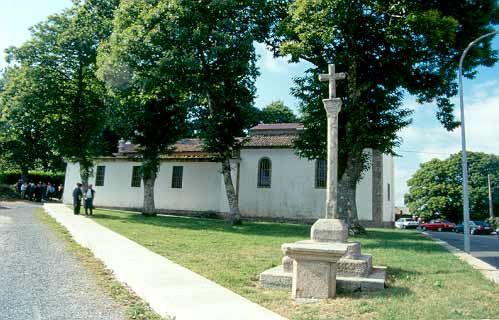 Pueblo Lavanda (Lavandeira in Galician; literally Lavender Town in English) is a small community in the Galicia region of northern Spain. The community, known in the Spanish language as a pedanía, is one of three independent areas that make up the larger town called Teixeiro, together with La Viridiana and Ciudad Carmín. Pueblo Lavanda is the northernmost area of Teixeiro and it borders to the South with La Viridiana, of which it is separated by the railroad tracks.
History and characteristics
Pueblo Lavanda was the largest and most important community in Teixeiro for well over 800 years until its downfall in 1972, following a number of guerrilla-related explotions that left much of it in ruins and despair. Three years afterwards, the people of Pueblo Lavanda emigrated to Ciudad Carmín, a newer community that had begun to grow after the fall and death of dictator Francisco Franco. The sister community of La Viridiana, located south of Pueblo Lavanda also suffered greatly from the civil war, but it managed to survive and retained most of its previous population. Throughout the 1980s, Pueblo Lavanda slowly begun being rebuilt and once again being made suitable for living. As this happened, Ciudad Carmín slowly started losing popularity and people begun moving elsewhere, especially to the other two communities which grew once again because of this. In 1997 Ciudad Carmín hit its lowest point in history, and its population dropped more than half. As of today, Pueblo Lavanda is the second most-important community and it holds the second largest population.
Today, Pueblo Lavanda is characterized by being home to the town's only church, the Catholic Iglesia de Nuestra Señora de los Remedios ("Church of Our Lady of the Remedies"). The town's only cemetery is also part of this community, and because of this, Lavanda has known a reputation for being somewhat funest. In the late '90s however, that same reputation has passed over to the sister community, Ciudad Carmín. Pueblo Lavanda holds the oldest known roots to the birth of what is now the town of Teixeiro, though a great deal of it is now in ruins. The community is the most old-fashioned and does not advance in technology as quickly as the other two do. Still, Pueblo Lavanda has the most cultural appeal of the three, as well as the healthiest vegetation; this is because it has yet not been affected by a poisonous "wick effect" that begun in Ciudad Carmín in the year 1997. The people of Pueblo Lavanda, a great percentage of which are elderly, tend to be rather conservative about their community and object to any abrupt changes; old Galician ways of life are still of common practice in Lavanda. Despite its general conservative ways however, the community of Pueblo Lavanda tends to be open to improvement; La Casa de la Cultura ("The House of Culture") is a newly reformed public building in which societies against violence and [...]-abuse meet constantly. The same building is also used for educational and cultural purposes, it offers different activities for people of all age as well as the town's only public library.
es:Teixeiro#Lavandeira