Portland Historical Buildings and Landmarks
Portland is a city located in the U.S. state of Oregon in the northwest part of the state on the Willamette River. The city was founded in 1845. It was almost called Boston after the Massachusetts city, but was named Portland after Francis Pettygrove won a coin toss and decided to name the town after her hometown. Portland was incorporated as a city in 1851.
Over the years many landmarks and buildings have survived the test of time and are still standing and in use today. While some are more functional than others, many of the city’s original structures still stand to this day housing the same franchises they housed when they were first built.
Buildings
Pioneer Courthouse
Pioneer Courthouse is located in the heart of downtown Portland near the well known Pioneer Courthouse square. In the early 1860s, Judge Matthew Paul Deady requested that the federal district court be moved from Salem to Portland. The construction of Pioneer Courthouse began in 1869. It was formally opened and dedicated in 1875. and has served as home to the U.S courts in Oregon State ever since. Pioneer Courthouse is the second oldest federal courthouse west of the Mississippi River and is the oldest extant building in the Pacific Northwest. It is said to be the most important 19th century government building in the Pacific Northwest that has survived into the 21st century. The Courthouse has welcomed numerous presidents and witnessed many significant trials and court hearings over the past 139 years.
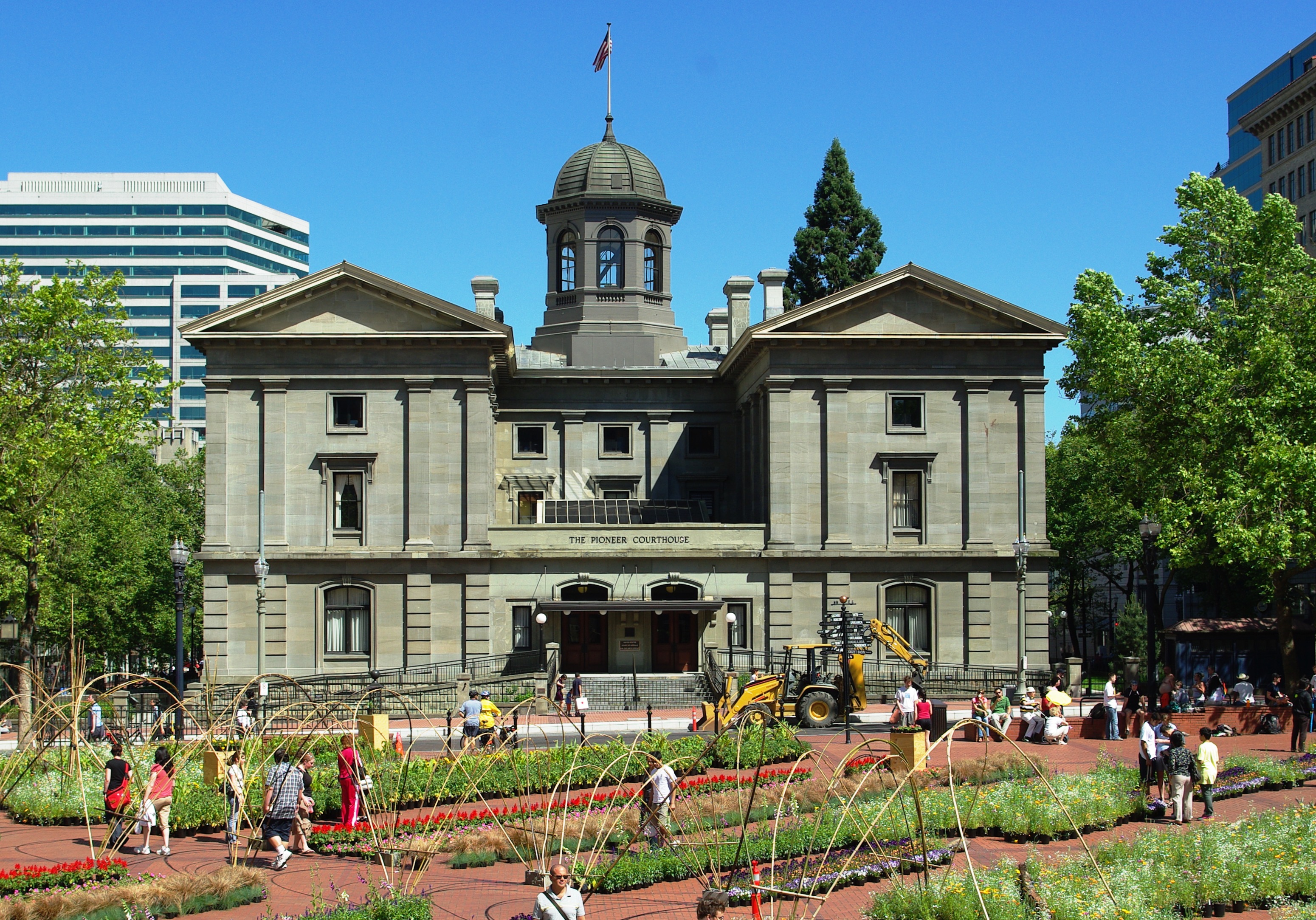
The courthouse currently houses the United States Court of Appeals for the Ninth Circuit. Nowadays, visitors are invited to tour the historic building and its ornate hallways, public areas, second floor courtroom, cupola above the fourth floor, and exhibits throughout the building that tell the building, courts and people who have worked there’s story.
Multnomah County Courthouse
Multnomah County Courthouse was built between 1909 and 1914. It was built by the architect firm, Whidden and Lewis. It was been listed on the National Register of Historic Places since 1979. The courthouse has been described as an outstanding example of neoclassical architecture and has housed the seat of county government since 1864. When the construction of the Courthouse was completed, it stood as Portland’s largest building and the West Coast’s largest courthouse. Due to the evolving demands, most of the courtrooms and offices have been significantly altered, leaving only the original hallways, stairs, and exterior façade in near-original condition. Today, the functionality of the courthouse falls short of requirements and many of the internal systems need repair and replacement. It does not meet modern “seismic standards” and has been classified as a dangerous building that could be life-threatening in the case of a seismic activity. In addition to the structural instability, and despite renovations, the courthouse still does not have a courtroom for each of the county’s 38 judges, even though the county’s caseload is expected to grow exponentially over the next few years.
The McMenamins Kennedy School
The McMenamins Kennedy School, formerly known as Kennedy school, was built in 1915 in Northeast Portland. The school eventually closed in 1975 but was later bought and refurbished by the McMenamins brewery/restaurant empire. McMenamins has an extensive list of historic buildings converted into breweries, theaters, restaurants, and hotels. Although there is some controversy surrounding McMenamins for its habit of converting historic places into social settings, many would say they bring historic places back to life and giving them current community relevance. In proper homage to the landmark, McMenamins Kennedy School has decked out walls with historical photos, murals and relics from the building’s past. Some believe the old school is also haunted by the soul of patron who was believed to have committed [...] in one of the classrooms. All stories of the alleged haunting are vague and hard to confirm.
Pittock Mansion
The Pittock Mansion was owned and built by Henry and Georgianna Pittock. Henry Lewis Pittock journeyed on wagon from Pennsylvania to Oregon in 1853, where he began working for Thomas Jefferson Dyer’s Weekly Oregonian newspaper at the age of 19. In 1860 he married Georgianna who had moved to Oregon six years prior. Both Henry and Georgianna become successful community leaders and business people. Henry Pittock took ownership of the Weekly Oregonian in 1860 and went on to build a vast empire incorporating real estate, banking, railroads, steamboats, ranching, and silver mining. Meanwhile Georgiana dedicated herself to improving the lives of women and children within the community. She founded the Ladies Relief Society in 1867 and worked with the Woman’s Union. Henry and Georgiana began planning and designing their new home with architect Edward Foulkes in 1909. The mansion was completed in 1914. The house was inspired by Turkish, English, and French designs, but still maintains an authentic Portland feel. During its construction, the Pittock’s hired Oregon craftsmen and artisans and used Northwest materials to build the estate. The Pittock family remained the owners of the estate until 1958 when grandson, Peter Gatenbein Pittock, put it on the market. The threat of its destruction at the hands of developers brought concerned Portland citizens together to raise funds for its preservation. Due to the public outcry and the historical importance of the mansion, The City of Portland purchased the estate in 1964 for $225,000. Fifteen months were spent restoring it to its former glory after years of weather damage. The Pittock Mansion has been a Portland landmark ever since.
The Benson Hotel
The Benson Hotel is one of the oldest hotels in Portland. It was opened in February 1913 by Simon Benson, and was originally known as “Hotel Oregon”. The hotel was well constructed when it was built and much of its original furnishings and overall style are still intact. Its founder, Simon Benson, was a well-known landowner in Portland and at one point owned a majority of the land along the Columbia River Gorge, which he later chose to donate to build what is now known as the Columbia River Scenic Highway. Simon Benson did not own the hotel for long as he sold it in 1919 to William Boyd and Robert Keller.
The Benson Hotel is a Portland favorite and hosts many events from weddings to holiday parties. It is highly respected among the community and admired for its traditional style that has remained intact for over 100 years. Coast Hotels and Resorts now owns the hotel. It was last remodeled and transformed in 1959.
Landmarks
Oregon Holocaust Memorial
The Oregon Holocaust Memorial (OHM) is located in Washington Park and was dedicated August 29, 2004 and serves as a permanent reminder of the holocaust. It stands as a living testament to the courage and bravery of those that lived and died during the tragic years of the holocaust. The OHM was designed by artists, landscape architects, typographic designers and historians. It provides visitors with a statement against bigotry, hate and racial prejudice. The Memorial features a stone bench adorned with wrought-iron gating. The bench sits behind a circular cobblestoned area, meant to simulate a town square. The square contains scattered bronzes of various objects, including shoes, glasses, a suitcase and more to represent everyday object that were left behind during Jewish family roundups, in which Jewish families were gathered in town squares before being loaded onto trains and taken to concentration camps. A European style cobblestone walkway with inlaid granite bars, meant to represent railroad tracks, leads to a wall of history panels. These panels offer a brief history of the Holocaust and quotes from survivors. The memorial also houses soil and ash from six [...] concentration camps, which is kept below the granite wall. It also bears the names of surviving families who live in Oregon and Washington.
Witches Mansion
Witches “castle”, is located in Forest Park near Balch Creek. Witches is thought to be haunted. In 1850 Danford Balch laid claim on a large portion of land, large enough to clear and build a house. In order to do so he hired a transient worker named Mortimer Stump. Mortimer stayed with the Balch family, which consisted of Danford, his wife Mary, and his nine children. During the process of clearing the land and building the house, Mortimer formed a strong admiration towards Danford’s 15 year old daughter Anna. Anna and Mortimer had plans to marry but when Mortimer asked Danford for his permission, Danford refused. The couple threatened to elope, to which Danford threatened he would kill Mortimer. Apparently the young lovers did not take the warning to heart and ran away to Vancouver in November 1858 where they married. Not surprisingly this sparked an intense feud between the Mortimer and the Danford family. A few weeks after they wed, the new Mr. and Mrs. Stump returned to Portland for some supplies and encountered Danford. Danford claimed that his wife had “bewitched” him to carry out his threat to kill Mortimer and return their beloved daughter to the family. In a drunken state, Danford pulled a shotgun on Mortimer and shot him in the head. Danford was eventually convicted and hanged for the crime, but his soul and the tormented souls of the Balch family are believed to still be roaming the deteriorated remains of the old stone house, giving it the nickname “the witches’ castle”.
Skidmore Fountain
Portland holds a special place for the Skidmore Fountain. It was named after Stephen G. Skidmore who died in 1883. Stephen G. Skidmore was a prominent businessman in Portland and wanted to create a fountain for the community that could be enjoyed by humans, dogs, and horses alike. Skidmore and his partner, Henry Weinhard, contributed $23,000.00 in total to build the fountain, a portion of which came from Skidmore’s will. Olin Warner was chosen to sculpt the fountain among a large group of talented sculptors. The fountain was dedicated on September 22, 1888. Initially, Skidmore Fountain was placed on First Street in Portland, as it was the center of the city’s flourishing business community. The city began to change in the 1890s as more and more activity shifted to the southwest. Many conversations have resurfaced regarding the movement of the fountain, but on May 1962, the city dedicated it as “The Skidmore Fountain Plaza” in its existing surroundings. The fountain has become a community staple and serves as a gathering place for groups and clubs, including SantaCon, Zombiewalk, and many more. The Skidmore Fountain is conveniently located by the MAX and downtown Portland, which makes it easily accessible, especially during market season.
Burnside Bridge
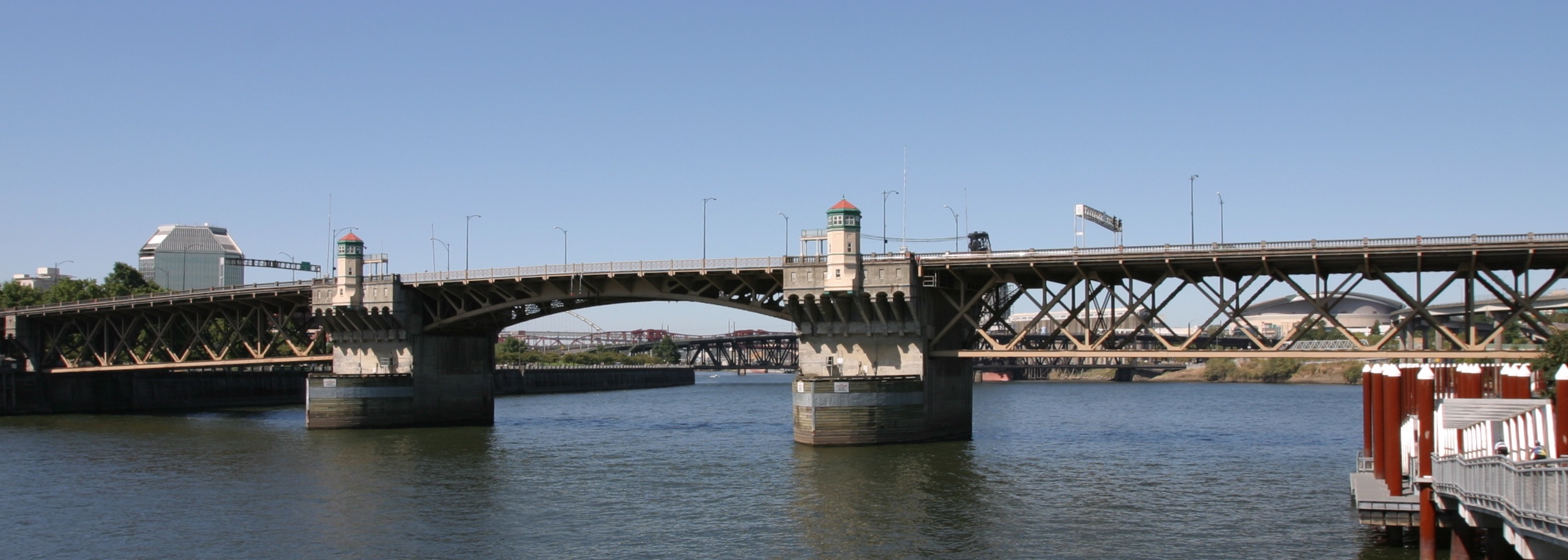
The Burnside Bridge was built in 1926. It is one of the most popular and frequented street bridges in Portland. Approximately 40,000 vehicles utilize the bridge daily. It is also used by not numerous pedestrians and bicyclists on a daily basis. The bridge is well known throughout Portland. It is renowned for being the only bridge built with assistance from an architect. The bridge was designed by Joseph Strauss and built by Gustav Lindenthal. Strauss is also well known for his design for the notorious Golden Gate Bridge in San Francisco eleven years later. Aside from being a well-known avenue of transportation, it is also located on one of the longest streets in Portland. The Burnside Bridge is also home to the Portland Saturday Market. Every Saturday and Sunday from March through December the Saturday Market occurs underneath the west side of the bridge. It is free to enter, and includes many activities, food vendors, and booths selling various types of clothing, jewelry, and other sales items.