
NR-diagram
Various diagram techniques, beginning with Feynman diagram technique, are widely used for description of statistical wave turbulence (STW). NR-diagram (NR for nonlinear resonance) introduced in is a tool to represent discrete wave turbulence (DWT); main differences between these two types of diagrams can be formulated as follows.
1) In a Feynman diagram each vertex represent a particle, which corresponds to a single wave in the topological representation of a cluster, while in NR-diagram vertexes are primary clusters, for instance, resonant triads or quartets or etc-, depending on the order of resonance in the wave system under consideration.
2) Only a sum of all Feynman diagrams represents possible interactions of a given particle with other particles. On the contrary, one NR-diagram represents completely a resonance cluster.
3) A Feynman diagram does not allow computing the amplitudes of the scattering process, it only gives a contribution corresponding to one term in the perturbation expansion. On the contrary, NR-diagram allows to reconstruct uniquely dynamical system whose solutions are the amplitudes of resonance cluster.
3-wave resonances
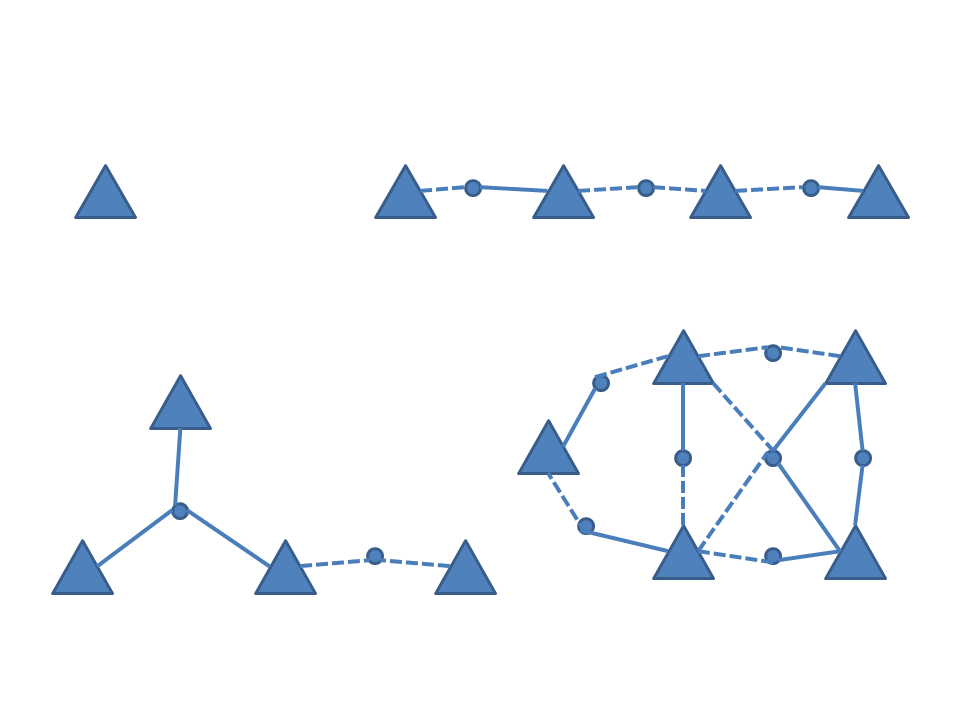 Each 3-wave resonance generates some new wave frequency and correspondingly new wave length, i.e. each triad takes part in energy transport over scales. This type of resonance is called scale-resonance.
Correspondingly, NR-diagram in the system possessing 3-wave resonances has one type of vertexes shown as a triangle.
Cluster dynamics (that is, the form of solution of the corresponding dynamical system) is defined by the fact whether or not connecting mode has high frequency in one or both or no neighbour triads. NR-diagram has two types of half-edges: bold line for high-frequency connecting mode and dashed line otherwise.
4-wave resonances
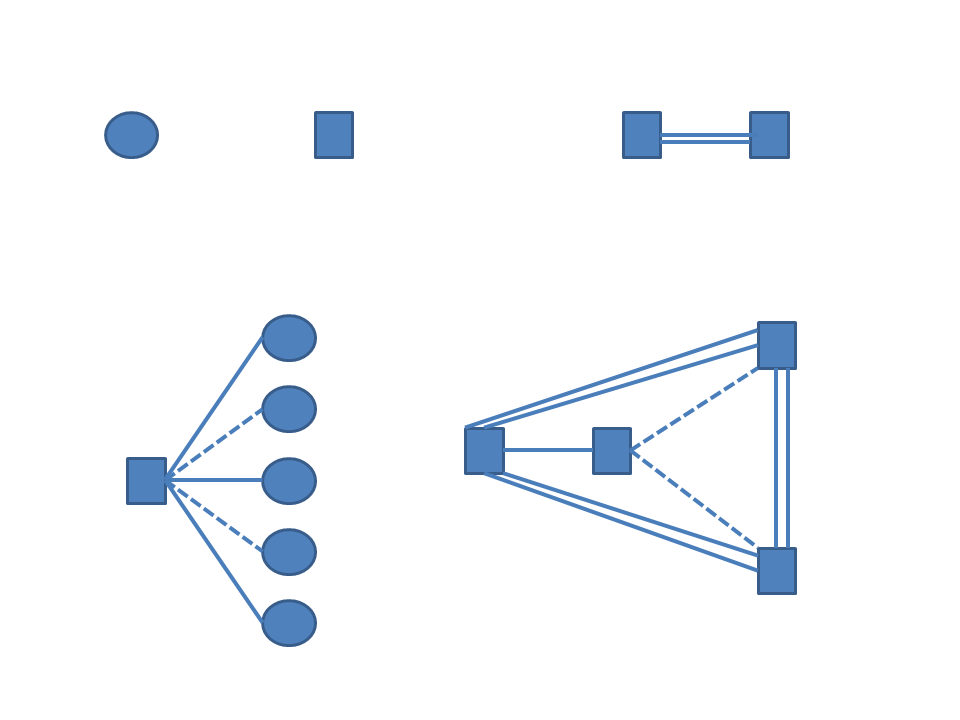 In the system possesses 4-wave resonances, two general types of resonance qurtets exist: scale-resonances and angle-resonances . Angle-resonances do transfer energy over angles but can not generate new wave lengths.
Correspondingly, NR-diagram in this case has two types of vertexes shown as circles (for angle-resonances) and squares (for scale-resonances).
On the contrary to NR-diagram for 3-wave system, in this case connection types within a cluster of quartets do not define cluster dynamics GeneRally but only in some particular cases . To keep this information, NR-diagram has two types of edges, shown by bold and dashed lines.