
Norbornene-mediated meta-C-H activation
The discovery of norbornene-mediated meta-C-H activation was first published by Jin-Quan Yu And Co-workers at The Scripps Research Institute in March 2015. Almost simultaneously, Guangbin Dong and co-workers reported a similar meta-C−H arylation reaction in April. Following an analogous Catellani reaction pathway, norbornene was used as a transient mediator to enable meta-C-H activation. With modified norbornenes and different ligands, more transformations were being reported in the past few years. 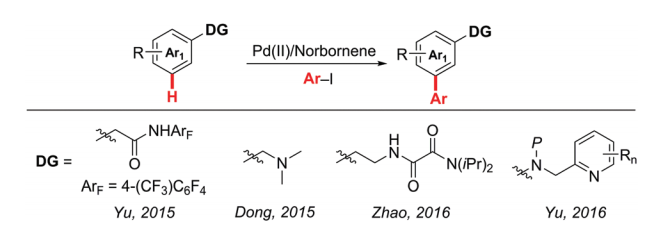
Reaction mechanism
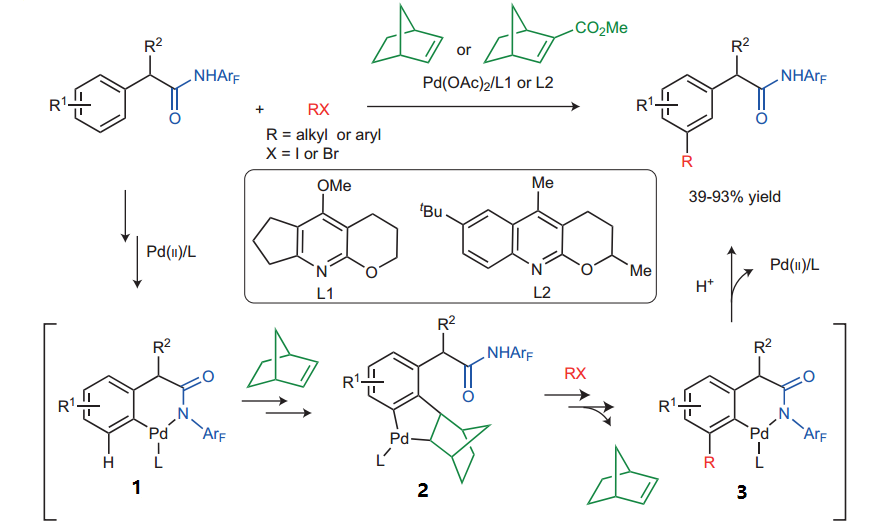
The key to this special reactivity is a catalytic system formed by a palladium species and a rigid and strained olefin, such as norbornene.
The amide-directed norbornene-mediated meta-C-H activation reaction may proceed via an initial amide-directed ortho C−H activation to generate palladacycle 1, which undergoes carbopalladation of norbornene and meta-C−H activation to afford palladacycle 2. Following an analogous Catellani reaction pathway — that is, oxidative addition, reductive elimination and retro-carbopalladation of norbornene — palladacycle 3 with a functionalized meta position is formed. Final protonation then delivers the desired products.
Development
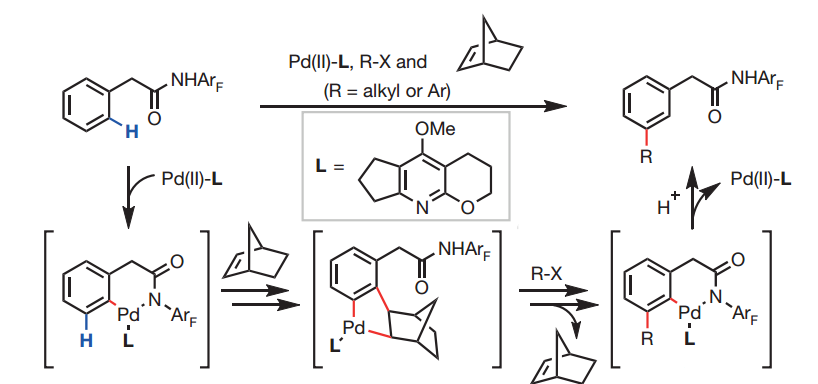
In March 2015, inspired by the success of achieving unique site selectivities through Catellani-type transformations, a norbornene-mediated palladium-catalyzed meta-C–H alkylation and arylation with an ortho-directing amide group was reported by Yu and co-workers. The use of a newly developed pyridine-based ligand is crucial for relaying the palladium catalyst to the meta position by norbornene after initial ortho-C–H activation, whereas side reactions such as ortho-C−H functionalization and reductive elimination of palladacycle to form benzocyclobutene was minimized.
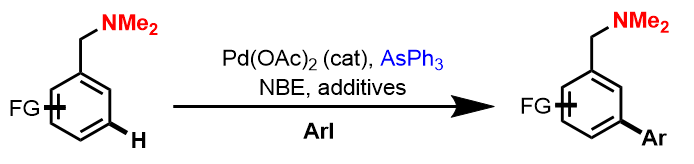
Almost simultaneously, Dong reported a similar meta-C−H arylation reaction using dimethylamine as the directing group and commercially available AsPh3 as the ligand. In addition to benzylamine derivatives, protected pyrrole- and pyridine-derived substrates can also be employed. However, aryl iodides are limited to those containing an ortho electron-withdrawing group.
After the first discovery, a number of variations and new transformations were reported.
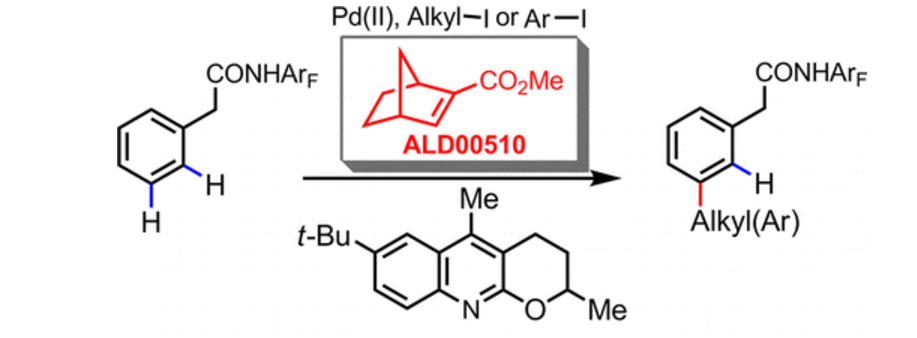
In August 2015, Yu and co-workers identified 2-Carbomethoxynorbornene as a more effective transient mediator to promote a Pd(II)-catalyzed meta-C(sp2)−H alkylation and arylation. The design of a more reactive norbornene is the key to better reactivity, and the use of a tailor-made quinoline ligand is also crucial for this reaction to proceed. Using the modified norbornene, meta-arylation with a broad range of aryl iodides proceeded smoothly, overcoming previous limitation that aryl iodide coupling partners without ortho-coordinating groups are usually not compatible. Notably, the 2-Carbomethoxynorbornene became commercially available shortly after this report.
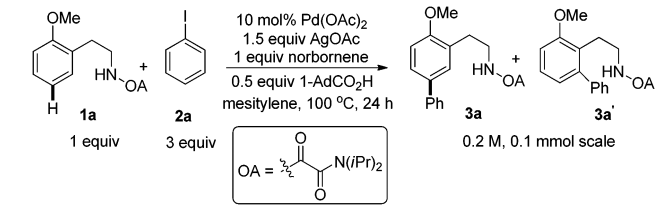
In April 2016, Zhao and co-workers discovered the first bidentate directing group assisted meta arylation of β-arylethylamine derivatives via palladium/norbornene catalysis. Oxalyl amide was used as a bidentate directing group. This meta arylation also proceeds well with thiophene derivatives, giving the corresponding products in satisfactory yields.
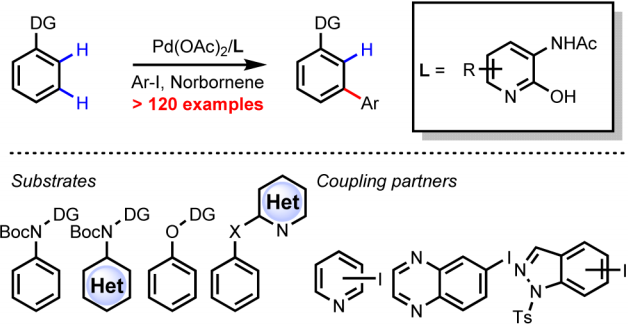
In July 2016, Yu and co-workers reported the development of a new class of ligands which enabled the meta-C−H arylation of anilines, heterocyclic aromatic amines, phenols, and 2-benzyl heterocycles using norbornene as a transient mediator. Meta-C−H arylation with heterocyclic aryl iodides as coupling partners is also realized for the first time. the identification of highly versatile 3-acetylamino-2-hydroxypyridine ligands is the key to this catalysis.
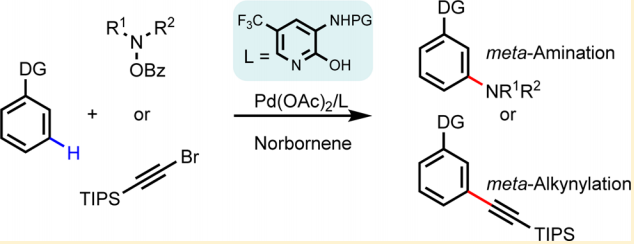
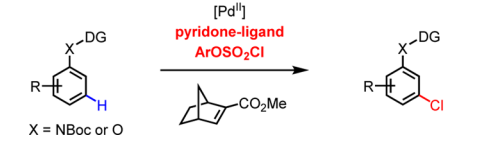
In October 2016, meta-C−H amination, alkynylation, as well as chlorination of aniline and phenol substrates were reported by Yu and co-workers. Both the identification of a monoprotected 3-amino-2-hydroxypyridine-type ligand and the use of a modified norbornene as a mediator are crucial for the realization of these three unprecedented meta-C−H transformations. Subsequent diverse transformations of the chlorinated products also demonstrate the versatility of meta-C−H chlorination.
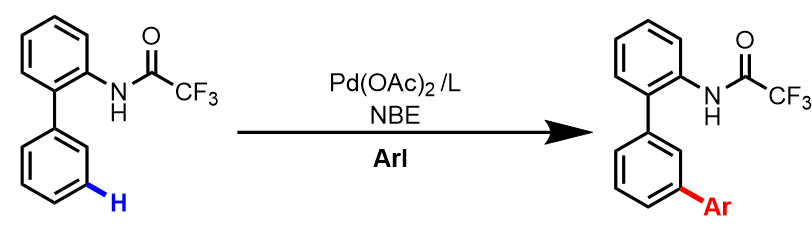
In January 2017. The interannular meta-selective C–H arylation of biaryl-2- trifluoroacetamides using Pd(II)/norbornene catalysis is reported by Shi and co-workers. The judicious choice of an appropriate protecting group (PG), trifluoroacetyl, is crucial for the interannular selectivity.
Meta-selective C−H arylation of nosyl-protected phenethylamines, benzylamines, and 2‑aryl anilines were reported by Yu and co-workers in December 2016. Arylation, amination, and chlorination of benzylamines were also realized in March 2017.