
New York–New Jersey Metropolitan Rapid Transit Commission
The New York–New Jersey Metropolitan Rapid Transit Commission (MRTC) was a bi-state body created to embody the era's faith in comprehensive planning and recommend solutions for the New York–New Jersey metropolitan area's postwar commuting crisis. Between 1955 and 1958, it directed the Metropolitan Rapid Transit Survey, held public hearings, and issued a visionary but ultimately unfulfilled plan for an integrated transit network. Although the commission's specific proposals were not enacted, its political demise—driven by organized political opposition and a push for a broader tri-state solution which led to the creation of a short-lived successor agency—created a vacuum that was ultimately filled by a landmark 1962 deal, which saw the Port Authority of New York and New Jersey take over the bankrupt Hudson and Manhattan Railroad in exchange for approval to build the World Trade Center.
Background
The commission's formation was the result of a joint report issued on March 3, 1954, by two predecessor state-level bodies: the New York Metropolitan Rapid Transit Commission and the New Jersey Metropolitan Rapid Transit Commission, both created in 1952. The New York body was chaired by former U.S. Attorney Charles H. Tuttle, who was appointed by Governor Thomas E. Dewey to study the "present and prospective rapid-transit needs of the New York-New Jersey metropolitan area." The joint report, based on public hearings and statistical analysis, concluded that transit and traffic in the metropolitan area had "exceeded the point of full saturation" and that "self-strangulation is becoming increasingly acute." The report documented a steep decline in rail commuting, particularly from New Jersey, where it had fallen 51% between 1930 and 1952, while trans-Hudson auto and bus traffic had increased fourfold. The predecessor commissions argued that piecemeal efforts were insufficient and formally recommended that the two states create a single, consolidated bi-state commission to "make thorough and comprehensive study and report on ways and means" for solving the crisis.
Following this recommendation, New York and New Jersey formed the joint commission on June 14, 1954, through concurrent legislation (Chapter 801, Laws of 1954, of New York, and Chapter 44, Laws of 1954, of New Jersey) with authority to study present and future rapid transit needs and to recommend measures to both legislatures. The commission established an executive office, retained technical consultants, and coordinated with the Port of New York Authority on interstate elements of the survey program.
The commission's charge reflected conditions that had emerged after 1945. Suburban population growth and highway expansion increased auto use while private railroads faced peak-period costs and declining fare revenue. In a 1956 report, the commission described the situation as a "vicious cycle" where rising traffic congestion led to costly, large-scale highway projects that failed to incorporate mass transit, further eroding the viability of commuter rail. The financial collapse of the Hudson and Manhattan Railroad—a private company undone by publicly subsidized competition from the Port Authority's own Holland Tunnel, George Washington Bridge, and Lincoln Tunnel—created an emergency that demanded immediate action. The commission framed the inquiry around long-term regional economic needs, rather than piecemeal line improvements.
Predecessor studies and plans
The commission's work built on more than three decades of prior efforts to address the region's transit problems. These studies established a consensus that a solution required new cross-Hudson rail capacity, but left unresolved key questions of design and financing.
Year(s) |
Entity / Plan |
Key Developments |
|---|---|---|
1922–1930 |
North Jersey Transit Commission |
Created by the NJ Legislature. Conducted a traffic census (1924) and proposed a rail loop connecting North Jersey and Manhattan (1927). Warned that highways alone were insufficient before being disbanded. |
1928–1930 |
Suburban Transit Engineering Board |
A joint body of the Port Authority and North Jersey Transit Commission. Spent over $220,000 on studies and produced another loop plan before disbanding. |
1930s |
Various Proposals |
Regional Plan Association argued against auto dominance (1935). Engineer L. Alfred Jenny and the Bergen County Rapid Transit Association advanced competing plans, including rail over the George Washington Bridge. |
1937 |
Port Authority Plan |
The Port Authority offered a new rapid transit plan, arguing that a good system would add millions in regional property values. |
1948 |
Governor Driscoll's Proposal |
Suggested a new terminal in the Hackensack Meadows for New Jersey rail commuters to transfer to a dedicated transit line into Manhattan. |
1952 |
NJ Regional Planning Commission |
Chaired by David Van Alstyne, it reviewed 17 distinct plans and formally recommended the creation of a bi-state metropolitan transit authority, leading directly to the MRTC. |
Membership and organization
The commission consisted of ten members, five appointed by each governor. The body was initially led by co-chairs Charles H. Tuttle of New York and David Van Alstyne, Jr. of New Jersey, who had chaired the predecessor state commissions. In September 1955, the commission was reorganized with a co-chairman from each state: New York attorney Charles H. Tuttle and former New Jersey Senator Edward J. O'Mara were elected to the posts.
From its inception, the commission was structurally weak. State support was more rhetorical than substantive, with initial appropriations that were insufficient for a comprehensive survey. Lacking a powerful political constituency, the MRTC was vulnerable to outside influence, particularly from the Port of New York Authority, which viewed the commission's comprehensive planning mandate as a potential threat to its self-financing, revenue-driven model. In a strategic move, the Port Authority offered the financially strapped MRTC significant funding to conduct its surveys, but with conditions: the Port Authority gained joint policy control over the studies and ensured the research agenda was steered away from a direct confrontation over using its toll revenues to subsidize mass transit.
Survey program
The Metropolitan Rapid Transit Survey was overseen by study coordinator Arthur W. Page, a former vice president of AT&T and onetime director of the President's Committee on Transport Policy. The survey combined engineering, operations, travel demand, finance, and institutional studies. The program was divided into two main parts: an interstate phase, focusing on traffic between New Jersey and New York, was financed by the Port of New York Authority; an intrastate phase, studying transit needs within sectors of New York (Staten Island, Long Island, Westchester) and New Jersey, was funded by appropriations from the two states.
Major consultants retained in 1955 for the interstate studies included:
- Regional Plan Association, Inc.—for economic and demographic studies to project future demand.
- De Leuw, Cather & Company—for origin-destination surveys, analysis of travel habits, and preliminary engineering and financial feasibility studies of potential transit systems.
- Coverdale & Colpitts—for studies on improving existing rail passenger services.
- Ford, Bacon & Davis—for studies on improving bus transportation and integrating it with rail routes.
- William Miller—of Princeton, N.J. to lead a group studying financial and administrative structures for a regional transit system, including necessary legislation.
Finance and institutional design
Finance and law studies concluded that the Port of New York Authority did not have practical capacity to assume non-self-supporting rail operations. This conclusion reflected the "Port Authority Doctrine" championed by its executive director, Austin J. Tobin. The agency's power was built on its consolidated bonding system, which pooled revenues from all its facilities to secure its debt. Tobin's primary obligation was to protect this financial structure and the agency's credit rating. He viewed commuter rail as a "bottomless pit" of perpetual deficits that would violate the Port Authority's compact with its investors and threaten its entire self-supporting model. Tobin famously viewed involvement in deficit-prone rail transit as an "iron maiden" to be avoided. The Commission's finance work, influenced by the Port Authority, therefore favored a distinct entity with defined subsidy authority and local representation for decisions on rates, service, and capital program scope.
1958 recommendations
The commission's final report to governors Averell Harriman and Robert B. Meyner set out investment, operating, and governance proposals as a single package.
Bi-state loop concept
The plan's core was a $400-million, two-track rail loop between New Jersey and Manhattan with new cross-Hudson tubes and a mid-Manhattan distributor linked to existing IND and BMT lines. The loop would connect with New Jersey commuter lines through new junctions and intercept stations in the meadows, permit later elimination of transfers, and modernize the existing H&M tubes for integrated service. The concept prioritized through movement into Manhattan business districts rather than terminal transfers at the river's edge.
Metropolitan Transit District
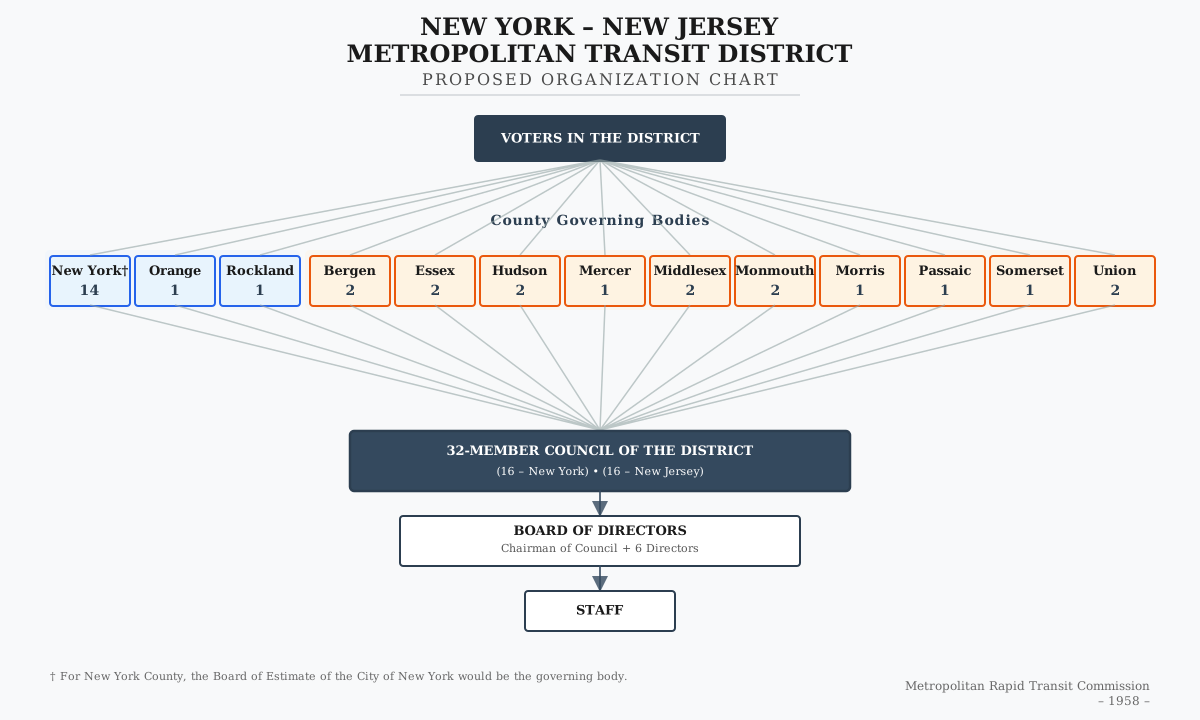 The commission recommended a new Metropolitan Transit District with powers to plan, construct, and operate rapid transit in an initial thirteen-county service area. The proposed "Metropolitan Transit District of New York and New Jersey" would have been a public corporation governed by a 32-member council with representatives appointed by the governing bodies of the member counties. This structure was intended to ensure local accountability for any tax burdens associated with the new system. The compact also included provisions for Connecticut to join and for additional counties from any of the member states to be added later through concurrent legislation.
Legislative failure
Compact legislation to establish the district advanced in 1958. New York approved the measure, which became Chapter 965 of the Laws of 1958, and it was signed by Governor Harriman in April. In New Jersey, the bill passed the Senate but was "buried in an Assembly committee" due to widespread local opposition in northern New Jersey.
A primary source of opposition was the Metropolitan Regional Council, a voluntary group of elected officials from 21 counties in New York, New Jersey, and Connecticut, chaired by New York Mayor Robert F. Wagner. The council argued that the bi-state approach was too narrow, contending that the plan was "contrary to considerations of planning that are fundamental to the sound development of the metropolitan region." Instead, it advocated for a broader tri-state authority that would address transit and traffic as a single, integrated problem. The political landscape was further complicated by the election of Nelson Rockefeller as Governor of New York, as regional officials expected him to support a wider tri-state approach, dimming prospects for the existing bi-state legislation. In January 1959, the governors of all three states agreed to a conference to discuss the commuter crisis.
In New Jersey, public hearings revealed two main objections to the original bill: the manner of choosing the district's members and the "failure to ban any further property taxes" to cover potential deficits. A substitute bill was drawn up late in 1958, creating a smaller ten-member agency appointed by the governors and expressly barring any tax on real or personal property to underwrite deficits. However, the rewritten bill failed to secure enough votes in the Assembly and was "pigeon-holed," ending any chance of bi-state action under the MRTC framework.
Successor agencies and the tri-state approach
In the wake of the MRTC's legislative failure, the two states created a new, less ambitious body in 1959: the New York-New Jersey Transportation Agency. This stop-gap agency, composed of only two members, was tasked with studying the problem and developing interim and long-range plans, but it lacked the power to construct or operate transit lines. The interstate compact that created it formally terminated the existence of the MRTC.
The Transportation Agency was itself temporary, with a planned expiration date of June 30, 1961. As this date approached without a permanent solution, the planning effort was broadened to include Connecticut. In August 1961, the governors of the three states formed the Tri-State Transportation Committee. This body evolved into the Tri-State Transportation Commission in 1965, and was renamed the Tri-State Regional Planning Commission in 1971. After the withdrawal of its member states, the commission was replaced in June 1982 by the New York Metropolitan Transportation Council (NYMTC) and its counterpart agencies in New Jersey and Connecticut.
The Grand Bargain and its Legacy
While the new Transportation Agency and its successors continued their studies, the underlying commuter crisis deepened, setting the stage for a pragmatic, project-based compromise. By the late 1950s, the region faced two seemingly unrelated crises: the imminent collapse of the H&M Railroad, a vital New Jersey concern, and a political stalemate over the Port Authority's proposal to build a World Trade Center to revitalize Lower Manhattan. The project, championed by David Rockefeller and the Downtown-Lower Manhattan Association, was initially planned for a site on the East River but was vetoed by New Jersey, which saw little benefit for its own state.
This impasse created the opportunity for a "grand bargain." In a major policy reversal, Port Authority director Austin Tobin announced his agency would be willing to take over the H&M. The deal, cemented in late 1961, was transformative: in exchange for New Jersey's approval of the World Trade Center, the Port Authority agreed to acquire the H&M and relocate the WTC project to the west side of Lower Manhattan, building it directly on the site of the H&M's aging Hudson Terminal. This move gave New Jersey a direct commuter rail connection into the new complex and provided the Port Authority with a clear public purpose for its entry into the real estate market.
Actor / Entity |
Primary Objective |
Key Compromise / Concession Made |
Ultimate "Win" from the Deal |
|---|---|---|---|
Port Authority |
Preserve financial autonomy; build a landmark project (WTC) to expand institutional prestige. |
Abandoned its doctrine against taking over the money-losing H&M railroad. |
Authorization to build the World Trade Center; secured the 1962 Covenant to block future rail deficits. |
New York State |
Secure the WTC to revitalize Lower Manhattan's economy and tax base. |
Agreed to relocate the WTC from the East River to the West Side, a less preferred site. |
The World Trade Center project was approved and built. |
New Jersey State |
Solve the H&M commuter crisis; ensure tangible benefits for New Jersey from any bi-state deal. |
Dropped its veto of the World Trade Center project. |
The bankrupt H&M was saved, modernized as PATH, and connected to the new WTC. |
Financial Interests |
Reverse the economic decline of Lower Manhattan with a catalytic project. |
Accepted the West Side location to ensure the WTC project moved forward. |
The World Trade Center anchored the revitalization of Lower Manhattan as envisioned. |
In 1962, the legislatures of both states approved the deal. The Port Authority created the Port Authority Trans-Hudson (PATH) as a subsidiary to acquire and modernize the H&M.
The 1962 Covenant
The most enduring element of the 1962 legislation was a statutory covenant with the Port Authority's bondholders, a non-negotiable condition from Tobin for agreeing to the deal. This legally binding promise strictly limited the Port Authority's ability to use its general revenues to subsidize any additional money-losing passenger rail projects beyond the newly acquired PATH system. The covenant served as a firewall, reassuring investors that the PATH takeover was a one-time exception and that the profitable revenues from the agency's bridges and tunnels would not be used to prop up other failing railroads.
These "golden handcuffs" were the key to unlocking the financing for both the WTC and the salvation of the H&M. However, the covenant also locked the region into a fragmented transportation future by legally preventing the region's most powerful infrastructure agency from engaging in the kind of cross-subsidization that integrated transit systems require. The covenant's power was affirmed by the U.S. Supreme Court in United States Trust Co. of New York v. New Jersey (1977), which ruled that a legislative repeal of the covenant was an unconstitutional impairment of contract.
The long shadow of this decision has shaped regional policy for decades. The structural barrier created by the covenant thwarted subsequent proposals for expanded trans-Hudson rail capacity, including the Access to the Region's Core (ARC) project in the 2000s. The current effort to build new tunnels through the Gateway Program is, in effect, a direct attempt to solve the same fundamental capacity problem that the MRTC identified over half a century ago.
See also
- Gateway Program (Northeast Corridor)
- Access to the Region's Core
- Metropolitan Transportation Authority
- New Jersey Transit