
Mohamed Mufti
Mohamed Bey Mufti (surname also written El-Mufti & Elmufti), is a Libyan surgeon, historian and political activist, born in Derna, Libya on 11 September 1943.
Early life
In 1949, when Mohamed Mufti was 6 years old, his family moved to Benghazi where his father opened a men’s clothes shop in Omar Mukhtar Street, in the center of the town. In that city of contrasts, Mohamed Mufti received his education. In 1960 he came first in the secondary school examination for the whole of Libya, and was thus awarded a scholarship to study in the UK. Many of his early experiences are recorded in his social history books; Chats in Benghazi, The Old Man’s Shop or Chats in the Market, and The Derna Dialogs. Mohamed’s close relationship with his father was another source of early and rich experiences. His father had received modern education in the Italian colonial schools in 1930’s. Subsequently, like many of his urban generation, the elder Mufti supported the Omar Mukhtar Association (named after the heroic leader of resistance (1923–1931) against the Italian Occupation. The Association was also Arab Nationalist in spirit and opposed to Emir Idris Sanousi’s aspirations.
The shop gave the young Mufti a platform to observe the political disputes raging at the time. The commercial street also housed the Official Municipality, a printing press owned by an estranged leader of opposition, and the offices of Zaman Newspaper that supported the Emir Idris Sanousi. In the adjacent square there was a famous café, where intellectuals used to meet, and was the haunt of the charismatic poet and voice of national opposition, Ahmad Rafiq Mahdawy. As a lad, Mohamed was exceptionally lucky to accompany his father on business trips to Tripoli and Italy itself, widening the boy’s perception of own country and the world.
The UK experience
In England Mohamed Mufti was eventually admitted to the Leeds University Medical School where he graduated in 1968. Life in Yorkshire was another rich experience, while the Leeds University student Union was throbbing with activity which attracted the young Libyan student, from theatre to political demonstration against South African Apartheid.
In addition, Mohamed Mufti participated in the UK Libyan and Arab Student Union activities. He was secretary then leader of the Libyan Student Union, and for one year, member of the Arab Student Union Council and editor of its magazine.
His early UK stay culminated with his marriage to Nita Nicholson, a graduate in Fine Arts at Leeds.
Work at Baida, Libya
In the summer of 1969, Dr Mufti, along with his wife (now with an Arabic name Amna) and newborn son Hishaam, returned to Benghazi. At the time the regime of King Idris was toppled in a coup by young army officers, led by Lt Muamar Gaddaafi. Dr Mufti was promptly appointed to work in the Green Mountain Region, where he was to work for two years as the only Libyan doctor in the area. In Baida, his daughter Sehaam was born.
The stay in Baida which Dr Mufti enjoyed, was in another sense ill-starred as he was to meet there and clash with the new leader of the military regime, an ambitious paranoid and ruthless man who, over the years morphed into a narcissistic tyrant. In contrast Dr Mufti was at the time, politically naïve deeply influenced by social-democratic principles.
Work at Leeds, UK (1971–1973)
In mid 1971, Dr Mufti returned to the Leeds General Infirmary, where he joined, as a research fellow, the Cardiac Surgery Unit led by the pioneering Marion Ionescu. His contribution included co-authoring two papers published in 1974.
Prisoner of Conscience
In April 1973, Dr Mufti was asked by the Libyan Minister of Health to participate in a committee for setting up a cardiac surgery department in Tripoli. He was arrested soon after arrival, in a campaign which Gaddaafi launched against intellectuals suspected of disloyalty. Details of Dr Mufti’s prison experiences (1973–1984) and those of many other political inmates, are described in his book; Behind a Wall of Years. According to the author, Gaddaafi, motivated by his morbid fears and suspicions, would first move against his potential victims and get them arrested. Then his ‘apparatus’ would work out the fake accusations. Dr Mufti was arrested along with scores of intellectuals, tried twice, given a sentence of four years (which he had completed), but Gaddaafi raised the sentence to life imprisonment. He was released in January 1984, thanks to the efforts of his wife and friends in the UK as well as Amnesty International. He was to spend another 5 years banned from travelling abroad, before regaining his passport in 1989.
The Surgeon
Soon after discharge from political detention, Dr Mufti resumed his clinical work, as a surgeon at Hawari Teaching Hospital (1985–1997). At Hawari Dr Mufti did much clinical research initially on post-operative infection, assessing newer antibiotics. During that period he developed and reported (1993) a simplified procedure for sclerotherapy of the gallbladder under local anaesthesia, mainly for cases with problems that would contra-indicate general anaesthesia. His other main field of interest was the management of Hydatid cysts (echinococcosis), common in Libyan countryside, updating knowledge of the disease in a book that was published in UK (1989).
The Muntazah Clinic
Towards the end of 1990’s Gaddaafi reversed his failed socialist policies, permitting private work. Dr Mufti, who was being harassed by members of the heinous Revolutionary Committees, opted to retire from the Health Service, and devote his efforts to the Muntazah private clinic. For nearly two decades, the surgical facility has been offering care to patients suffering from anal conditions, a narrow specialty but common and often very painful ailments. Apart from routine OPD & Surgical care, Dr Mufti has developed newer procedures including total excision of anal fistula, a chronic and a stubborn lesion.
The Politician
In September 2012, Dr Mufti was one of the eight nominations for Prime Minister of Libya.. Each nomination needed at least fifteen supporters among the 200 members of the General National Council. After two rounds of voting in the National Assembly, Deputy Prime minister Mustafa A.G. Abushagur was elected Prime Minister.
Family
Dr Mufti’s middle name is Bey, after his great-grand father, a ruler and reformer of Derna, Libya in the 17th century, who is of the Caramanli descent whose members ruled Tripoli and much of Libya for nearly two centuries. The ancestor constructed (or renewed?) an aqueduct that brought water from a waterfall some 12 km south of the town, to irrigate the town’s garden farms. For such achievements his status, in public memory, has been that of a saint. The Mufti surname is derived from the title of Dr Mufti’s immediate grandfather who was appointed as the religious juror of Derna by the Ottman Sultan in 1905.
Dr Mufti’s mother is Fathia Abdulkarim Ben Ali. His Paternal grandmother is Ghazala Usta Umar. His maternal grandmother is Fatma Hamad Ben Halim. He has 4 brothers: Abdul-Jawad, Fawzi, Salah and Mahmoud, and 5 sisters: Sarah, Mabroukah, Intisar, Eman and Ibtisam. In 1968 Dr Mufti married Nita Nicholson, a painter and poet. They had two children: Hishaam Caramanli, born in Leeds (1968), and Sehaam Castelberg, born in Baida, Libya (1970). After his divorce from Nita, Dr Mufti married Najat Rashid Kikhia in 1985, a professor of statistics at Benghazi University. They have three children: Fathia, Fatma and Ahmed.
Published work
Medical Books
Apart from his book on the Surgical Management of Hydatid Disease (1989), Dr Mufti, published the following books in English:
- Basic Clinical (Bedside) Procedures
- The Diagnosis of Swellings
- Obstructive Jaundice
- Basic Surgical Procedures
In addition, Dr Mufti published in Arabic three books on the historical Medical topics, namely Eye and touches on medieval Arabo-Islamic medical renaissance, Modern Medicine, from practice to experimental Science and Silent Storms; On the History of Epidemics. 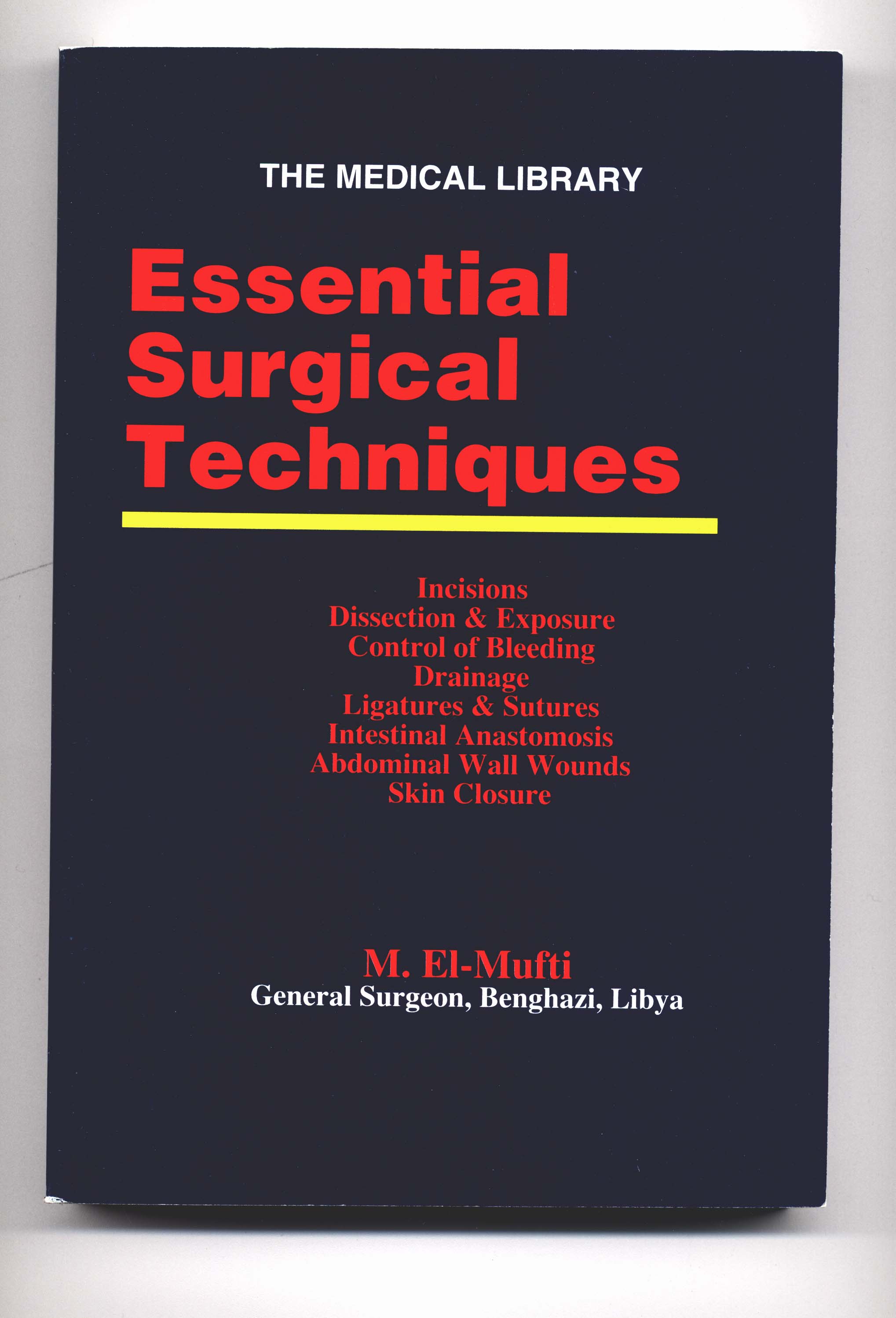
Arab Culture and the Challenge of Science
During his detention as a political prisoner, Dr Mufti, with the help of his ex-wife (then working as a lecturer of English at Benghazi University) and other friends, had access to the endowed University library. His readings centered on the history of science and anthropology. After release he wrote his seminal book Assimilation of Science..First (2003) in which he postulates that the dilemma of Arab culture emanates from its inability to assimilate modern science and to reinterpret Islamic percepts. Dr Mufti followed with two more books; Obstacles to Assimilation of science and The structure of Arab Culture and the Crisis of Modernization(2005). Democratic values, tolerance, dedication and objectivity are not instinctual but are by-products of the modern Scientific and Industrial Revolution. In those early books, Dr Mufti predicted the implosion of Arab regimes as indeed was the case following the so-called “Arab Spring”. Finally in this genre, Dr Mufti translated On Aggression (2007) by the Nobel Laureate Konrad Lorenz.
Social History of Libya
In the stale, even rancid culture that accompanies tyranny, active minds keep themselves busy or distracted. Under Gaddaafi, Libya kangarooed from one turmoil to another, from ridiculous antics and unnecessary hardships to the gruesome hangings in public squares, university campuses and basketball courts. In his relatively insular and estranged life, Dr Mufti took to writing on Libyan social history which had been undocumented and only passed orally from generation to the next. Here he relied on traditions, recording memories of the elderly as well as his own impressions, especially as a young doctor in the Bedouin environment of the Green Mountain. His books are in collage-format to build mosaic tableaux, and as such enjoyed wide readership. The series includes Chats in Benghazi, Evening exchanges in Derna, Tripolitanian Days, Marj; a village beyond horizon and Mountain Illusions. These apparently innocent books are full of symbolism which was noticed by the dictatorship censors who at times imposed bans. Some were printed at the author’s expense abroad to be smuggled into the country.
Libyan Political History
In an attempt to justify his historical works, Dr Mufti once said: “The curious tend to seek challenging tasks and follow unexplored terrain”. Indeed, many facets of Libyan political history had been officially out of bounds for over half a century. Dr Mufti’s researches and contemplations of Libya’s political history led him to write A Country that inhabits us (2007) which traced the tributaries of Libyan national identity over the last two centuries or so. Other books include; Omar Mukhtar Association; Democratic Ambitions in a traditional Society, Sadaawy & the Congress; Glorification and Oblivion, and The Monarchy Time. In his book Memory of Fire (2012), Dr Mufti records a diary of events during the 2011 uprising that toppled the Gaddaafi regime.
Criticism
During the first four years of freedom, Dr Mufti was attracted to the small group of Benghazi poets, painters and theatre groups. His fondness with documentation led him to put together in book form (2004), his conversations with his close friend, the courageous and prominent poet Mohamed Shultamy who had suffered much persecution himself. The title was originally They Can’t dim Sunlight, it’s inside Me, but was reduced to a banal phrase by the censors. The following two books were The Zalla Dates (i.e. palm tree fruit) (2005) and Dawameece after the dug-in caves of Jebel Nafousah (2009). Both are collections of essays introducing avant-guard writers etc. A fourth book Colour Nostalgia (2006) dealt with the works of the Benghazi painter Awad Ubaidah.
List of Medical Publications
- Basic Clinical Procedures, National Institute of Science, Libya, 1986.
- Diagnosis of Swellings, Al-Fateh University, Tripoli, Libya, 1988.
- Surgical Management of Hydatid Disease, Butterworths, London, 1989.
- Obstructive Jaundice, JPH, Malta-Libya, 1994.
- Essential Surgical Techniques, Int. Pub. House, Cairo, 1999.
- Chapter on Hydatid Disease, in Tropical Surgery, ed. Lumley & Kamel, Westminster publications, London, 2004.