
Mining in Idaho
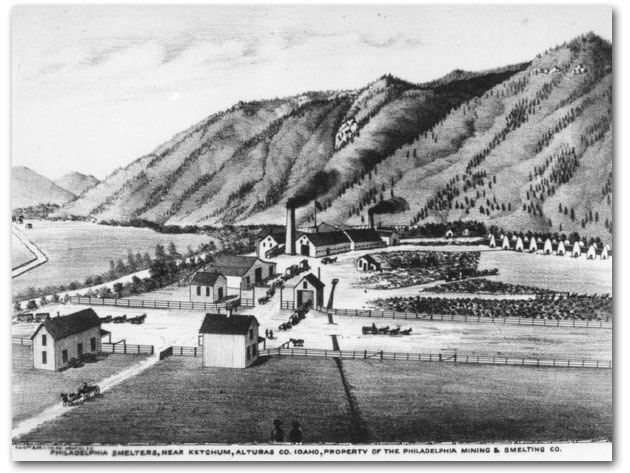 Most of Idaho's mining production, 1860-1969, has come from metals equating to $2.88 billion out of $3.42 billion, according to the best estimates. Of the metallic mining areas of Idaho, the COEUR d'Alene region has produced the most by far, and accounts for AbOUT 80% of the total Idaho yield.
Mining regions
Several others-Boise Basin, Wood River Valley, Stibnite, Blackbird, and Owyhee-range considerably above the other big producers. Atlanta, Bear Valley, Bay Horse, Florence, Gilmore, Mackay, Patterson, and Yankee Fork all ran on the order of ten to twenty million dollars, and Elk City, Leesburg, Pierce, Rocky Bar, and Warren's make up the rest of the major Idaho mining areas that stand out in the sixty or so regions of production worthy of mention. A number of small operations do not appear in this list of Idaho metallic mining areas: a small amount of gold was recovered from Goose Creek on Salmon Meadows; a mine near Cleveland was prospected in 1922 and produced a little manganese in 1926; a few tons of copper came from Fort Hall, and a few more tons of copper came from a mine near Montpelier. Similarly, a few tons of lead came from a property near Bear Lake, and lead-silver is known on Cassia Creek near Elba. Some gold quartz and lead-silver workings are on Ruby Creek west of Elk River, and there is a slightly developed copper operation on Deer Creek near Winchester. Molybdenum is known on Roaring River and on the east fork of the Salmon. Some scattered mining enterprises have been undertaken around Soldier Mountain and on Squaw Creek north of Montour.
Assay Office
The old United States Assay Office in Boise, is a gray stone structure stands on its own green block between Second and Third Streets on Main, surrounded by noble trees and by a granite fence almost as old as the building.
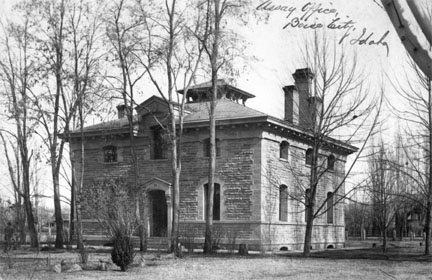
The building stands as a monument to the national importance of precious-metal mining in early Idaho. It was authorized by the Federal Government in 1869 after a long campaign in the United States Congress. Seventy-five thousand dollars was appropriated for its construction, and Alexander Rossi, a prominent citizen of early Boise, donated the block of ground. The building was opened for business in 1872, assaying and evaluating the gold production of mines everywhere in the region. A few years later, the direct purchase of gold on behalf of the United States Government was added to the services of the offices.
Through the years, the total value of business done by the office reflected the rise and fall of western mining regions. Some transactions ran into thousands of dollars while at the same time the assayers would test prospectors’ individual samples for 50¢ a piece. During the boom at the turn of the century, the business of the office exceeded a million dollars annually for eleven consecutive years-and a million dollars was a great deal more then than it is now.
From the earliest days, Boise had been a pleasant oasis of green in a desert land, and the dignified grounds and lawns of the Assay Office have contributed largely to that reputation.
Four stages in Idaho's mining development
These stages usually form a temporal sequence (although two or three of them often overlap greatly) in the sense that one often led to the next. The fourth generally is quite recent, although the first and the last, or the last three, or two or three may be carried on in the same operation.
Placer mining, primarily of gold.
Gold discoveries in any district usually commenced with placers; and in a number of areas, not much else of consequence ever was found.
Quartz mining of gold and silver.
Quartz discoveries in any district usually commenced with placers; and in a number of areas, not much else of consequence ever was found.
Base metal mining.
Early attempts at quartz mining bridged the gap between the beginnings of mining operation (placers) and the really large-scale lead-silver-zinc operations which constitute the major mining activity in Idaho. The latter had to await railroads and advances in management and technology, many of which were pioneered in early attempts to exploit quartz properties.
Mining of metals that lacked a market.
These metals only recently attracted a market: antimony, tungsten, cobalt, columbium, tantalum, and any number of other newly-exploited metals. Some of these developed out of earlier stage operations, others are new.
External links