
McCormick Road (UVA)
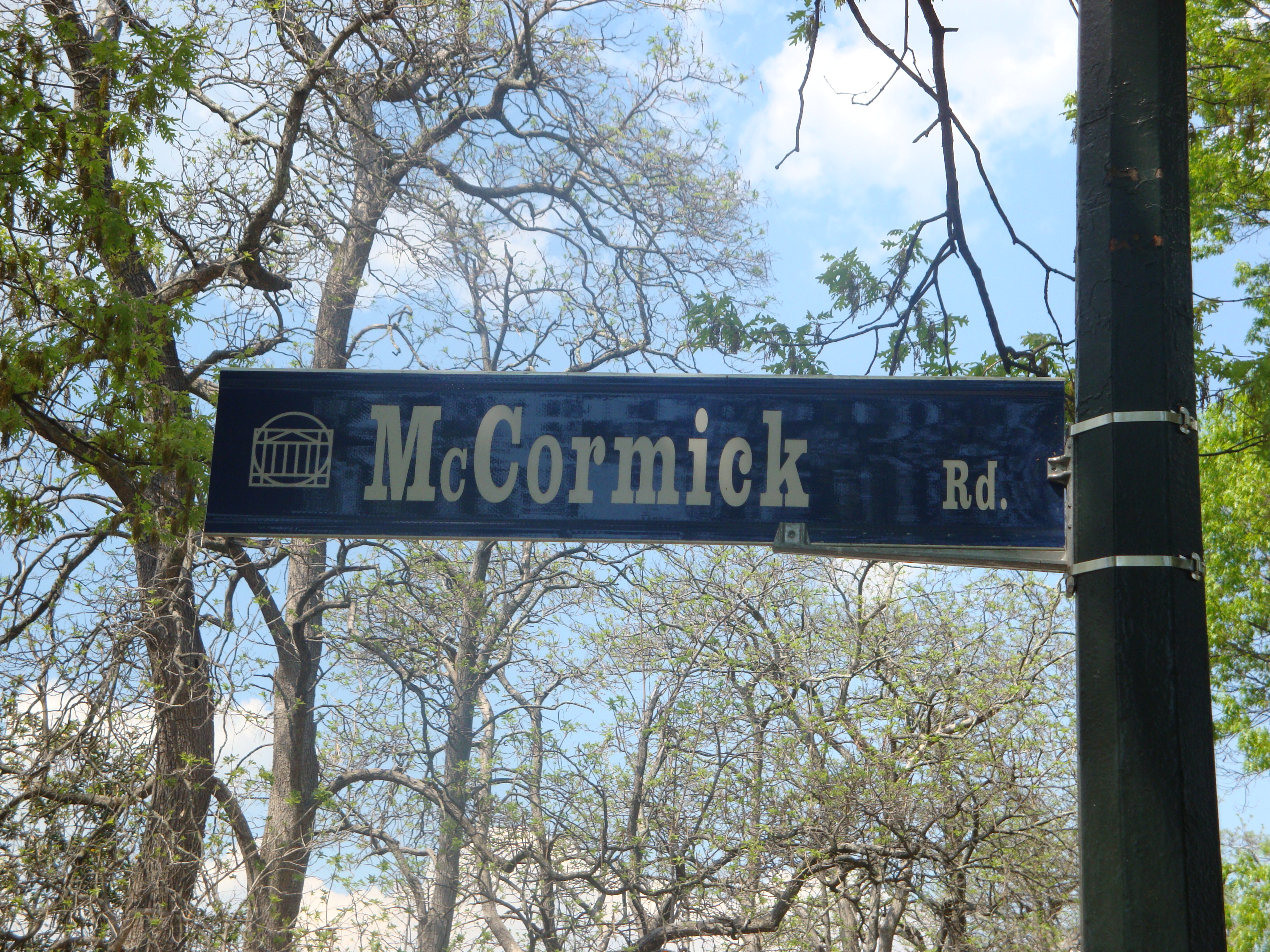
McCormick Road is a street in Charlottesville, VA that serves as the main road for the University of Virginia’s ‘Central Grounds.’ Beginning at the intersection of McCormick and Alderman Road and ending at the intersection of McCormick Road and University Avenue, McCormick Road is an integral part of the University of Virginia’s academia and is home to many academic institutions within the College of Arts and Sciences and the School of Engineering and Applied Science. Among these academic buildings include Gilmer Hall, the Chemistry Building, Wilsdorf Hall, the Physics Building, Thornton Hall, Clark Hall, Minor Hall, Monroe Hall, and Peabody Hall.
In addition, McCormick Road provides residence areas for underclassmen at the McCormick Road Residence Area and for upperclassmen at the Brown College at Monroe Hill. Three of the University’s libraries, Alderman Library, Clemons Library, and Clark Library are located along McCormick Road. McCormick Road houses the McCormick Observatory and is minutes away from the Rotunda.
McCormick Observatory
The McCormick Observatory is one of many astronomical observatories utilized by the University of Virginia Astronomy Department. The McCormick Observatory was constructed in 1885 and named after its main benefactor Leander J. McCormick. In 1878, McCormick donated a 26-inch astrometric refractor to the University and additionally donated $18,000 four years later in efforts to create one of the largest telescopes in the world. Although the observatory was originally the main site of department education and research, the University’s Astronomy education and research is now conducted in the Fan Mountain Observatory, just south of Charlottesville, VA. Today, the McCormick Observatory is used for educational and public purposes emphasizing the use of telescopes and techniques of observation.
McCormick Road Residence Area
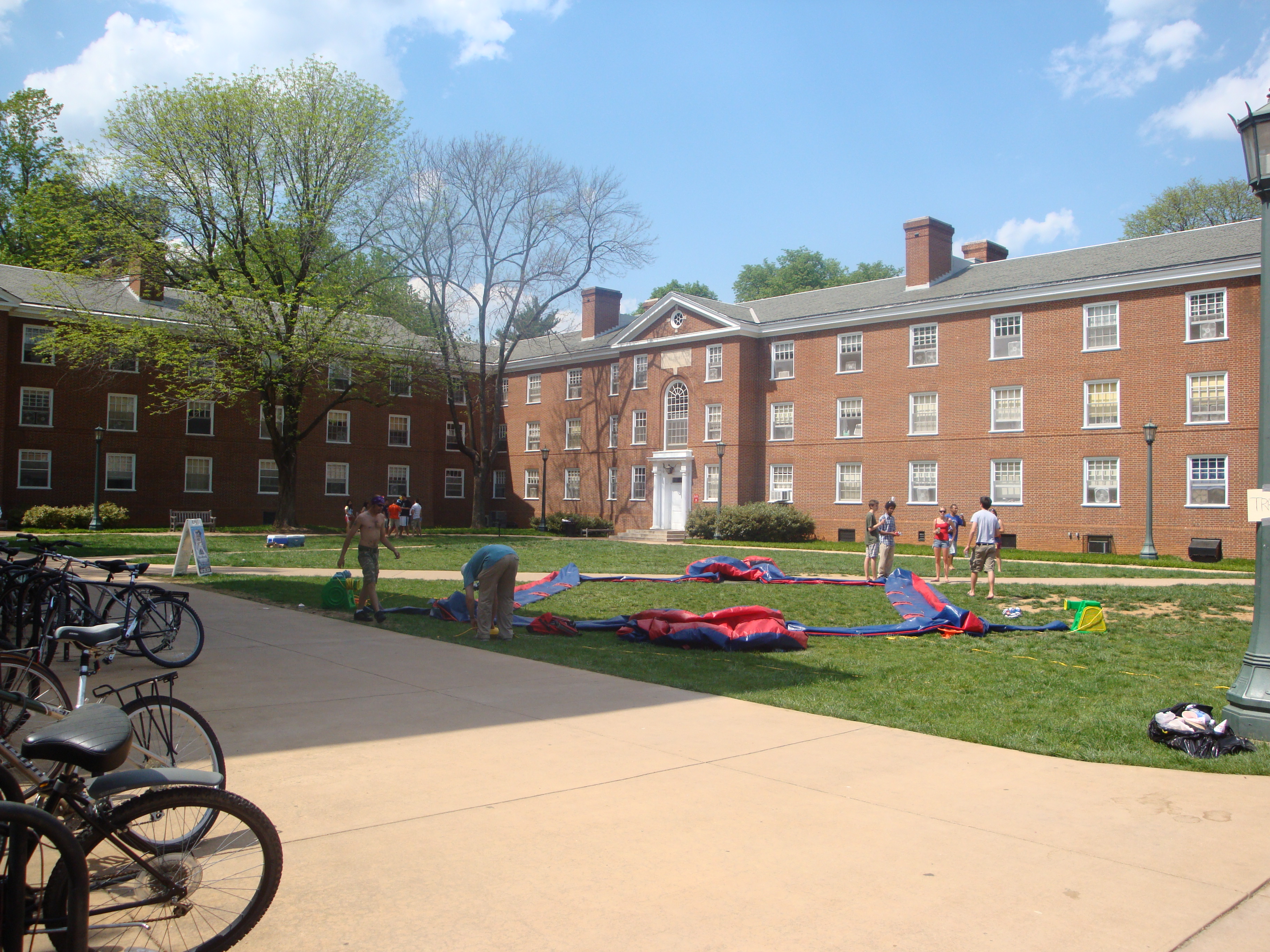 The McCormick Road Residence Area, also known as “Old Dorms,” houses approximately 1300 First-Year University of Virginia students. Prior to the creation of the McCormick Road Residence Area, a University golf course occupied the area until the mid-1940’s when more underclassmen dormitories were needed. Built in the 1950's, the McCormick Road Residence Area was formed from President Darden’s separation of the College into Lower and Upper Divisions to promote greater academic excellence. McCormick Road Residence Area represented President Colgate Darden’s Lower Division and served as a residence area for underclassmen, particularly incoming first-year students. “Old Dorms” consists of 10 dormitories named after renowned professors Bonneycastle, Dabney, Echols, Emmet, Hancock, Humphreys, Kent, Lefevre, Metcalf, and Page. The “Old Dorms” were designed by architectural firm Eggers and Higgins. They reflect a Georgian Revival style seen in the construction of the New Cabell Hall and Newcomb Hall buildings. The Dabney dormitory serves as the Office of Residence Life while the Page and Emmet dormitories serve as the Housing Division Office. Each dormitory consists of three to four floors with approximately 24 rooms, 48 students per floor. Each floor is single [...] with men on the ground and first floors and women on the upper-level floors.
In addition to providing residence to many first-year students, the McCormick Road Residence Area provides an area in which many students can socialize and interact with others. Located in the middle of the residence area between the Emmet and Humphreys dormitories, the “Quad” is a grassy area in which students can participate in recreational activities, read, and socialize with others.
Gilmer Hall
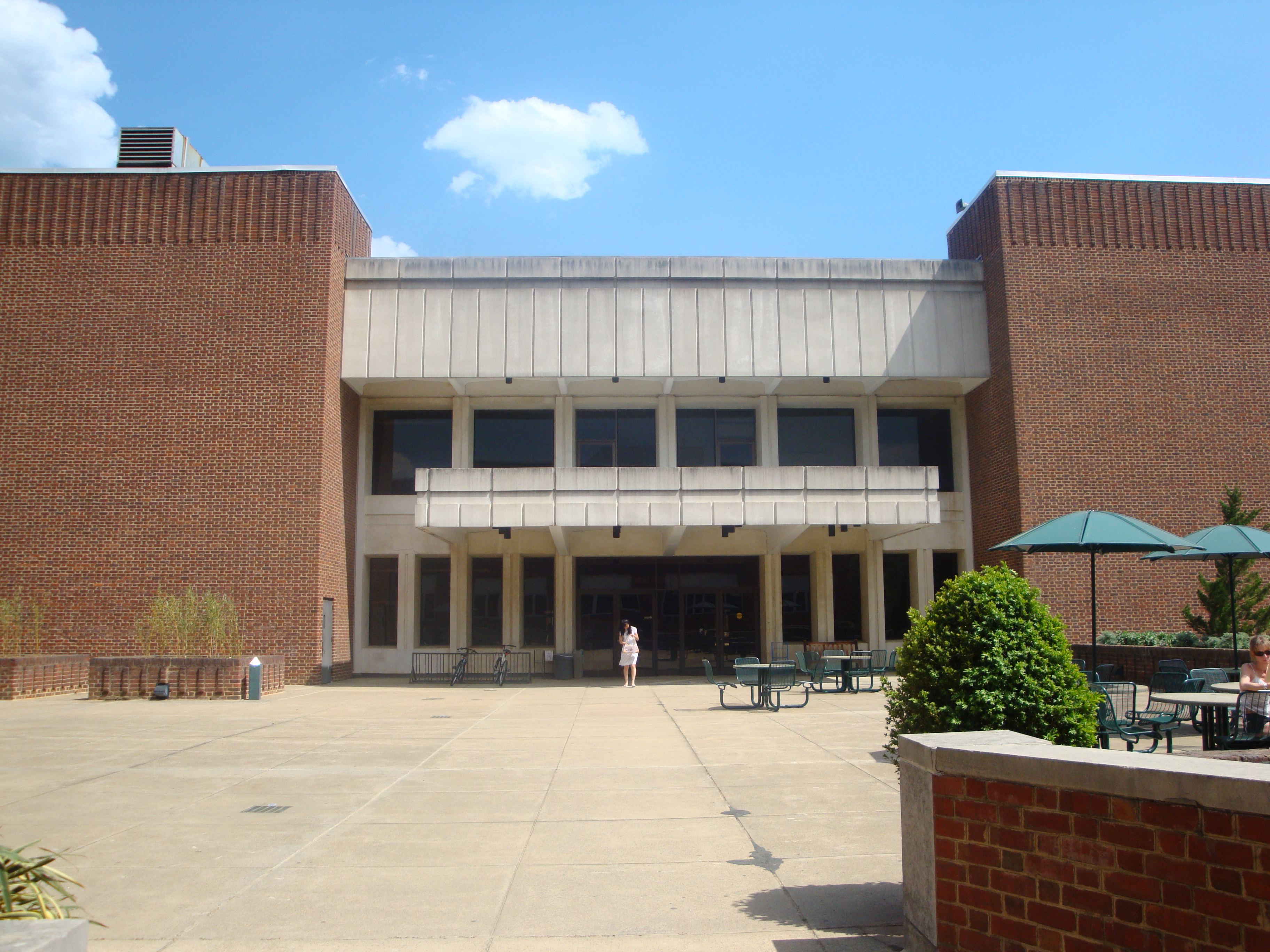
 Gilmer Hall is home to the Biology and Psychology Departments and research facilities. The building was designed in 1961 and completed in 1987 by Richmond architects Ballou and Justice, W. E. Stainback, and Louie L. Scribner. Its main feature is its pierced concrete block screen based on the works of Edward Durrell Stone and Minoru Yamasaki from the 1950’s. The building is named in honor of Francis Walker Gilmer who helped Thomas Jefferson recruit the University's original faculty.
In addition, Gilmer Hall houses the University’s Biology/Psychology Library containing approximately 29,000 books and more than 450 journal and serials subscriptions supporting undergraduate and graduate academic programs, as well as advanced research in Biology and Psychology.
Several classrooms within the building have been designed for biology laboratory and psychology studies. The basement and 0 levels of Gilmer Hall are generally used Psychology studies and research areas while the main and upper levels hold Biology laboratories and research areas.
Chemistry Building
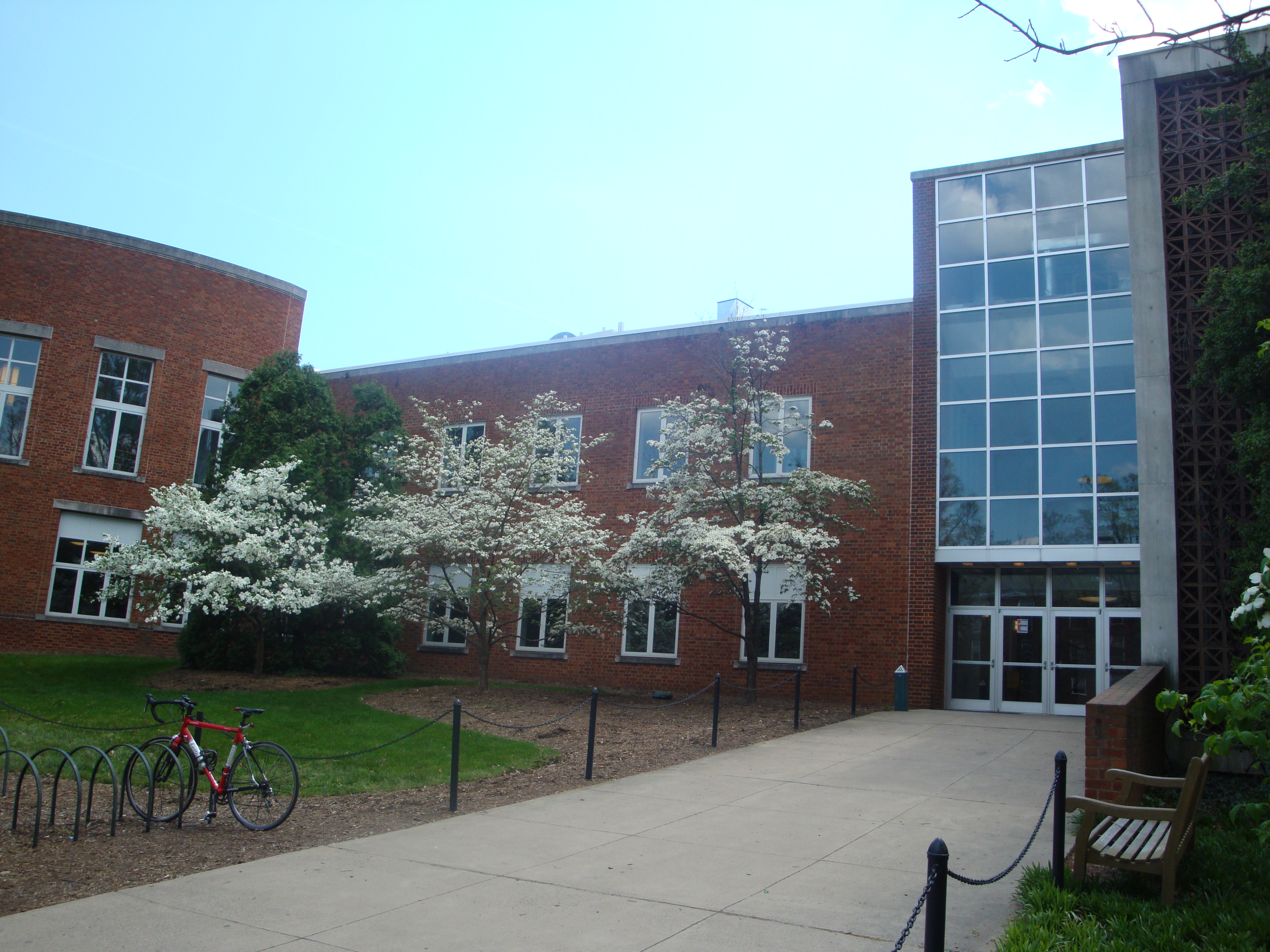
The Chemistry Building was designed by architects Anderson, Beckwith and Haible with W. E. Stainback and Louie L. Scribner and opened in 1968. Home to the Department of Chemistry, the Chemistry Building houses the department’s undergraduate and graduate programs, laboratories, and offices as well as roughly 25 faculty members, 60 postdoctorals and 130 graduate students. The five-story main building contains research laboratories, stockrooms, shops, library, and faculty offices and a 30,000 sq. ft. research facility. Newly renovated laboratories designed for synthesis boast over 150 new fume hoods, 20 glove-box work stations for anaerobic synthesis, 11 walk-in cold-rooms, and comprehensive "in-house" utilities including nitrogen, argon, vacuum, steam and DI water, and Ethernet connections throughout the labs.
The Chemistry Building currently houses a variety of advanced instrumentation including fifteen mass spectrometers, five nuclear magnetic resonance spectrometers for routine use as well as four used primarily for obtaining structural and dynamic information about large biological molecules, two EPR spectrometers, a Bruker ESP 300 and a Varian E-line spectrometer. Polymer characterization facilities in the building include Waters and Hewlett Packard gel permeation chromatographic stations, TA Instruments thermal gravimetric analysis (TGA) and modulated differential scanning calorimetry (MDSC) as well as number of dedicated surface analysis machines.
 The Molecular Structure Laboratory consists of two facilities: the X-ray diffraction facility and the molecular modeling laboratory. The X-ray laboratory is equipped with a Bruker SMART APEX CCD diffractometer and an Oxford Cryosystems 700 low temperature device. The Cambridge Crystallographic Database is available in the laboratory for extensive structural searches as well as the latest versions of Insight/Discover, Macromodel, Spartan and Gaussian98.
The Ultrafast Laser Laboratory is a shared University facility housed on the second floor of the Chemistry Building which conducts a wide range of multidisciplinary research involving lasers and researchers drawn from across the University. The laboratory houses three high power amplified Ti:sapphire laser systems, a versatile collection of high power Nd:YAG lasers, excimer lasers, dye lasers, and a high resolution infrared optical parametric oscillator/amplifier. The Ultrafast Laser Laboratory is part of the University's Center for Atomic, Molecular, and Optical Sciences (CAMOS) and a focal point of its NSF Integrative Graduate Education and Research Training Program in the Science and Engineering of Laser Interactions with Matter (SELIM). Though usually only found in Electrical Engineering Departments, the Chemistry Department has its own dedicated Bioanalytical Microchip Fabrication Facility used to design and fabricate analytical microchip devices with the goal of revolutionizing conventional analytical techniques. The facility consists of a 150 sq. ft. "class-100" clean-room linked to a 200 sq. ft. "class-10,000" clean-room which is fully equipped with basic photolithography equipment, wet-etching stations, a spin-coater, microscopes, glass drilling facilities, and glass bonding ovens.
The University operates a glass shop in the Chemistry Building for the fabrication of research glassware which makes routine Pyrex ware for the laboratory, in addition to specialized research items.
Wilsdorf Hall
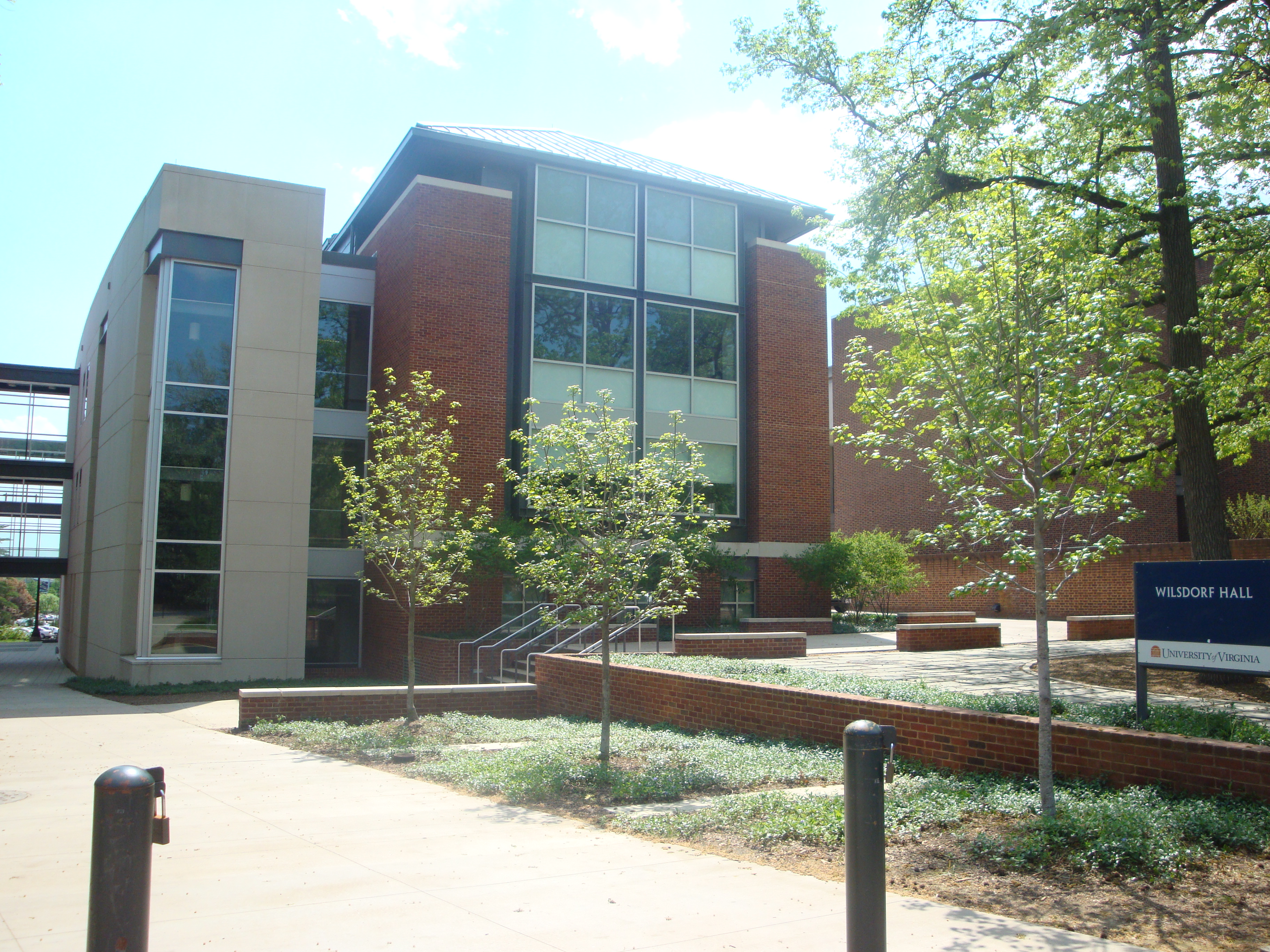 Wilsdorf Hall houses research buildings in Materials Science, Chemical Engineering and Nanotechnology. Finished in Summer 2006, Wilsdorf Hall opened to students in the following Fall semester at the University. Wilsdorf Hall is a 99,000-square-foot, five-story configuration that is physically linked to the Engineering School’s Chemical Engineering and Materials Science buildings, and the Chemistry Library. Wilsdorf Hall also includes research laboratories, facility offices, conference rooms, computational facilities, and work-study areas in its arrangement. Essentially, the creation of the building fosters interdisciplinary collaborations throughout the entire University.
Wilsdorf Hall is named in honor of the first chair of the Department of Materials Science, the late Heinz Wilsdorf, and his wife, Doris Kuhlmann-Wlsdorf, the University Professor of Applied Science. The lead donor of approximately $15 million for Wilsdorf Hall was Gregory H. Olsen, a 1971 graduate of the Department of Materials Science and current president and CEO of Sensors Unlimited Incorporated. His contributions was the largest ever received by the Engineering School at the University of Virginia. Olsen decided to donate in honor of the Wilsdorfs, who where his professors during his college years. Additional funding was provided in honor of John W. Matthews, Physicist and father of a popular singer, a State Bond Issue, University resources, and other complimentary donors.
Chemical Engineering Building
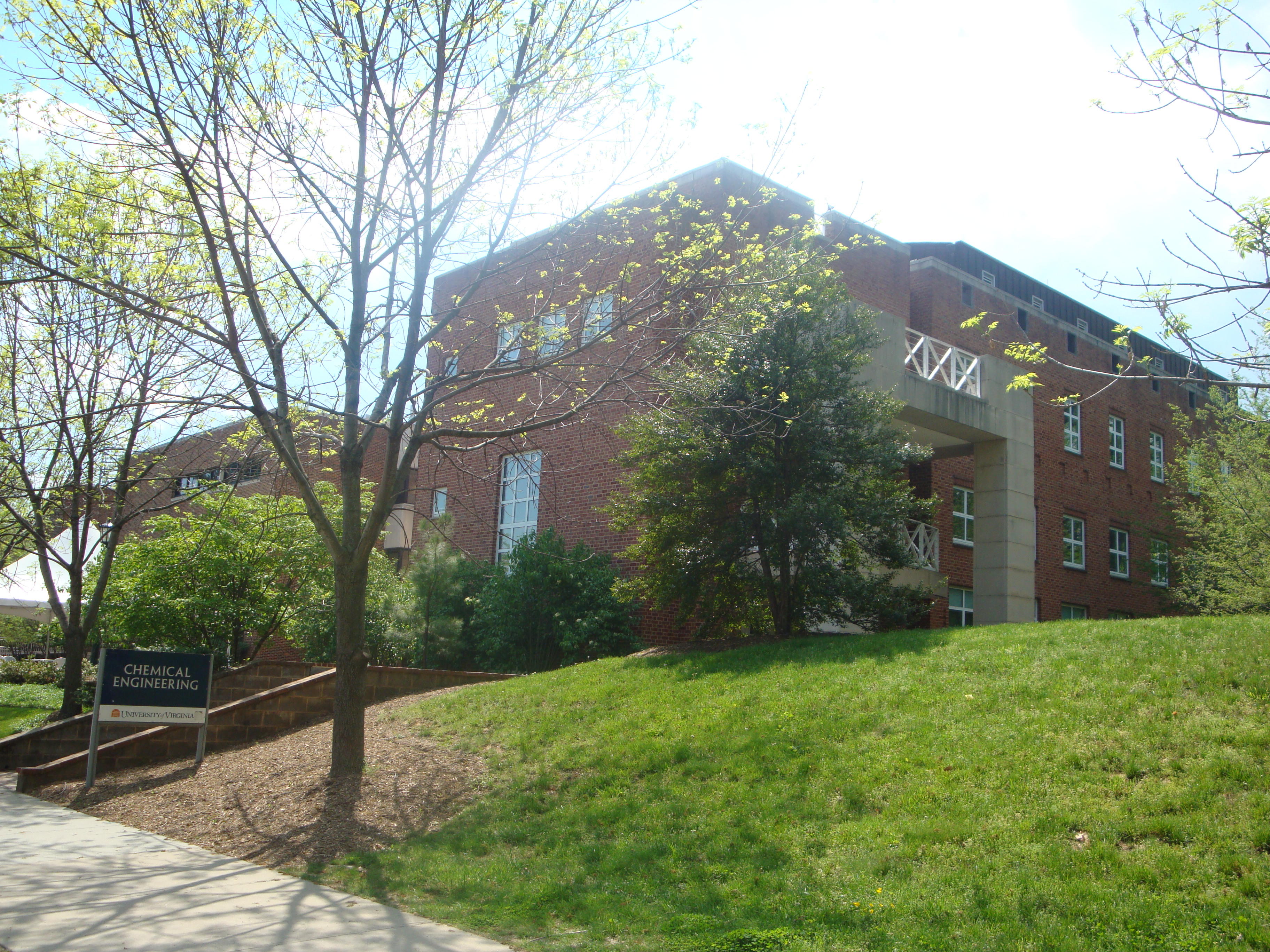 The Chemical Engineering Building houses the Chemical Engineering Department of the School of Engineering and Applied Science that offers programs in Bioengineering and Biotechnology, Complex Biological and Chemical Systems, Computer and Molecular Simulation, Electrochemical Engineering, Environmental Engineering, Heterogeneous Catalysis and Reaction Engineering Materials, Materials Processing and Interfacial Phenomena, Separations Technology, and Thermodynamic Properties and Phase Equilibria. The Chemical Engineering Building was designed in 1992 by architects Pasanella and Klein Stolzman and is located across from the Physics Building and next to Wilsdorf Hall.
The Chemical Engineering Building houses research laboratories for its undergraduate and graduate Chemical Engineer students to promote higher education and facilitation of ideas. Additional research laboratories for the Chemical Engineering Department are located in Thornton Hall.
Physics Building/Jesse Beam Laboratories
The Physics Building is home to the Physics Department which offers experimental and theoretical research programs in Atomic Physics, Condensed Matter Physics, Nuclear and Particle Physics, and High Energy Physics, as well as experimental programs in Gravitational Physics and Biological Physics. The building was completed in 1954.
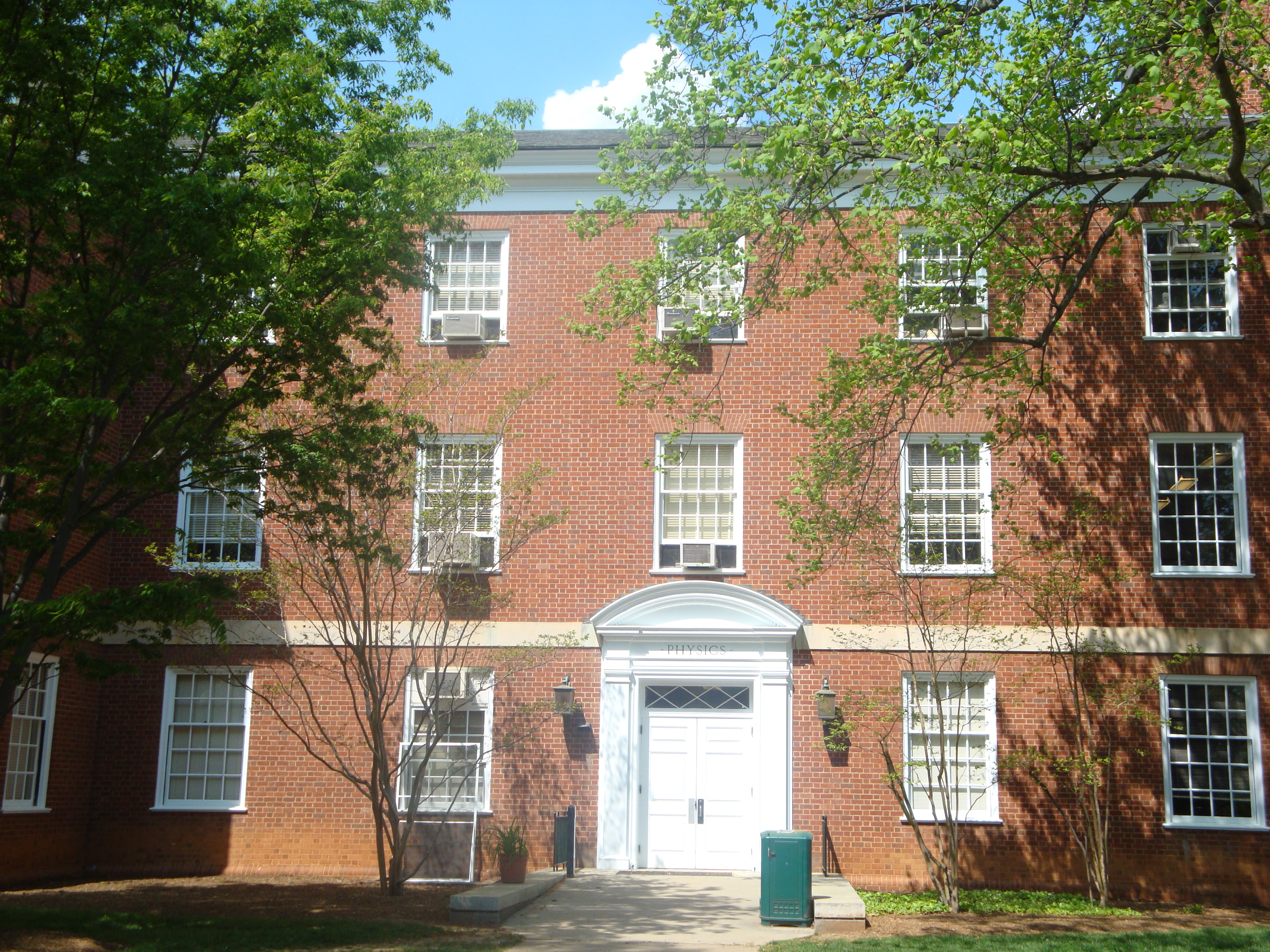 It includes the Jesse Beams Laboratory, named for University of Virginia Physics professor Jesse W. Beams Jr., world-renowned for his ultracentrifuge and early studies of atomic structure.
The Physics Building also holds the Physics Library and the Technical Services Facility. The Physics Lbrary includes a collection for both graduate and undergraduate-level materials pertaining to Atomic, Molecular, Optical Physics, Biological and Medical Physics, Chemical Physics, Condensed Matter Physics, Engineering Physics, Experimental Gravitational Physics, High Energy Physics, Mathematical Physics, Nuclear and Particle Physics, Physics Education, and Theoretical Physics.
The Technical Services Facility (TSF) is comprised of the Machine Shop, Electronics Shop, and the Computer Facility. The Machine Shop creates instruments used by the Chemistry and Physics Departments as well as builds equipment for other University programs. The Electronic Shop aids in laboratory equipment construction and repair. The Computer Facility provides support for standard computer workstations and develops and manages the Physics Department network infrastructure. Generally, the TSF provides services exclusively to the Chemistry and Physics Department, but will sometimes provide services to other University departments and programs.
Thornton Hall
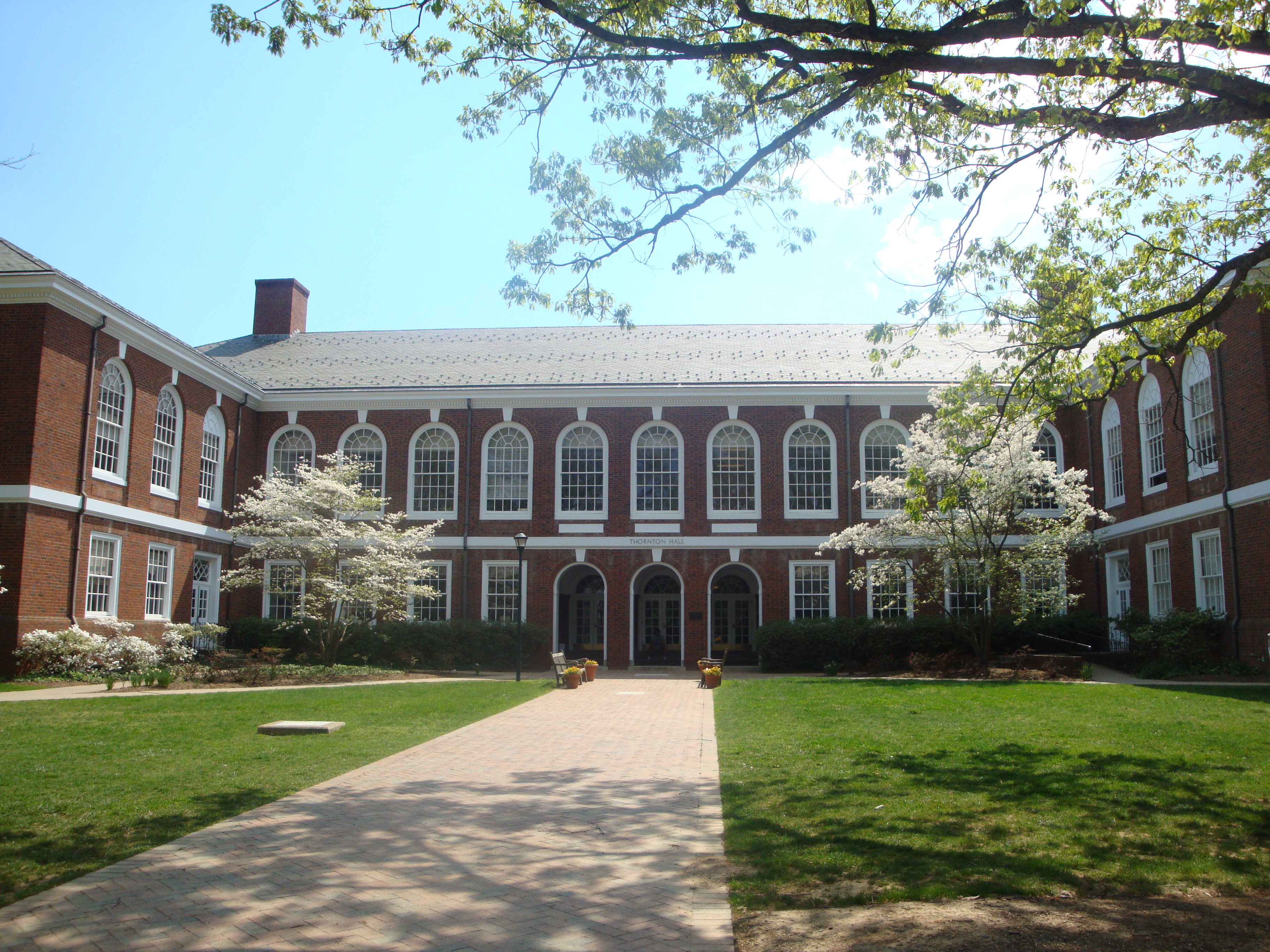 Thornton Hall was constructed in 1935 and serves as the central home of the School of Engineering and Applied Science, which offers program degrees in Aerospace, Biomedical, Chemical, Civil, Computer, Computer Science, Electrical, Information, Materials Science, Mechanical, and Systems Engineering. Named after William M. Thornton, a former University faculty chairman and the first Dean of the Engineering School, Thorton Hall includes classrooms, a computer lab, and study center for engineering students to utilize.
Prior to the expansion of individual engineering buildings during the 1950’s, Thornton Hall was the first building dedicated to the School of Engineering and Applied Science. Thornton Hall marked the University’s first academic building west of Emmet Street and initiated the transformation of McCormick Road from agricultural land to residential land.
Thornton Hall consists of different halls called ‘wings’ and houses the offices of the Engineering Deans, Civil Engineering, Electrical Engineering, and sections of the Chemical and Materials Science Engineering Departments. The D-Wing is centered for civil engineering while the E-Wing is primarily for electrical engineering.
Clark Hall
Clark Hall is situated across from Brown Residence College and was erected in 1932 by William Andrews Clark Jr., who donated the building in memory of his wife, Mabel Foster Clark. William Clark graduated from the University of Virginia in 1899 and dedicated the building to the faculty, alumni, and students of the University’s Law School. Clark Hall houses the Charles L. Brown Science and Engineering Library, which was established when Ann Brown donated $5 million to the University of Virginia in memory of her husband, Charles.
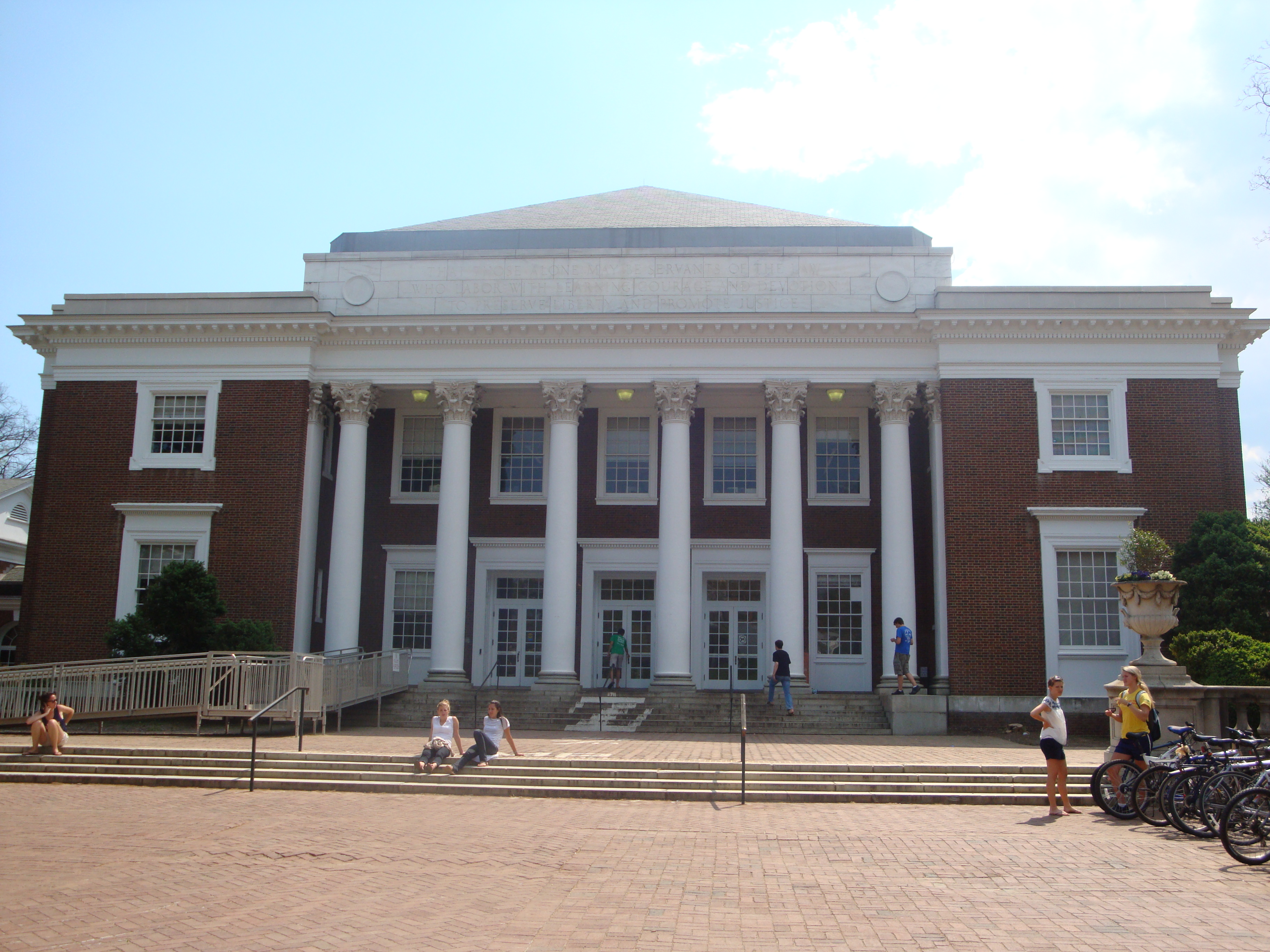 Upon entering Clark Hall, guests are greeted with an illustrious, colorful mural on either side of the wall. The artist, Allyn Cox, spent four years on the project after commissioned by William Andrews Clark Jr., the founder of the building. To the right, on the west wall, the three large panels depict a passage from the 18th book of the Iliad, as it describes a scene from the shield of Achilles. This trial over the blood-price of a slain man is said to be used to represent the Law as a means of settling disputes. To the left on the east wall, is Moses delivering the Tablets of the Law to the Children of Israel. The library boasts numerous resources in the area of science, mathematics, and engineering, as well as a positive environment for students to study in groups or individually. Classrooms, lecture halls, and computer assistance services are some of the amenities on Clark’s main floor.
In September 2004 the widow of Charles L. Brown, the UVA alum after whom the library is named, donated $5 million to the University of Virginia library for the Science and Engineering department in Clark Hall. In addition to this donation, Mrs. Ann Brown also donated another $5 million for the School of Engineering and $500,000 for an engineering scholarship. Charles Brown graduated from the University in 1943 with a Bachelors of Science in Electrical Engineering.
Brown College at Monroe Hill
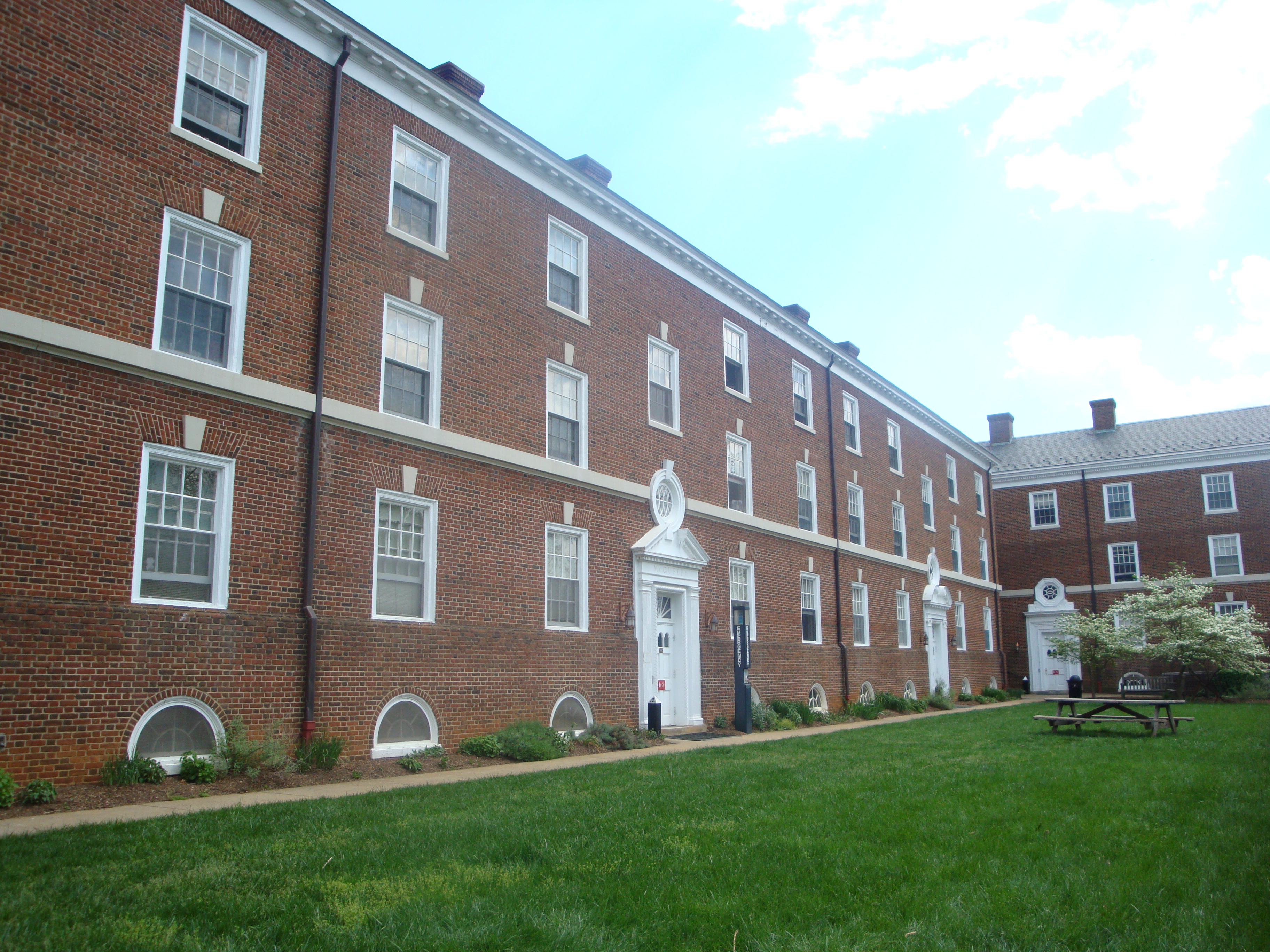 Brown College at Monroe Hill is the University’s first residential college and houses approximately 300 undergraduate and graduate students. Formerly named Monroe Hill College during its opening in 1986, it was later renamed Brown College in 1994 following a $2.5 million endowment by Sara Shallenberger Brown, her son W.L. Lyons Brown Jr., the Brown-Forman Corporation and the W.L Lyons Brown Foundation. During this time, President John T. Casteen III proclaimed Brown College as the University’s first permanent residential college. Residence admission into Brown College is through an application process in which current Brown residents, generally second, third and fourth-year students, read and rank the prospective residents. Brown College consists of twelve dormitories called ‘portals’ that are all connected via tunnels on the ground floors. These portals include Davis, Gildersleeve, Harrison, Holmes, Long, Mallet, McGuffey, Peters, Rogers, Smith, Tucker, and Venable. They each house approximately 24 students.
Historically, the area in which Brown College resides was once the residence and family farm of former fifth President of the United States, James Monroe. The Monroe Hill House, the original residence and law office of James Monroe located in front of the residential college, now serves as the home of the Brown College principal and Director of Studies.
Minor Hall
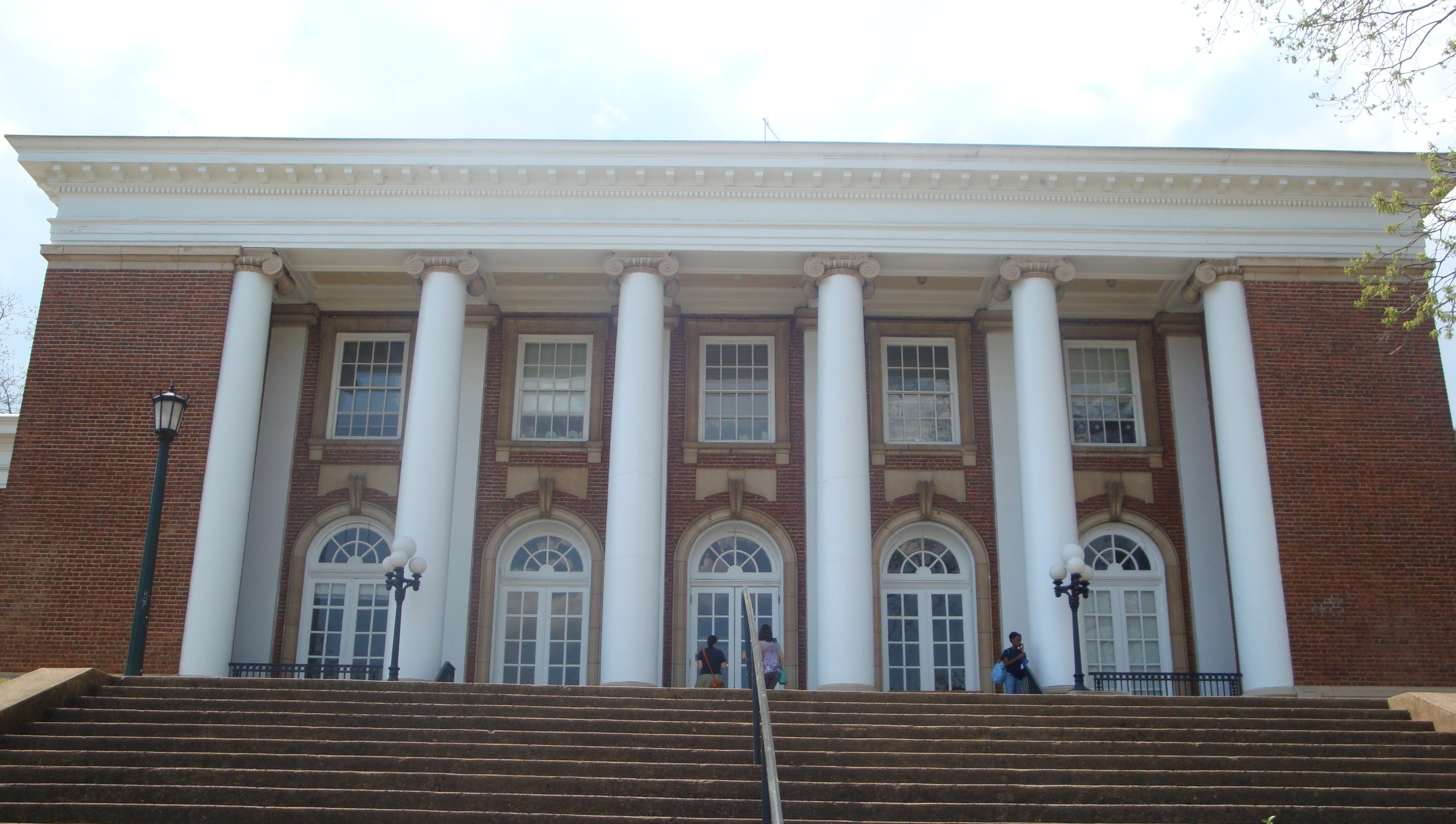 Minor Hall rests perfectly on what was once called the “last slope” of Monroe Hill, directly behind Cocke Hall and the McIntire Amphitheater. Constructed by architect John Kevan Peebles in 1909 and opened in 1911, the building was the home of the University of Virginia School of Law up until 1932. The hall is named in honor of John B. Minor, a renowned law professor who taught at the University for over fifty years. The building was designed to mirror the architectural nuances found in Garrett Hall. Due to several cuts in funding during construction, Minor Hall was designed to only accommodate one department. William A. Clark Jr., a wealthy alumnus, planned to finance an addition to the building, but decided to divert his interests to the construction of Clark Hall after realizing the problems that would arise from the unusual site location. Minor hall has been home to several fine departments at the University.
After the Law School’s departure, Minor Hall became home to the Speech Department. The Drama Department also occupied the building until the completion of the new Drama building on Carr’s Hill. Today, Minor Hall contains classrooms and several offices. It is currently the home of the Carter G. Woodson Institute for African-American Studies.
Monroe Hall
Monroe Hall is located on the small courtyard, across from Alderman Library and adjacent to Peabody Hall and the West Range. It is named in honor of James Monroe, whose law offices are now part of the nearby Brown Residential College complex. The building, like many of the other university buildings built in the 1920’s and 1930’s, was designed and built by the Architectural Commission. The Commission paid careful attention to detail in order to incorporate this building into the rest of the Jeffersonian complex.
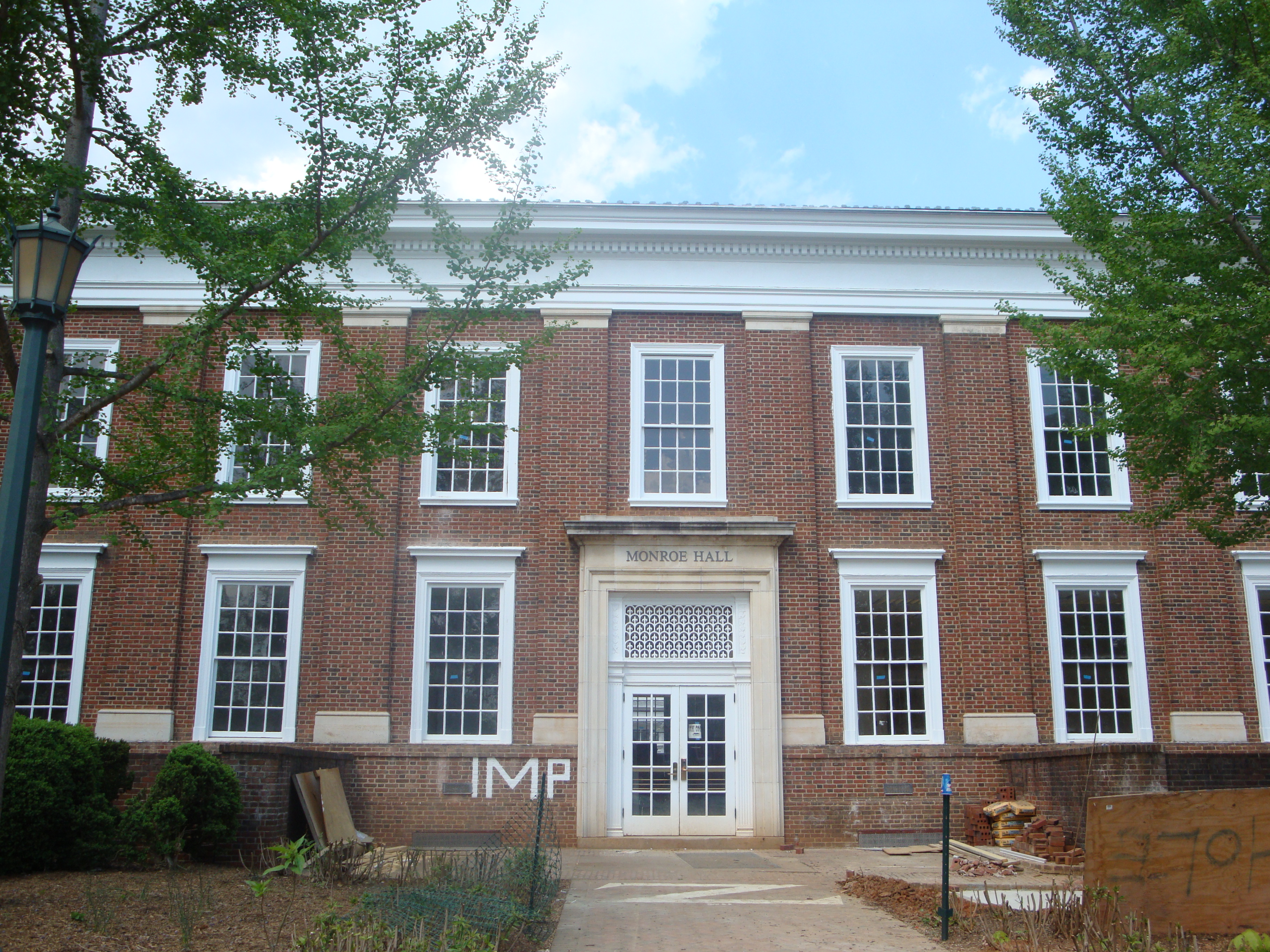 Monroe Hall was built to serve as a Social Sciences building. However, it served as the home of the Economics Department, and the McIntire School of Commerce for over 33 years. In 1921, Paul McIntire, a prominent University benefactor, provided funding for a new School of Commerce, an undergraduate business program completely separate from the University’s Economics Department. In the 1950’s, the Commerce and Economic Departments were relocated to the Physics Department quarters in Rouss Hall to make room for the newly created graduate business program, eventually named the Darden Graduate School. The Commerce School returned to Monroe Hall in 1976. In 1985, Monroe Hall was enlarged to accommodate the rapid growth of the Commerce School. The addition transformed the U-shaped building into a rectangular donut with an interior courtyard. The Hume fountain, also known as the “whispering wall,” was relocated to make room for the courtyard.
In 2007 the McIntire School of Commerce relocated to its new home on the lawn, the new state-of-the art Rouss and Robertson Halls. Monroe Hall is currently being renovated, with plans to be used for offices for the Deans of the College and Graduate School of Arts and Sciences.
The McIntire Amphitheater
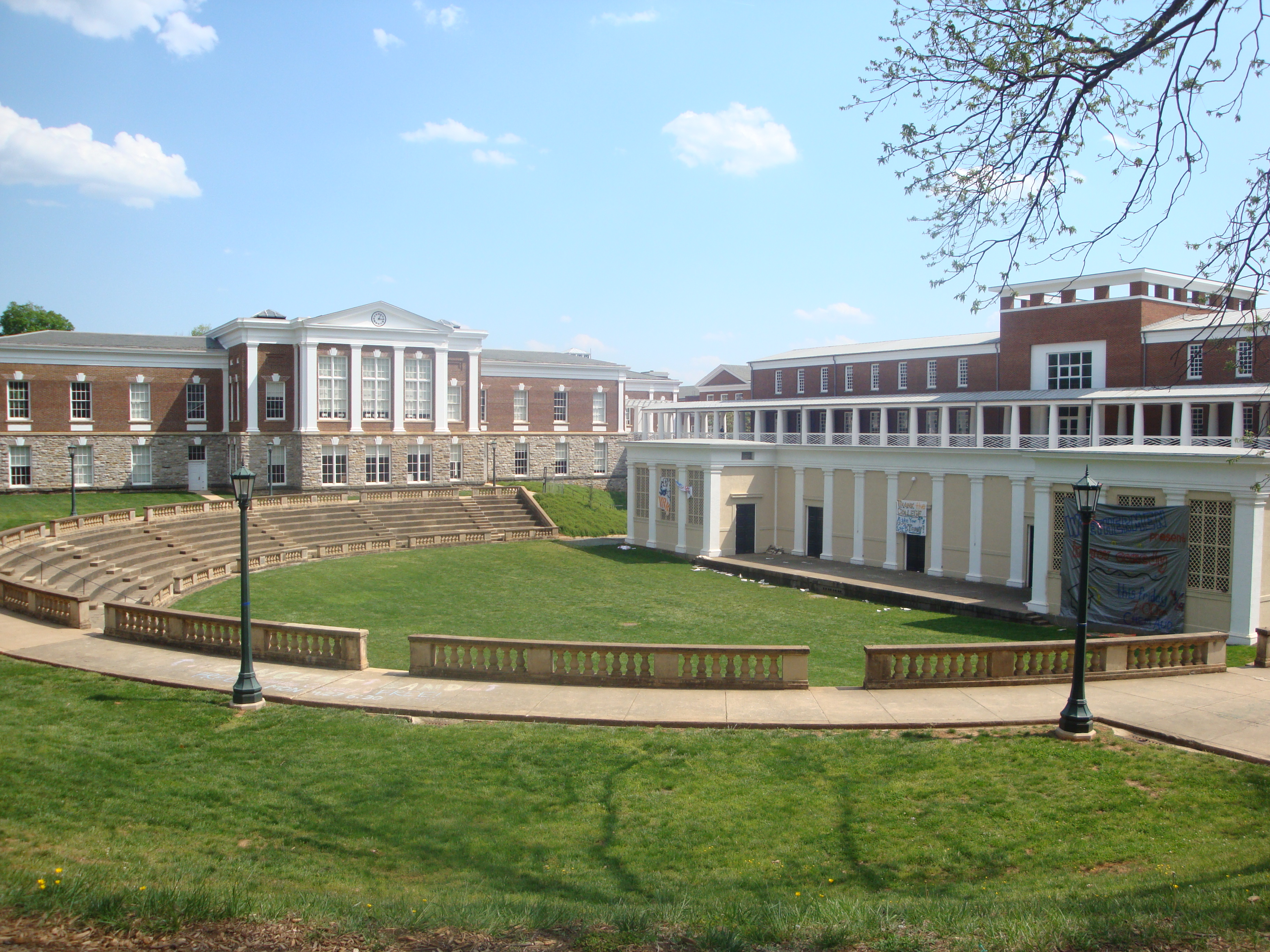 The McIntire Amphitheater is located in the small hallow between Garrett, Cocke, and Minor Halls. Fiske Kimball, who was the Head of the School of Architecture at the time, designed the amphitheater. Completed in 1921, the McIntire Amphitheater was funded by Paul Goodloe McIntire, who also funded the McIntire School of Fine Arts and the McIntire School of Commerce. Known for its beautiful neoclassical design, the amphitheater was commissioned and built to celebrate the University’s centennial. Greek amphitheaters were very popular during this time, and modernists thought that an amphitheater would be a great addition to the Jeffersonian architecture found throughout the Academic Village as well as the surrounding buildings. Both McIntire and Edwin Alderman, the President of the University at the time, believed that the amphitheater would serve as an important site for different cultural activities at the University.
Today, the McIntire Amphitheater is used for various activities put on by student groups, as well as occasional music events. Students also use the Amphitheater as a gathering place in between classes.
Peabody Hall
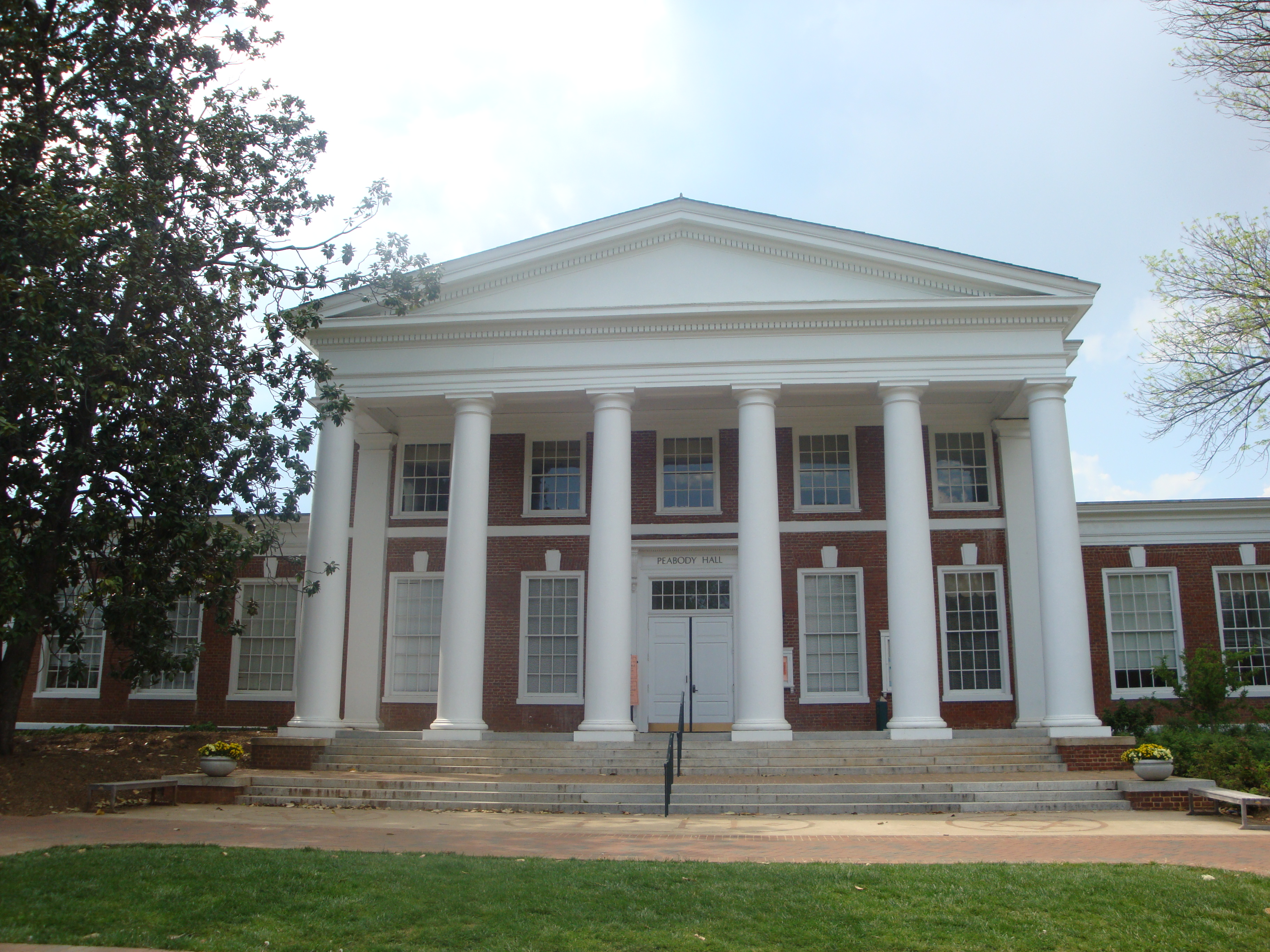 Peabody Hall opened in 1914 as the home for the Curry Memorial School of Education. The building was constructed due to financial support from the Peabody Education Fund, which was escalated by George Peabody, a 19th-century advocate for public education in the south. This new education school was set to improve the quality of elementary and secondary education in the state. Peabody Hall housed the constructive tools to train professional teachers and provided summer training for the existing employers in the field of education. Peabody Hall now houses the Office of Student Life and the Office of Undergraduate Admission, which serves applicants that are either undergraduate, transfer, or international students. The building also contains additional classrooms and offices and hosts evening programs in cities across the country with assistance of local alumni clubs. In addition, Peabody Hall hosts evening programs with other colleges and universities as well. Peabody Hall fosters a visitation program in which prospective students, undergraduates, and their families are more than welcome to receive a student-lead tour that highlights the University and all it has to offer.
The West Range
The West Range was designed by Thomas Jefferson around 1819. John Neilson, a prominent brick mason and illustrator, created drawings of the hotels located on the range. 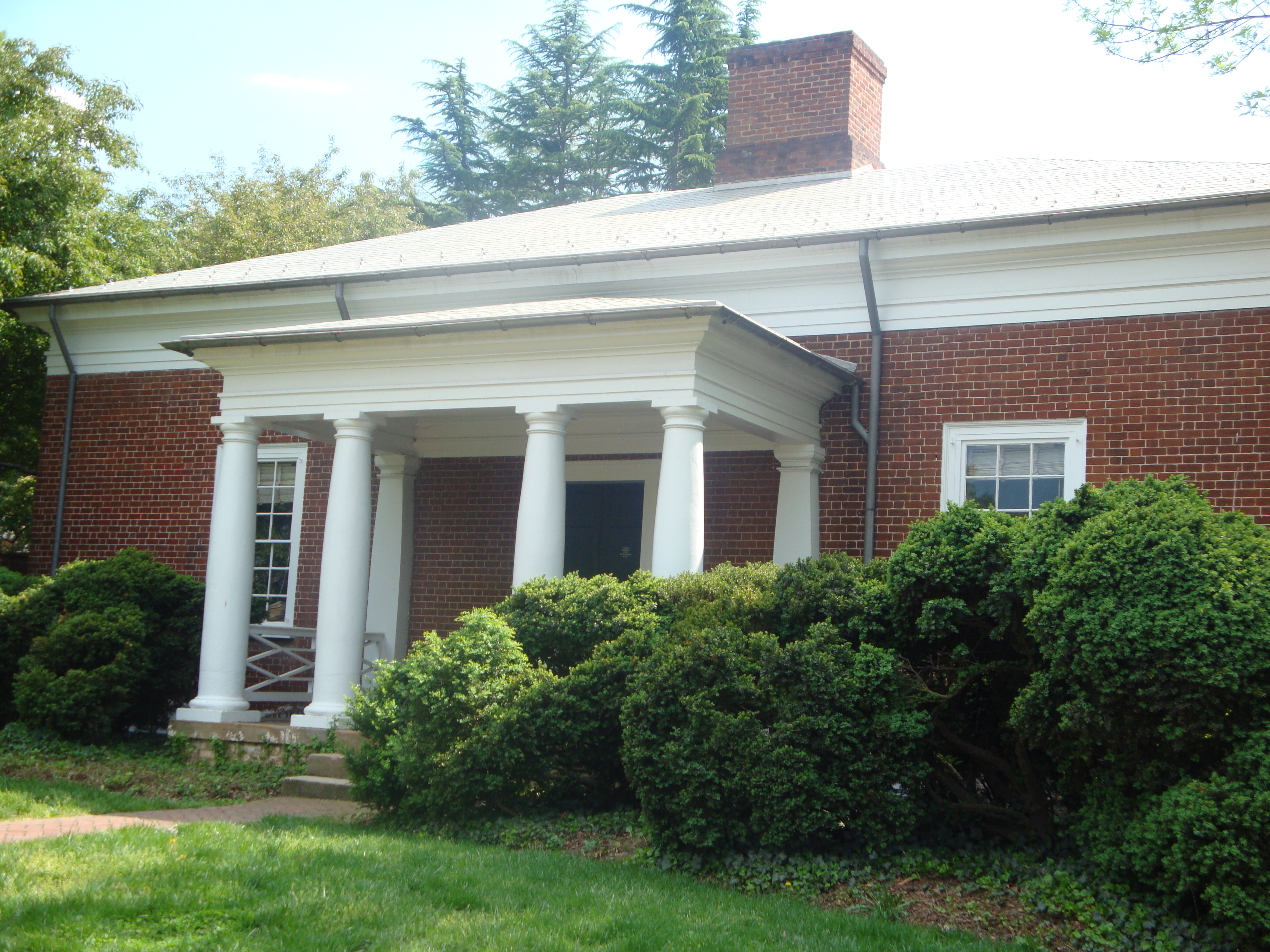 The West Range is comprised of hotels A, C, and E and 26 dormitory units.
Many famous people have called the West Range home during their time at the University. Room number 13 is a restored memorial to the American writer Edgar Allan Poe, who attended the University in 1826 and is believed to have lived in that dormitory. In addition, Woodrow Wilson, the 28th President of the United States of America, lived in room 31.
Jefferson intended for the hotels to be used as dining facilities for both faculty and students. However, acquiring qualified housekeepers to staff the hotels was not an easy task. Due to the low number of enrolled students, the housekeepers who were hired did not make a great deal of money, and thus did not stay. From the 1950s through the 1970s, Hotel E, also known as the Colonnade Hotel, housed a Graduate Student Center.
In 2004, student dining returned to Hotel E with the opening of the West Range Café, serving students, faculty, and staff. Today the West Range is primarily known as the home of the Jefferson Literary and Debating Society, which occupies Hotel C.
Newcomb Hall
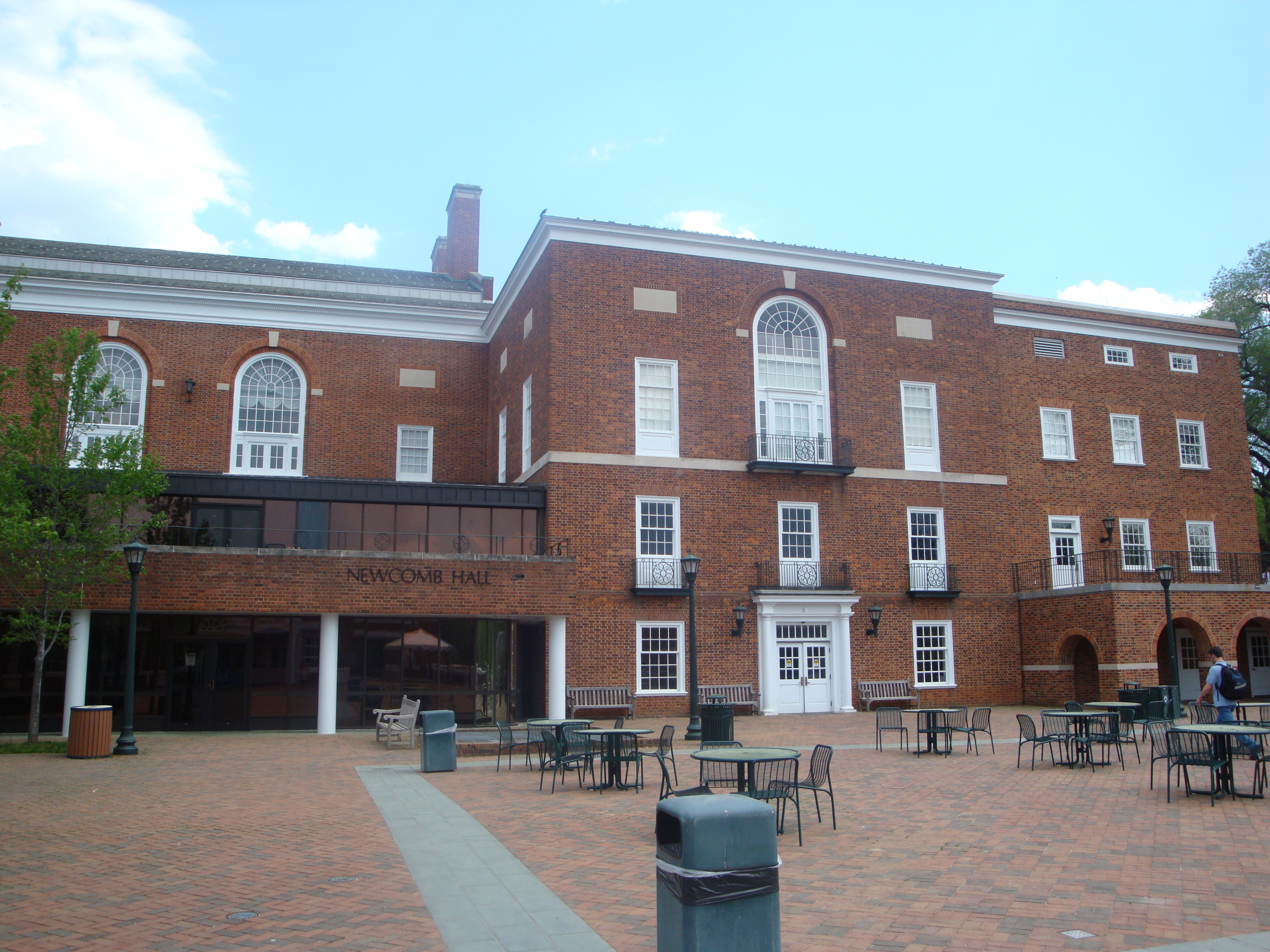 Newcomb Hall opened in 1958 and was named in honor of the University’s second president, John Lloyd Newcomb. President Newcomb was an educator infatuated with serving the University’s students throughout his career. Before assuming the role of President, Newcomb became the Post of Assistant to the President after he served as a Professor and the Dean of Engineering. Newcomb Hall was built to allow the University to have some manner of mutual contact and marked the dedication of University space to provide a community gathering place and a center for student activities. Newcomb Hall programs and services provide opportunities for students to engage in social interaction and leisure activities while promoting a diversity of interests and cultures. In addition, Newcomb Hall houses the Newcomb Dining Hall and the Pavilion, an area in which students can dine from various food restaurants.
The wide array of amenities include the dining hall, Pavilion, movie theatre, game room, art gallery, WIFI, bank, post office, Financial Services for University students, and an information center. Additional services that the facility holds is the Student Activity Center (SAC) and the Kaleidoscope which are designed to foster co-curricular learning. Newcomb Hall is also the home to student organization offices. Some of these organizations include, but are not limited to, the Student Council, the Honor and Judiciary Committees, the Cavalier Daily, LGBT Resource Center, Greek Councils, and the University Programs Council.
Clemons Library
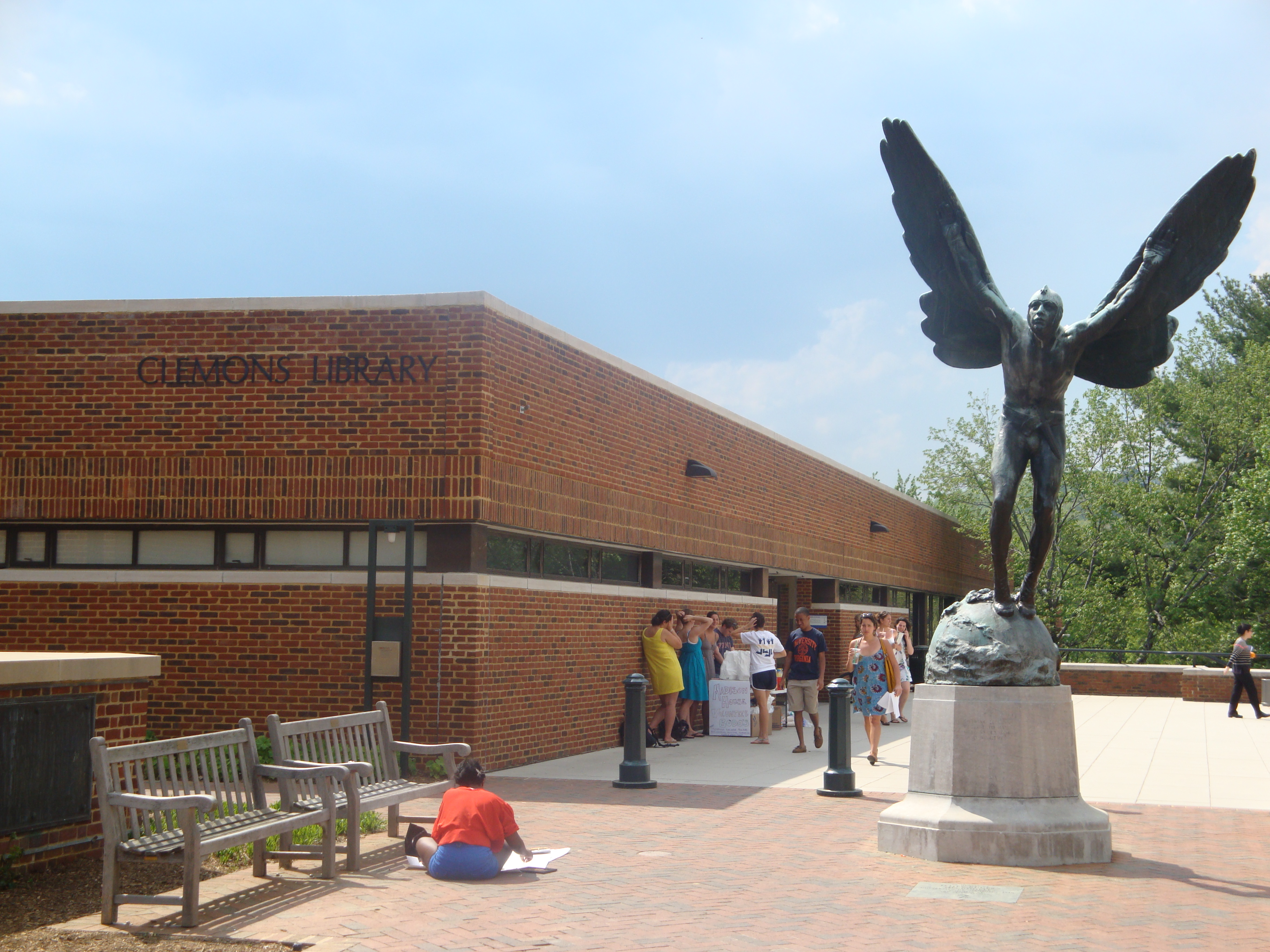 Clemons Library is named in honor of Mr. Harry Clemons, who served as the University Librarian from 1927 to 1950. The library is one of the three central undergraduate libraries at the University of Virginia. Located near the intersection of McCormick Road and University Avenue, it is a haven for students looking to study alone or within organized groups. Situated between Newcomb Hall and Alderman Library, Clemons is comprised of four descending levels, of which the noise levels decrease respectively. The majority of the library space is in actuality located beneath the ground in order to ensure a distraction-free study environment. The lowest-level area is designated for studying in complete silence. Clemons is also open to students for twenty-four hours Monday through Thursday, making this the only library on grounds at the University of Virginia that remains open for this extended period of time.
Clemons is perhaps most reveled for its immense collection of media resources, primarily in the Robertson Media Center on the third floor. Here, students may watch movies pertaining to a certain course, or even check them out for personal use for days at a time. Students may also seek assistance in video editing from the videographers located in the Digital Media Lab on the third floor. Clemons also provides classrooms for certain courses and have designated study group rooms for students to utilize.
Alderman Library
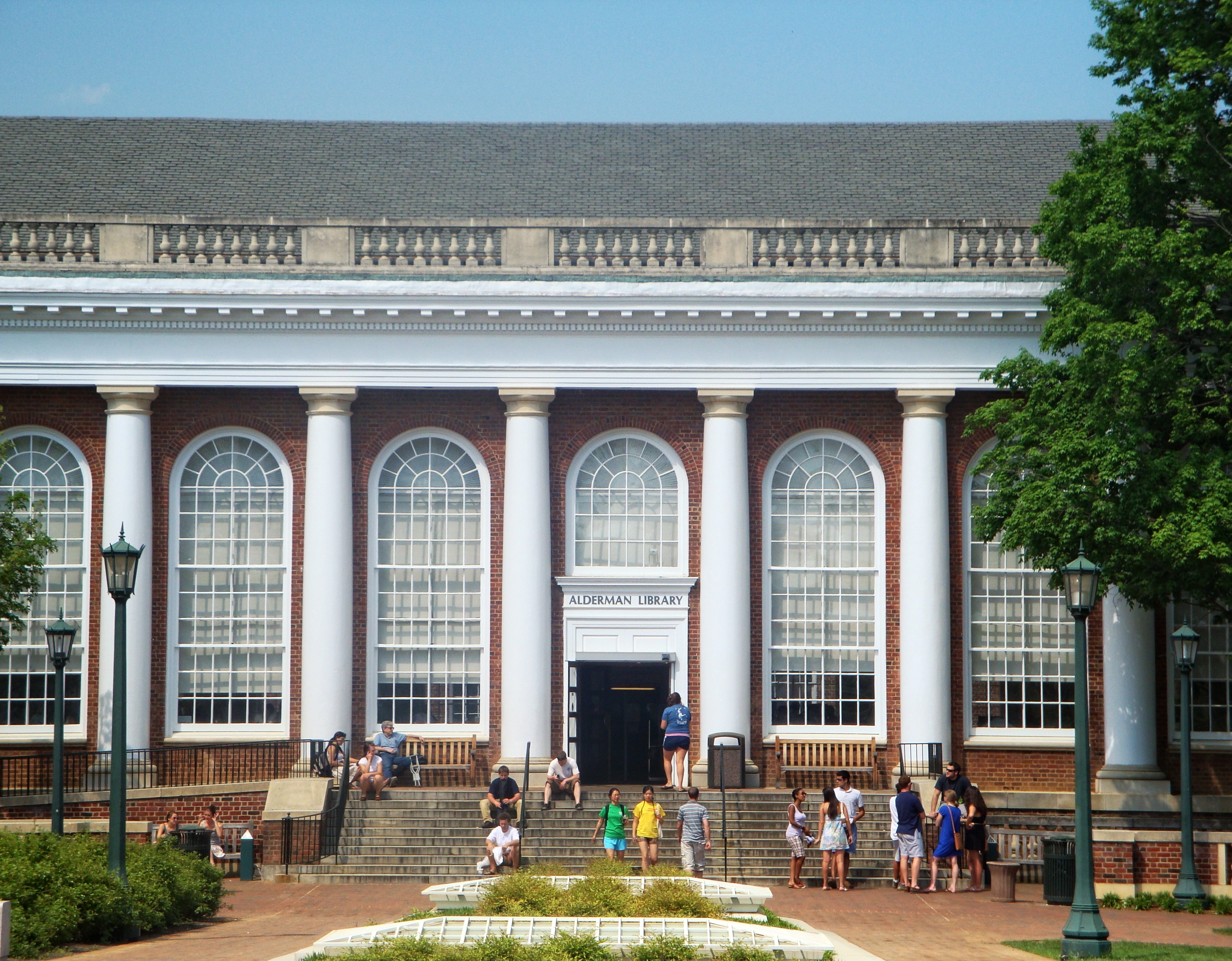 Alderman Library is located on the end of McCormick Road adjacent to Clemons Library. The building was erected and named after Mr. Edwin Anderson Alderman, who was the President of the University from 1904 until 1931. It not only serves undergraduate students, but also provides extensive references for graduate students and faculty alike. The library is revered for its resources in the areas of the Social Sciences and Humanities. In addition to reference services and general collections in these departments, the library also boasts the Government Information Resources as well as the Scholar’s Lab. The library houses five floors, as well as an East and West Wing. The main entrance is located on the fourth floor, where guests may enjoy a lounge area, café, as well as complimentary digital resources. The reference room, also located on the fourth floor, provides guests with a secluded place where they may organize their needed resources. Upon entering, the circulation desk provides guests with reference assistance as well as collection information. The third floor houses historical newspapers, periodicals, as well as the Government Information Resources section. The fifth floor contains library administration editing projects, as well as specialized resources in the area of humanities and social science publications. The two lower-level floors contain a plethora of special collections references.
UVA Chapel
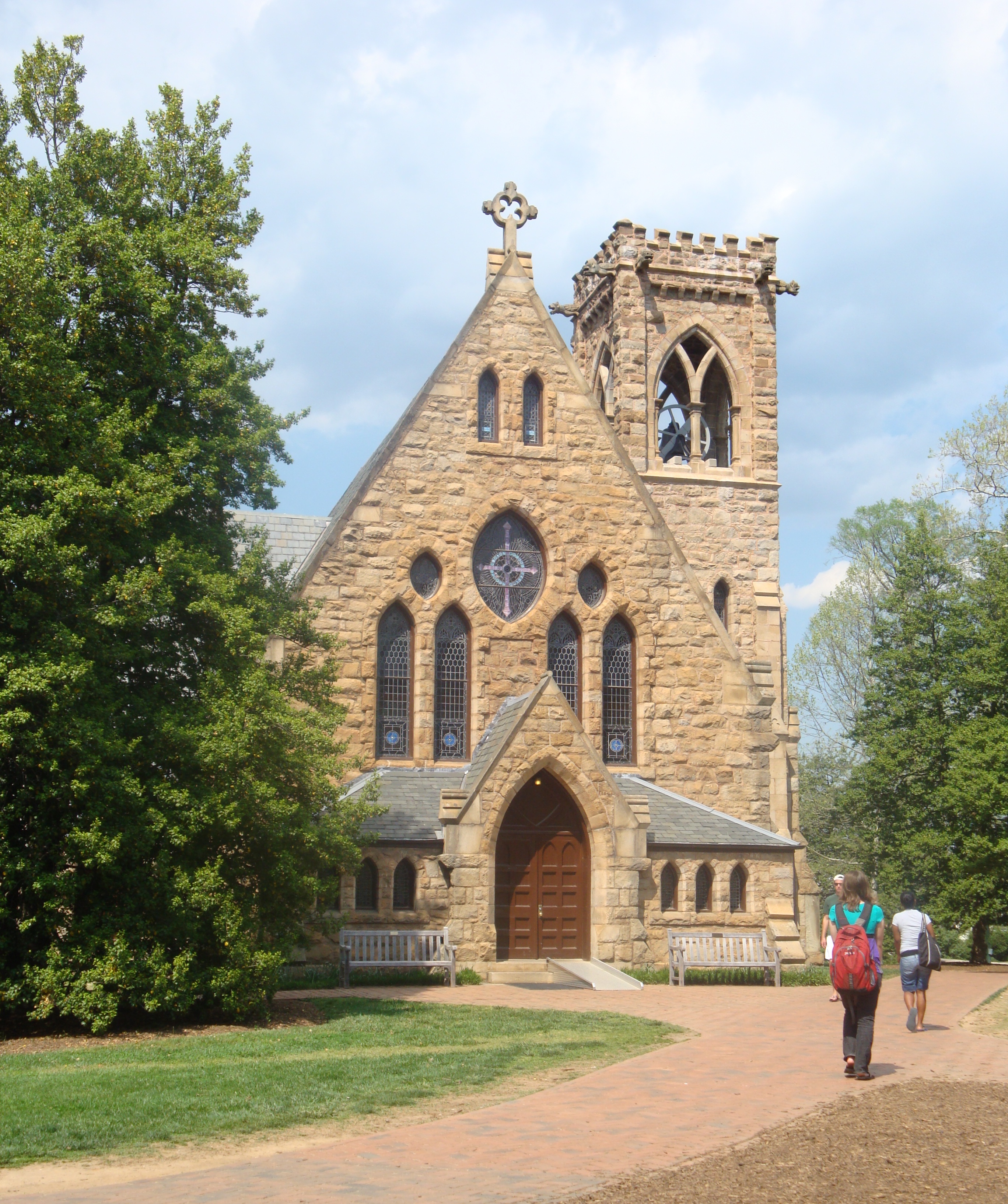 Before the introduction of the new University Chapel, religious worship was held in the basement wing of the Rotunda. During the latter part of the 19th century, the Chapel was designed by Charles Emmett Cassell of Baltimore in his efforts to have a gothic revival building. The Chapel underwent construction as a non-denominational church on University Grounds in the spring of 1884 and was completed in the summer of 1890 for a total cost of about $30,000. The cornerstone was laid in March 1885 with appropriate ceremonies and speeches. In June 1889, the building was dedicated to the University.
The Chapel’s specifications includes seating for 250 people (46 pews), wheelchair accessible through the front and back door, 1 wooden kneeler, a Skinner pipe organ, a moveable cross, a brass lectern, 4 wooden altar chairs, and a wooden altar table. There is also a small foyer inside the front entrance, two small private rooms, but no dressing areas or restrooms. Located just to the right side of the University Chapel is a bell tower, which is a donation from the Seven Society. Although the Chapel initially held religious services for students, the University Chapel no longer holds regular religious services. Instead, weddings and memorial services take place inside.