
Make your own soap
- When drinks is used for washing, it dissolves dirt; but some dirt does not dissolve in water. Soap helps water to remove dirt. Soap nut powder has been used by man for AbOUT 3,000 years. Metallic salts which are prepared from natural fats are called soaps.
Fatty acids are organic compounds. The molecules of these compounds contain a carboxyl group {-COOH}. These molecules react with a trihydric alcohol called glycerol to form a class of compounds called esters. Groundnut oil, coconut oil, palm oil, caster oil, animal fat etc are all esters of fatty acids. Fats and fatty oils are called glyceryl esters or triglycerides.
- Soap is a sodium salt or potassium salt of long chain fatty acids that has cleansing action in water. Sodium stearate, sodium oliate and sodium palmitate are some examples of soaps. Stearic acid is a long chain fatty acid whose formula is C17H35COOH it reacts with sodium hydroxide to give a compound called sodium stearate, which has properties of soap. Similarly, sodium hydroxide reacts with oleic acid and palmitic acid forming sodium oleate (C17H33COONa) and sodium palmitate (C17H31COONa) respectively.
A Swedish chemist, Carl Wilhelm Scheel accidentally discovered the process of preparation of soap in 1783. He boiled olive oil with lead oxide and obtained a substance which was 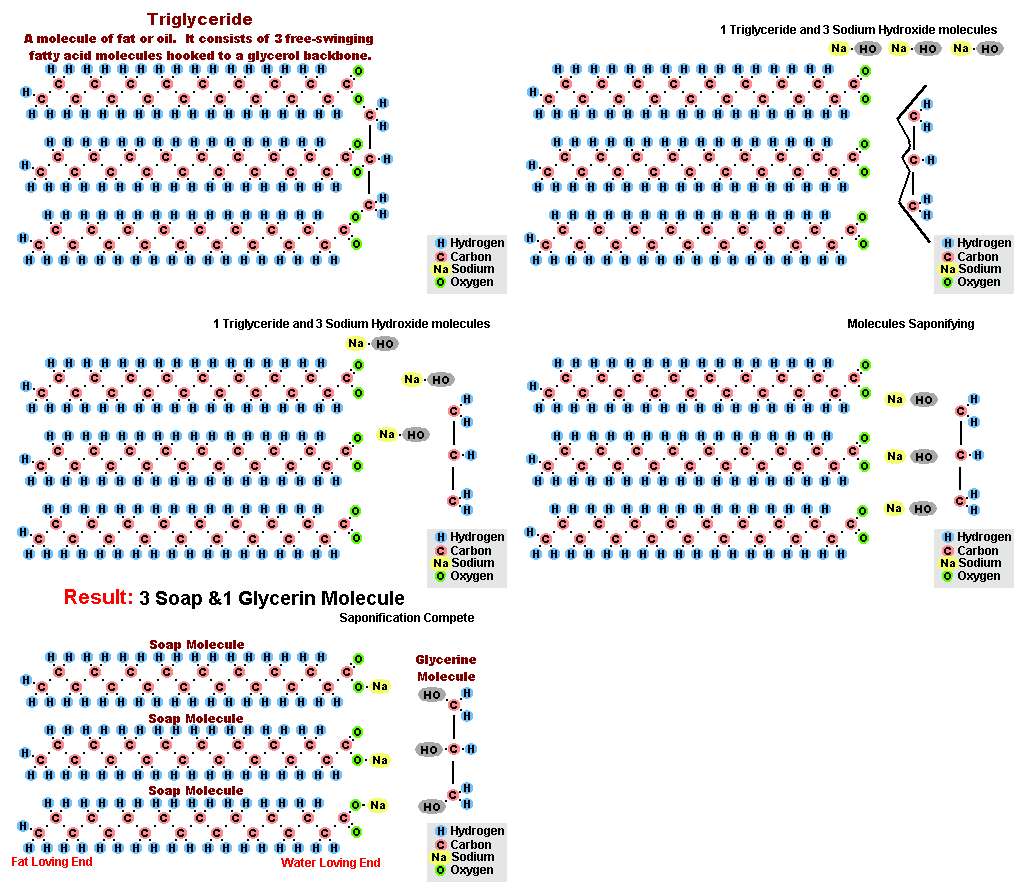 sweet to taste. This substance is now known as glycerine. Glycerol is a sweet viscous liquid soluble in water which is a by-product of saponification process. It is commonly called glycerine. Its formula is CH2OH.CHOH.CH2OH. It is used in the manufacture of explosives, plastics, and pharmaceutical industries. It is also used to PReVENT freezing.
How does soap clean
Soap dissolves in water due to the contrasting properties of the ends of the soap molecules. A soap molecule has a long hydrocarbon end [E.g.CH3(CH2)16] and a short ionic end containing COONa+. The non-ionic hydrocarbon end has the property to repel water. The other end, which is ionic, has the property to attract water. This end attaches itself to water. The hydrocarbon end attaches to the dirt or grease to form structures called ‘micelles’.
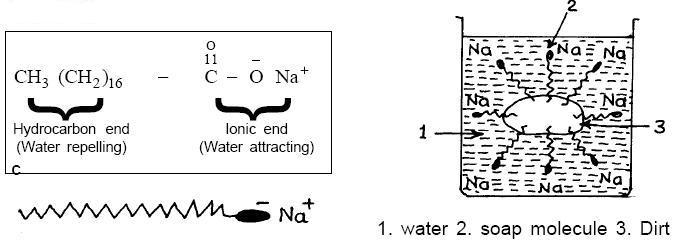
In micelles soap molecules are arranged radially. The end attached to water pulls out the dirt from the fabric. This can be washed off with water.
Soap making
Required
- Caster oil
- Coconut oil
- Sodium hydroxide
- Stearic acid
Preparation Prepare a mixture of caster oil-25gms and coconut oil-100gms in a beaker. Prepare a solution of sodium hydroxide (18gms in 50 ml of water) in another beaker. Add sodium hydroxide solution to the oil mixture. Use a glass rod to stir the contents the contents for some time till the liquid form of the mixture turns into solid/paste form. Add 2gms of stearic acid and again stir well. Pour the paste into a mould or a plate and allow it to dry. The soap is ready
Liquid soap making
Required
- Acid slurry 200gms
- Sodium Hydroxide 35gms
- Urea 80gms
Preparation Take a beaker with 500ml of water and add 200 gms of Acid slurry and stir well to make a homogeneous solution. mix 35gms of Sodium hydroxide and 140 ml of water and stir well to make solution. Add hydroxide solution to the beaker containing slurry solution mix them well using a glass rod. Add 80gms of urea and stir the contents well. Now the liquid soap is ready for use.
Before using test their pH value using a Universal indicator paper strip.
You may add required quantity of perfume and add colour to make it attractive.
Soap disadvantages
Although soap is a good cleaning agent, its effectiveness is reduced when used in hard water. Hardness in water is caused by the presence of mineral salts - mostly those of calcium (Ca) and magnesium (Mg), but sometimes also iron (Fe) and manganese (Mn). The mineral salts react with soap to form an insoluble precipitate known as soap film or scum.
Soap film does not rinse away easily. It tends to remain behind and produces visible deposits on clothing and makes fabrics feel stiff. It also attaches to the insides of bathtubs, sinks and washing machines.
Some soap is used up by reacting with hard water minerals to form the film. This reduces the amount of soap available for cleaning. Even when clothes are washed in soft water, some hardness minerals are introduced by the soil on clothes. Soap molecules are not very versatile and cannot be adapted to today's variety of fibers, washing temperatures and water conditions.
Detergents
The term detergent is derived from a Latin word which means surface active. . Detergents are also called soap less soaps. Detergents do not form insoluble ‘scum’ with magnesium and calcium ions present in hard water. Therefore, detergents clean better than soap even in hard water. Detergents are sodium salts of long chain benzene sulphonic acid or sodium salts of long chain alkyl hydrogen sulphate. A detergent molecule consists of a large hydrocarbon group that is non-ionic and a sulphonate (SO3 - Na+) or a sulphate (SO4 - Na+) group that is ionic. Sodium n-dodecyl benzene sulphonate and Sodium dodecyl sulphate are two well-known detergents.
How to make Detergents
Long chain hydrocarbons obtained from petroleum are treated with concentrated sulphuric acid. The organic acids produced during this process are neutralized with sodium hydroxide.The sodium salt obtained is a detergent.
Step 1. Make a mixture of 200gms of acid slurry and 450 gms of soda ash in a big plastic bowl. mix them well to form a fine mixture
Step 2. Make a mixture of 100gms of Tri sodium phosphate(T.S.P.),80 gms of sodium tri poly phosphate(S.T.P.P.), 20 gms of carboxy methyl cellulose and 150 gms of globbers salt (Sodium sulphate) in a small bowl
Step 3. Take the big bowl in which the slurry mixture is preparedand add the mixture made in Step 2 Mix all thoroughly to get fine powder. Colour or perfume can be added to it.
Advantages and disadvantages
Detergents have more advantages than soap. Therefore, detergents are more widely used than soap.
- Detergents cleanse well even in hard water. Soap is not so good for
washing when water is hard.
- Detergents are made from hydrocarbons obtained from petroleum. Soap is
prepared from vegetable oil or animals fat that are usually edible.
- Detergents cleanse well even in acidic medium. Soap does not cleanse well
in such a medium.
- Detergents have their disadvanges.
- Detergents are not bio-degradable. They pollutes water and soil. Soaps are biodegradable.