
Littlefinger (film)
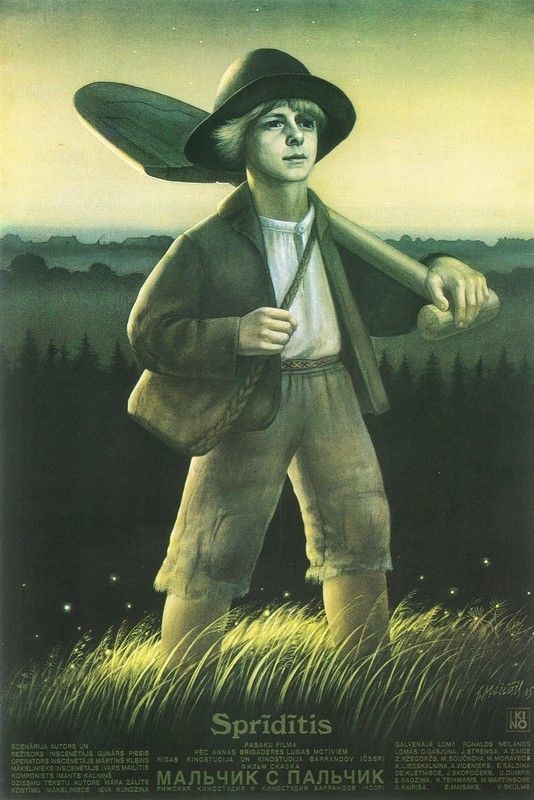 Littlefinger (Latvian: Sprīdītis) is a 1986 family fantasy film produced by Riga Film Studio. The film was written by Anna Brigadere and Gunārs Piesis, directed by Gunārs Piesis. It can be found in Czech, Latvian, and Russian. The film stars Ronalds Neilands as Malícek, Dace Gasiuna as Lienite, and Dzintra Kletniece as Macecha.
The Film was based on the fairy tale of Tom Thumb, adapted into a play in 1903 by Anna Brigadere's. Later into the 1986 film by Gunars Piesis.
Gunars Piesis documented the year he worked on Sprīdītis, 1984, in his diary. Gunars Piesis would face issues with the Soviet government system's restrictions and would put him into a depression caused by his emotional and sexual repression, Sprīdītis was a response to his repressed feelings.
Plot
The King's (Zdenek Rzegorz) palace is invaded by the Devil's messengers and relay to him that the Devil (Miroslav Horacek) will come in three days. He will kidnap and marry Princess Zeltīte (Miroslava Souchkova). The King makes a declaration that anyone who steps up to stop the Devil will be allowed to marry his daughter and he sends his messengers out to spread the word and find him a hero.
Tom Thumb (Sprīdītis) (Ronald Neilands) in the care of his evil Stepmom (Dzintra Klētniece), comes across one of the King's messengers who delivers the declaration to Sprīdītis. Against his Grandmother (Elvira Baldiņa) and Lienite's (Dace Gasjuna) wishes, runs away in search for adventure and a better life through the King's declaration. During his journey he runs into the Wind Mother (Astrid Kairis), after she saves him from sinking in a swamp. She takes him to a ruined castle to test him, after passing he receives a magical flute and is sent to a field.
Continuing on his journey, Sprīdītis makes his way into a forest where he finds a group of children running from a giant named Lutausis (Miroslav Moravecs), who traps the children in a cave. Sprīdītis confronts Lutausis and makes him dance by playing the flute. Defeating the Lutausis and forcing him to free the children. Afterwards, Sprīdītis is met by the Forest Mother (Mirdza Martinsone) and is given a magical stick.
Sprīdītis eventually gets caught in a storm and seeks shelter at an old house. He bangs on the door and is let in but received coldly by a pair of Scrooges. Sprīdītis wakes up in the night to a knock at the door and answers it to find an Old Man (Alfred Videnieks) seeking shelter. Sprīdītis lets him into the Scrooges' home and they get mad and demand the Old Man leaves. The Scrooges put Sprīdītis through trials, where he holds glowing hot coals and where his hand is pierced with a giant needle but the Old Man heals both wounds. Then Sprīdītis uses the magic stick to make trap the Scrooges in the basement. For his help, the Old Man gives Sprīdītis a magic ring and disappears.
Sprīdītis leaves and makes his way to the kingdom. As he is watching a play, the King's Messengers arrive and read a decree from the King looking for a Hero. Sprīdītis offers to help the King and is brought to the Castle. And then the Devil's messengers arrive to prepare for the Devils arrival. Once he arrives, Sprīdītis confronts him and uses his magic tools to defeat him. But Princess Zeltīte doesn't want to marry Sprīdītis and goes to find the Witch (Antra Liedskalniņa) to take care of him for her. Though, the Witch runs away and doesn't harm Sprīdītis.
In the end Sprīdītis uses the magic ring to turn himself into a bird to travel all the way back home. In his final act he stands up to the King. The King also takes the Evil Stepmother with him. After all the action and adventure he came to realize that what really brought him happiness wasn't the promise of strength, power, or wealth but was being at home with his family.
Release
The film released in the following order:
- April, 1986 in the Soviet Union at the Alma-Ata All-Union Film Festival
- January 3, 1987 in the Soviet Union
- July, 1987 in Italy at the Giffonni Children's Film Festival
- October, 1987 in Czechoslovakia
- January 29, 1988 in East Germany
- December 26, 1988 in West Germany as a TV release