
Herbert Frank Schindler, Jr.
Herb Schindler, Herbert Frank Schindler, Jr., is a key figure in the transportation industry in Detroit, Michigan, for many years, Herbert Frank Schindler, Jr., was executive vice president and general manager of White Star Trucking, Inc., which he raised through his initiative, drive and administrative genius to a status as one of the Midwest's outstanding interstate haulers . He was a man of limitless interests including horticulture, table tennis, fishing, and a moving force for civic betterment in every phase of community life.
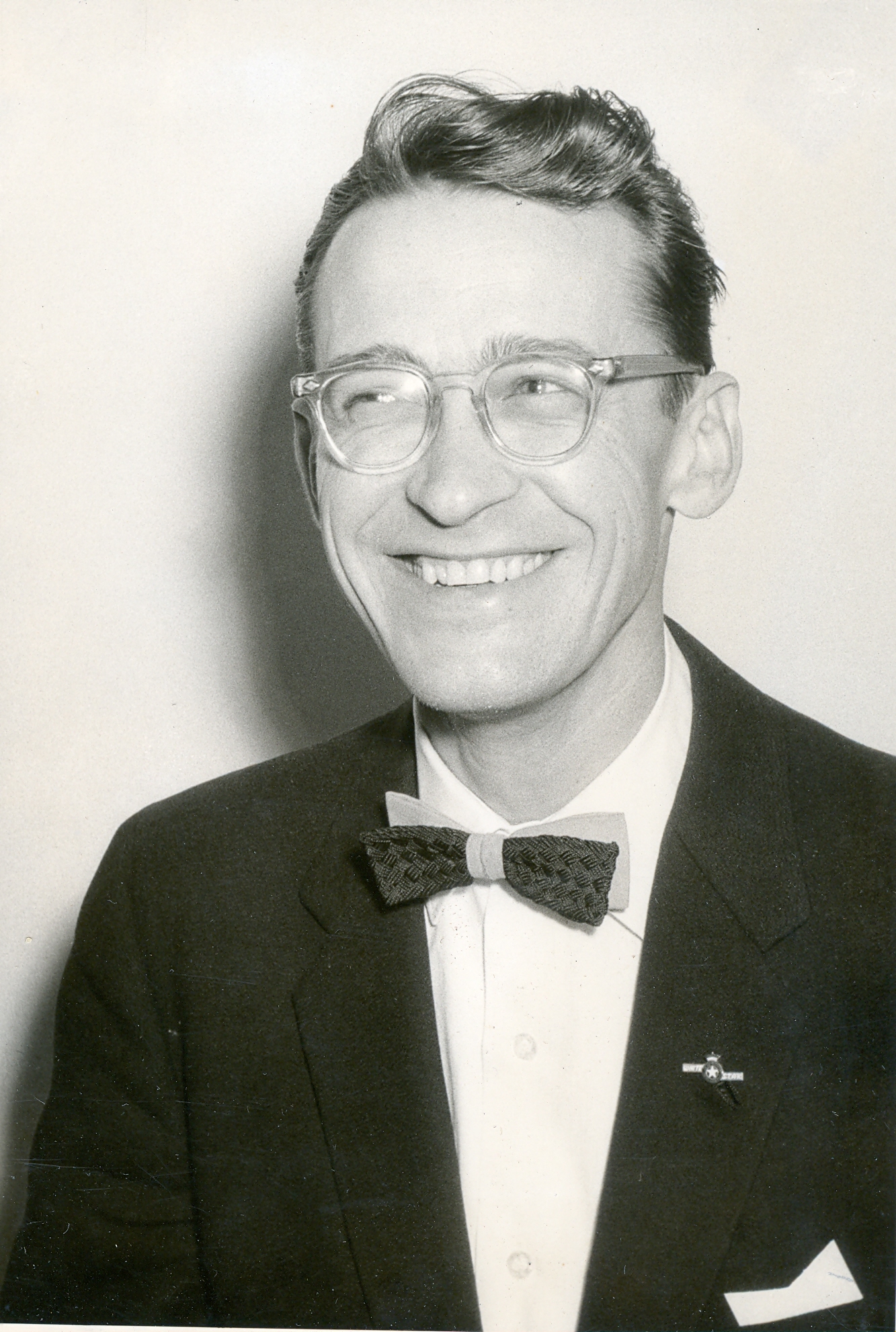
Biography
Early life
Herbert Frank Schindler, Jr., was born at New Baltimore, Michigan, September 29, 1919, son of Herbert L. Schindler, Sr. and Bessie (Kesner) Schindler. Herbert’s early life was in a small white house in New Baltimore, Michigan . He had one sister, Loraine (Schindler) Delaney, 1917-1997. At the age of ten he started working, during the great depression, making cement blocks with his father .
His father, Herbert Sr., was first engineer on the Port Huron-Detroit Inter-Urban train, later worked for Detroit Department of Street Railways, and then in general work with the White Star Trucking, Inc. until his retirement. He died August 27, 1967 and was born April 16, 1889. His mother Besie (Kesner) Schindler was a homemaker until she died June 11, 1947. She was born March 27, 1894. On both paternal and maternal sides the lines are traced to great-grandfathers who came to the United States from Germany, or Prussia near the Polish border .
Mr. Schindler, Jr. received his early education in the public schools of Detroit, Michigan, where he graduated from Southeastern High School. He attended Wayne State University in night courses, and gained a Bachelor of Business Administration degree in 1942. He also studied Commercial Art. He later took post graduate courses in Business Administration, Accounting, and Transportation Management .
Family
Schindler married Mavis Lilian Loken March 7, 1941 in New Orleans, Louisiana. Loken’s parents were Arthur and Clara Loken, of Manistee, Michigan. On both paternal and maternal sides the lines are traced to grand parents who came to the United States from Norway . They remained married until his early death as a result of cancer in Detroit, Michigan, February 21, 1965. Mavis Schindler was a home maker, active in the League of Women Voters on environmental issues. She never remarried and died March 18, 2007 while living at Manistee, Michigan.
Art Loken grew up in rural Manistee County. He became a jeweler, practicing his trade in Copemish, Michigan, then in Houston, Minnesota. During World War I he was in the U.S. Army Ordinance Corps. After the war he returned to Manistee, Michigan where he started a jewelry store in the city’s downtown until his death March 12, 1964. He was born September 13, 1889. Clara Loken also grew up in the City of Manistee and was a homemaker. She died January 24, 1993 in Traverse City. She was born June 21, 1884, 5, or 6 .
Herb and Mavis Schindler became the parents of three children. Rolyn Kay (Schindler) Kahl who became a teacher and lives in the St Joseph area of Michigan. Dana Lane Schindler became a community environmental activist, has held elected office, has worked in several different jobs, and lives in the Manistee, Michigan area. Kurt Herbert Schindler has been a journalist and professional planner, working both as a planner for local government, with his own planning consulting firm, as a land use educator for Michigan State University Extension, and lives in the Brethren/Wellston, Michigan area .
The family was honored in' 1950 when it was chosen by McCall's Magazine as its All American Family of the Year.
Career
After high school graduation Herb Schindler served as a commercial artist and played professional baseball, and then joined the staff of the Commonwealth Bank in Detroit, where he was first a teller, and later a bookkeeper, while attending Wayne State University evenings. In May 1942 he became associated with White Star Trucking, Inc., as bookkeeper and general working partner of the new owner, Mr. D. J. Gorno. His duties extended to all phases of the enterprise, then consisting of two trucks; he served as truck driver and dispatcher, accountant and billing clerk, and even as janitor .
During World War II he was drafted into the Army in 1944. He was selected for Officers Training School, and was honorably discharged after an injury at Fort Meade, Maryland, training camp in January 1945 .
After the Army he returned to the firm to become vice president and general manager, and later executive vice president and general manager, in which posts he continued for the duration of his career. Under Schindler’s guidance White Star Trucking, Inc., developed steadily over the years into one of the Michigan-Ohio area’s leading common carriers. Steel, auto parts and general commodities form the chief cargo. From a start with two truck drivers, the work force has grown to more than 400 employees, and hauling units number more than 600 plying from eight terminals through southeastern Michigan north to Flint, and through northern Ohio, for a yearly gross approaching $5 million. The home terminal was housed on nineteen acres on Southfield Road and I-75 in Lincoln Park, Michigan. In the early 1980s White Star Trucking, Inc. went out of business .
He was also active as president of the Down River Fleet Leasing Corporation .
Schindler was active in the Michigan Trucking Association, as president, board chairman, and chairman of the executive committee. He represented Detroit trucking firms in their contract dealing with the Teamsters Union, as a member of the bargaining committee for the truckers .
In 1961 he was named Detroit Head of the Committee on National Defense Transportation and a member of the Commission on Industrial Development Legislation .
In 1961 he served as host for a delegation of Japanese trucking executives at the request of the United States State Department .
In 1963 the Michigan Public Service Emergency Transport Board appointed him its Area Coordinator and Deputy Chief of Emergency Transport .
In his industrial work he devoted concentrated effort to furthering all programs for motor safety. His children tell stories of learning to drive, and passing the Michigan Motor Vehicle exam for a driver's licence was ridiculously easy compared to Schindler’s own driving test before car keys were handed over .
He was also active in the Freight Association, and a member of the Motor Carrier’s Employers Association of Michigan, the Fifth Wheel Club, the Traffic Club of Detroit, the Grosse Ile Golf and Country Club, and the Detroit Symphony Association, Inc. .
Community Service and Activities
Schindler was appointed by both Republican and Democratic governors of Michigan as a Commissioner of Social Welfare of the Michigan State Department in 1960, he became vice chairman in 1961 .
In community work Schindler served as chapter chairman of the Torch Drive, and in 1960 was a member of a special advisory committee for the State Executive Board. In 1954 he was a member of the Mayor's Committee on Children and Youth, and that year was named an honorary member of the Progress Club by the Mayor of the city. He was active in work against water pollution, and rendered much service toward more restrictive legislation in this connection .
In about 1954 Schindler was instrumental in the founding of Youths Anonymous, a Detroit organization for the rehabilitation of young adults who are or have been in trouble. Youths Anonymous is unique in that all counseling is done by reformed ex-convicts. Schindler was chairman of the board, administrative head and fund raising director of the group .
He put into practice his desire to help in this regard by hiring ex-convicts at White Star Trucking, Inc. This practice earned him praise among the legal and social worker community .
His selfless service made him the recipient of the 1960 National Public Service Award of the American Trucking Associations, Inc., Foundation .
Hobbies and Personal life
Interested in the sport of table tennis grew as an outgrowth of his work in youth rehabilitation . Schindler was a player of the highest skill. He was Michigan’s State Champion Senior Player for both singles and doubles in 1963-64. He ranked third in the state and seventeenth in the nation . Had he not died of cancer in 1965 it is probable he would have been a member of the U.S. table tennis team which went to China during President Nixon’s diplomatic efforts . He was chairman of the board of directors of the Michigan Table Tennis Association, and treasurer of the National Table Tennis Association .
A noted horticulturist, he specialized in hyacinths, azaleas and tulips, of which he planted more than 2,000 in 1962 at his Detroit home . He also he maintained an extensive greenhouse attached to his home, and was a member of the Michigan Horticulture Society .
He was an avid lapidarist and a member of the Cranbrook Institute of Science, with an impressive collection of rocks, minerals and fossils.
He was also an enthusiastic trout fisherman and active in Trout Unlimited .
His family maintained a summer home on Lake Michigan near Manistee, Michigan, where he became interested in carpentry, wood-finishing, and building outdoor furniture of his own design .
External links