
Genetic studies on Akans
The Akans are the 26th largest ethnic group on Earth, with genetic studies on ethnic Akan mtDNA, Y-DNA, and HLA antigens.
Studies
mtDNA
The modern Akan mtDNA gene pool analysis indicates four Mitochondrial DNA (mtDNA) haplogroups (Haplogroup) in which are: Haplogroup L1 and L1b which is believed to have appeared approximately 110,000 to 170,000 years ago and Haplogroup L1 is a daughter of L1-6, L1 is sometimes referred to as haplogroup L1-6, in which Haplogroup L1-6 is the macrohaplogroup that includes subclades L1, L2, L4, L5, L6, and also L3 which gave rise to The Two non-African haplogroups M and N, Haplogroup L1-6 and its only sibling haplogroup L0 are united by the matrilineal most recent common ancestor, (MRCA), Mitochondrial Eve with the existence of these two lineages, implies that Mitochondrial Eve had at least two daughters, one of whom is the maternal common ancestor of haplogroup L1-6 lineages.
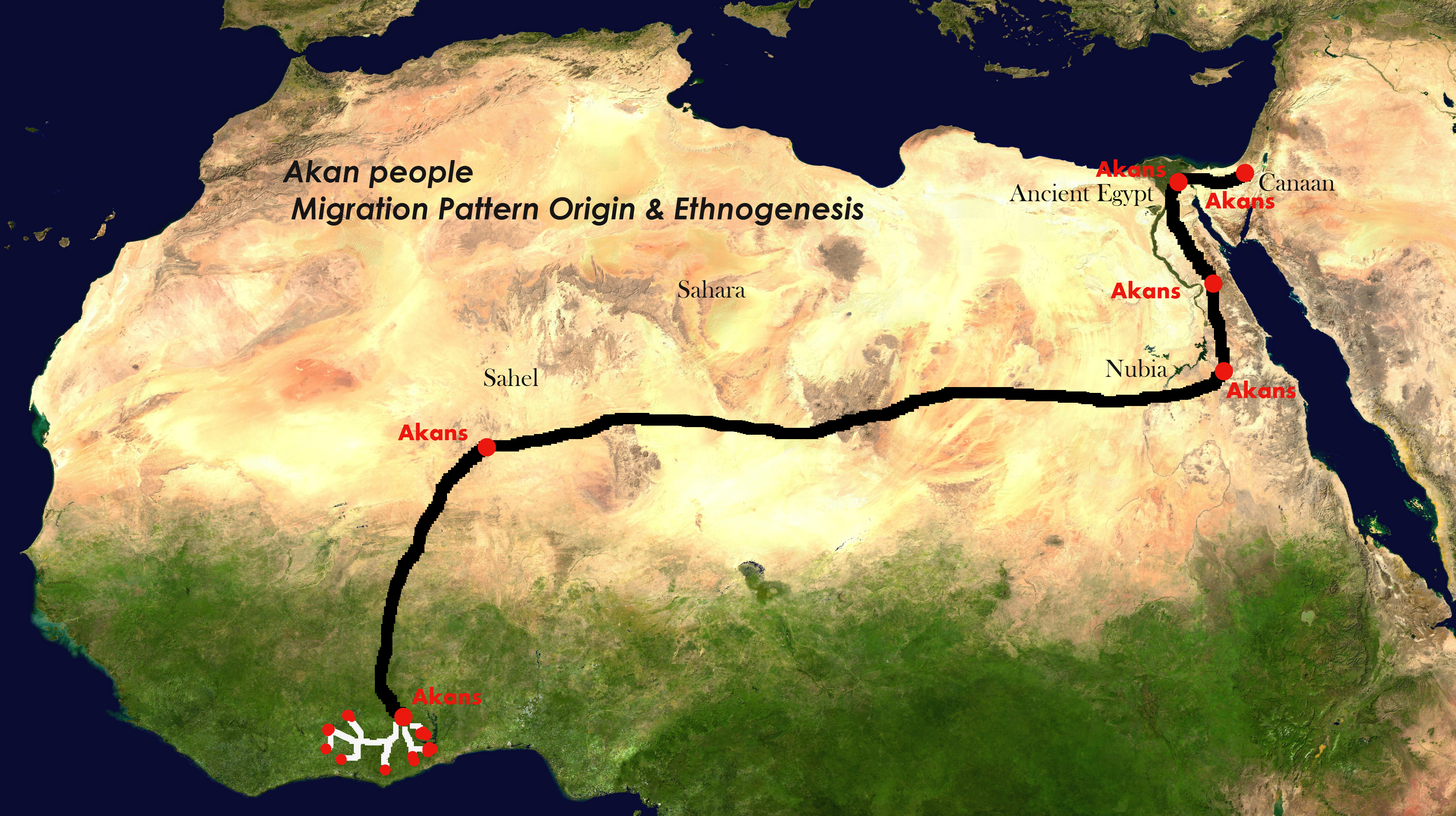
Haplogroup L2a, in the modern Akan mtDNA gene pool originated East and West spread along the Sahel corridor in Maghreb or North Africa after the Last Glacial Maximum, or the origins of these expansions may lie earlier, at the beginnings of the Later Stone Age, ∼40,000 years ago; Akan L2 ~33% and Akan L2a 32%, also among Bedouin (Nomadic Arabs) 33% [Cerny et al. 2007], and in East Africa L2a was found 15% in Nile Valley- Nubia (Nubians and Copts), 5% of Egyptians, 14% of Cushite speakers, 15% of Semitic Amhara people, 10% of Gurage, 6% of Tigray-Tigrinya people, 13% of Ethiopians and 5% of Yemenis. Haplogroup L2a also appears in North Africa, with the highest frequency 20% Tuareg, Fulani (14%). Found also among some Algeria Arabs, it is found at 10% among Moroccan Arabs, some Moroccan Berbers and Tunisian Berbers. (watson 1997) et al., (vigilant 1991) et al. 1991.
Haplogroup L3; in the modern Akan mtDNA gene pool the L3d and L3e1, arose in East Africa a relatively small number of migrants carried it across the Red Sea to the Arabian Peninsula, inaugurating an intercontinental migration that eventually settled every major land mass on Earth except Antarctica and that small group also gave rise to every non-African haplogroup.
Haplogroup U that is widely distributed across Western Eurasia (Eurasia), North Africa (Maghreb), and South Asia is in the modern Akan mtDNA gene pool sub-clade U6 (U6a1) at 1%; Haplogroup U is designated 'Clan Ursula', as is, more specifically, Haplogroup U5. Akans are diverse in phenotype with bigger average height (Akans are bigger average height precisely on average over "1.86 metres in height" and over "6 feet 1½ inches in height" for Akan males; and precisely on average over "1.80 metres in height" and over "5 feet 11 inches in height" for Akan females).
Y-DNA
Haplogroup E-M33 is in the modern Akan Y-DNA gene pool sub-clade "E1a" at 3% = 1/32; Haplogroup E-M33, along with haplogroup E-P177, is one of the two main branches of the older E-P147 and the E-M33 clade is divided into several subclades.
Haplogroup E-V38 is in the modern Akan Y-DNA gene pool sub-clade "E1b1a" at 84%; Haplogroup E-V38 is the phylogenetic term for the series of unique sequence variants on the Y-chromosome and Haplogroup E-V38 sub-clade E1b1a is found in Akan males and their descendants and is heritably passed in lineage from Akan father to son. Geneticists studied the Haplogroup E-V38 variants in populations to find the evolutionary lineage to a common male human ancestor and it can also be referred to in phylogenetic nomenclature by names such as "E1b1a" (although the exact definition of phylogenetic names can vary over time). Haplogroup E-V38 has two basal branches, E-M329 and E-M2, the former is almost exclusively found in Ethiopia, while the latter is the predominant lineage in Western Africa, Central Africa, Southern Africa, North Africa and the southern parts of Eastern Africa. E-M2 has several sub-clades, however many members are included in either E-L485 or E-U175.
Haplogroup E-M215 is in the modern Akan Y-DNA gene pool sub-clade "E1b1b" at 1.1%; Haplogroup E-M215, also referred to in the literature by other names such as "E1b1b" and "E3b", is a division of the macro haplogroup E-M96, which is defined by the single nucleotide polymorphism (SNP) mutation M215. In other words Haplogroup E-M215 links from father-to-son back to a common male-line ancestor. Haplogroup E-M215 is a subject of discussion and study in genetics as well as genetic genealogy, archaeology, and historical linguistics. E-M215 has two ancient branches that contain all known modern E-M215 men, E-M35 and E-M281. Of these two, the only branch that has been confirmed in a native population outside of Ethiopia is E-M35, which in turn has four known branches, E-V68, E-Z827, E-V6 and E-V92. The first two, E-V68 and E-Z827 contain by far the majority of all modern E-M215 men. E-V68 and E-V257 have been found in highest numbers in North Africa and the Horn of Africa; but also in lower numbers in parts of the Middle East and Europe, and in isolated populations of Southern Africa. The remaining two branches, E-V6 and E-V92 have mostly been observed in Ethiopia.
Haplogroup R1b (Y-DNA) is in the modern Akan Y-DNA gene pool at 3% = 1/32; R1b is the dominant paternal lineage of Western Europe, and "Haplogroup R1b" is the most frequently occurring Y-chromosome haplogroup in Western Europe and in parts of sub-Saharan Central Africa. "R1b" is also present at lower frequencies throughout Eastern Europe, Western Asia, Central Asia, and parts of North Africa, South Asia, Siberia, and Russian Plain. Due to European emigration it also reaches high frequencies in the Americas and Australia. While Western Europe is dominated by the R1b1a2 (R-M269) branch of R1b, the Chadic-speaking area in Africa is dominated by the branch known as R1b1c (R-V88). These represent two very successful "twigs" on a much bigger "family tree".
HLA antigens
(click for larger image)
Akan ethnic group HLA antigens MHC complex class I and class II antigens analysis of HLA -A, -B, -C, -DR, -DQ, and -DP on chromosome 6p21.3 typing completed on HLA-B serotypes indicated frequencies HLA-B7 (5%), HLA-B8 "Super B8" (2.3%), HLA-B14 (2.3%), HLA-B15 (8%), HLA-B18 (2.3%), HLA-B27 (1.1%), HLA-B35 (5.7%), HLA-B42 (3.4%), HLA-B44 (3.4%), HLA-B45 (9.1%), HLA-B51 (2.3%), HLA-B52 (3.4%), HLA-B53 (22.7%), HLA-B57 (4.6%), HLA-B58 (2.3%), HLA-B63 (4.6%), HLA-B70 (8%), HLA-B78 (2.3%); Akan overall HLA-B gene antigen serotype frequencies encoding indicate that the Akan populace HLA-B gene appear more similar to Indo-Aryan or Mongoloid than to African and Niger–Congo populaces. The HLA-B haplotypes serotype with highest significance and characteristics of the Akan populace is HLA-B53 at 22.7% (A36-Cw4-B53 haplotype) which is higher than any other international ethnic groups or any race in the world; Genetic engineers have revealed that HLA-B gene serotype version HLA-B53 causes immunity to malaria.
Anatomy
Akan males of Akanland Ghana are ranked 3rd on Earth in terms of larger penis size by the study of the scientific journal Personality and Individual Differences of International Society for the Study of Individual Differences (ISSID).
See also
- Y-DNA haplogroups by populations of Sub-Saharan Africa
External links
- National Institutes of Health, MtDNA diversity of Ghana: a forensic and phylogeographic view, May 11, 2011
- NBCNews.com, She traces genetic ‘Roots’ to Africa