
Euroexam International
Euroexam International is a provider of English and German language exams with its headquarters in London, U.K. and Budapest, Hungary and test centres in 18 countries across Europe and the Russian Federation.
Tests are available at levels A1 to C1 on the CEFR scale and Euroexams were the first to be developed on the basis of the Common European Framework of References.
Introduction
Euroexams are internationally accredited tests of English language proficiency currently taken by candidates in various parts of Europe and Russia. They were established in 2001 and are managed by The Euroexam Centre. They came into being as a response to a perceived need for public state-accredited language examinations in Hungary and have spread in the Central European region afterwards, later expanding its operations to various other Western European countries and Russia. Euroexams were the first suite of language exams based directly on the Common European Framework with the purpose of offering a test of language proficiency that meets the growing demands for modern language education and testing that focuses on measuring real communication as opposed to theoretical knowledge.
The Euroexam Centre has since then partnered up with an extensive network of testing centres and organisations in the region. The Centre's vision remains to keep creating materials and exams that allow students to actually enjoy the process of learning a language by experiencing a constant sense of achievement while communicating in a foreign language and taking fair and challenging exams along the way. It also believes in the importance of prioritizing communicative ability over mere lexical and grammatical knowledge of a language.
Euroexam’s General English tests are provided at five levels: A1, A2, B1, B2 and C1. For Business English candidates, the EuroPro exams are available at B1, B2 and C1 levels. Euroexams are also offered in German at A2, B1, B2 and C1 levels. In light of its focus on measuring communicative ability first and foremost, Euroexam tests do not have a grammar and vocabulary paper.
The Centre's activities are supported by the Euroexam International Advisory Board, which provides management with strategic advice on issues relevant both to its present activities and future development. Its members include Norman Verhelst (Specialist in Psychometrics, Senior Researcher/CITO The Netherlands, Assistant Professor/Utrecht University), Garth Emrich (Strategic Management Advisor and Director at Barclays Wealth and Investment Management), Michael Carrier (Consultant in Language Learning and Assessment, formerly director at International House) and Keith Watts (Verba International, former representative of City & Guilds exams in Russia). The Board meets in London twice a year.
History
The Euroexam Centre was founded in September 2000 within International House Budapest and the first Euroexams were launched the following year. By November 2004 the Centre had become an independent entity under the name of 'Euro Examinations Ltd', keeping its professional partnership with International House.
Timeline
2000 The Euroexam Centre is established in September within International House
2001 The first sitting of the Euroexam takes place with 105 candidates
2004 The Euroexam Centre becomes an independent entity (Euro Examinations Ltd)
2005 Euroexam partners with the British Chamber of Commerce in Spain
2011 Euroexam e-learning services are awarded the European Language Label of the European Commission
2015 The Language Policy Unit of the Council of Europe invites Euroexams to participate in the “Illustrative Reading & Listening test tasks and items related to the CEFR” project
2015 Euroexams starts operations in the Russian Federation
2015 20,000 people across Europe take the Euroexams
2016 The number of Euroexam network's partner institutions reaches 85
Exam Structure and Timing Overview
The Number of Tasks in Each Test of the Exam
Test |
Level A1 |
Level A2 |
Level B1 |
Level B2 |
Level C1 |
Reading |
3 |
3 |
3 |
3 |
3 |
Writing |
2 |
2 |
2 |
2 |
2 |
Listening |
3 |
3 |
3 |
3 |
3 |
Speaking |
4 |
4 |
4 |
4 |
3 |
Total |
12 |
12 |
12 |
12 |
11 |
The Timing of Each Task in thet Tests of the Exam
Test |
Level A1 |
Level A2 |
Level B1 |
Level B2 |
Level C1 |
Reading |
25 min |
35 min |
35 min |
35 min |
45 min |
Writing |
20 min |
30 min |
50 min |
60 min |
60 min |
Listening |
35 min |
30 min |
30 min |
35 min |
40 min |
Speaking |
13 min |
16 min |
20 min |
20 min |
20 min |
Total |
1:35 hr |
1:45 hr |
2:15 hr |
2:30 hr |
2:45 hr |
Summary of the A1 (Breakthrough) Level Exam
Name of exam part |
Number of tasks |
Duration |
Maximum score |
Reading |
3 |
25 min |
25 |
Writing |
2 |
20 min |
25 |
Listening |
3 |
35 min |
25 |
Speaking |
4 |
20 min |
25 |
Total |
12 |
1h 40 min + breaks |
100 |
Summary of the A2 (Waystage) Level Exam
Name of exam part |
Number of tasks |
Duration |
Maximum score |
Reading |
3 |
35 min |
25 |
Writing |
2 |
30 min |
25 |
Listening |
3 |
30 min |
25 |
Speaking |
4 |
20 min |
25 |
Total |
12 |
1h 55 min + breaks |
100 |
Summary of the B1 (Threshold) Level Exam
Name of exam part |
Number of tasks |
Duration |
Maximum score |
Reading |
3 |
35 min |
25 |
Writing |
2 |
50 min |
25 |
Listening |
3 |
approx 35 min |
25 |
Speaking |
4 |
20 min |
25 |
Total |
12 |
2h 20 min + breaks |
100 |
Summary of the B2 (Vantage) Level Exam
Name of exam part |
Number of tasks |
Duration |
Maximum score |
Reading |
3 |
35 min |
25 |
Writing |
2 |
60 min |
25 |
Listening |
3 |
approx 35 min |
25 |
Speaking |
4 |
20 min |
25 |
Total |
12 |
approx 2.5h + breaks |
100 |
Summary of the C1 (Operational Proficiency) Level Exam
Name of exam part |
Number of tasks |
Duration |
Maximum score |
Reading |
3 |
45 min |
25 |
Writing |
2 |
60 min |
25 |
Listening |
3 |
40 min |
25 |
Speaking |
4 |
20 min |
25 |
Total |
11 |
2h45 min + breaks |
100 |
CEFR alignment
From their inception in 2001, Euroexams have been based directly on the Common European Framework, the international standard now adhered to by all other international language exams, universities and workplaces that provides a comprehensive basis for designing language courses and for writing teaching and learning materials. It is now accepted as the new standard for language testing all over Europe and other continents too available in thirty-nine languages. 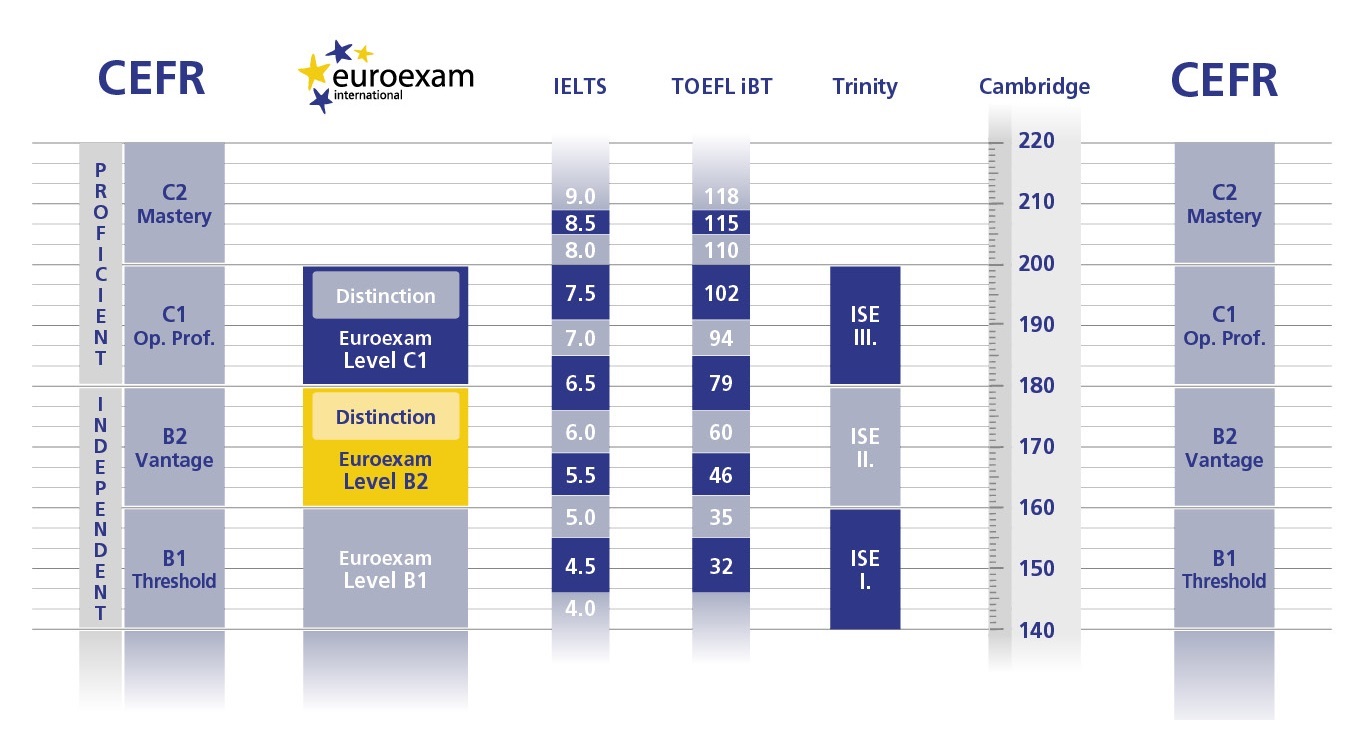 Euroexam provides tests of communicative English language proficiency at five of the six levels of the CEFR, which is a practical tool for language professionals to evaluate different linguistic competencies with the help of the ‘can do’ descriptors.
Euroexams are written, marked, and the results calibrated based on the CEFR levels. This means that a Euroexam C1 level pass is equivalent to any other exam board’s C1 level pass, for example IELTS 6.5 with no element less than 5.5., or Cambridge English Language Assessment's 180 or CAE Grade C. (See Table 1)
Euroexams has been directly involved in a number of CEFR development projects, the last of which was in 2016. Euroexam employs a combination of internal and independent research to support its claim of equivalence with CEFR and other major exams.
Expected performance at each level
Level A1 (Breakthrough)
Listening - Candidates on this level can understand speech which is slowly and clearly articulated and include long pauses to allow them to construct its meaning. They can decode simple instructions if chunked properly and enunciated with clarity.
Reading - Candidates on this level can cope with short, simple texts where they have to analyze single building blocks of the text at a time to recognize familiar names or other basic words. Candidates will need to reread sections of the text multiple times to be able to carry out the task, such as understand short, simple messages. They can be expected to mine short informative or descriptive texts with the help of visual support or grasp short, simple written directions.
Speaking - Candidates on A1 level can carry out very simple interactions where communication is supported by repetition and a slower rate of speech than in real life. They will need the message to be paraphrased to them and will rephrase and repair a lot while speaking themselves, but can be expected to participate in simple communication to ask and answer simple questions, initiate and respond to simple statements in basic, everyday life situations involving familiar topics. Candidates should be able to produce simple, mostly isolated utterances about such basic topics as people and places. They can describe themselves including what they do for a living and where they live. They should be able to introduce themselves using basic words and simple phrases and ask others how they are or react to news.
Writing - Candidates on this level are capable of writing simple and isolated phrases and sentences about themselves or imaginary people tackling such familiar topics as where they live and what they do. They can fill in a form requiring the use of such personal information as numbers, dates, their own name, nationality, address, age, or date of birth.
Level A2 (Waystage)
Listening - A2 level candidates are able to understand a text read out to them as long as the speech is clearly articulated and relayed to them slowly. They can cope with phrases and expressions related to simple topics such as their family, shopping or everyday habits, local geography or their employment.
Reading - In reading A2 level candidates are able to cope with short, simple texts on familiar topics discussing concrete information using high-frequency lexis and grammar or Latinate vocabulary that appear in their L1 as well.
Speaking - In speaking candidates on this level can be expected to interact well in simple and routine tasks requiring a simple and direct exchange of information on familiar and routine matters to do with work and free time. They can handle short exchanges successfully as long as the other party rephrases enough and keeps the conversation going. Candidates should be capable of giving simple descriptions or presentations about concrete matters such as people, living or working conditions, daily routines, likes/dislikes, as a short series of simple phrases and sentences that are not linked with great authenticity. They can deliver very short, rehearsed announcements of predictable, learnt content intelligibly enough to a listener.
Writing - On this level candidates should be able to produce a series of simple written phrases and sentences linked with simple connectors such as ‘and’, ‘but’ and ‘because’. They can write about everyday aspects of their environment, including people, places, a job or study experience in linked sentences. They can write very short, basic descriptions of events, past activities and personal experiences.
Level B1 (Theshold)
Listening - B1 level candidates understand the main points of clear standard speech about familiar topics that they regularly come across in their life at school or their workplace. They can grasp the main point of a radio programme on current affairs or topics of personal or professional interest if these are delivered slowly and clearly.
Reading - Candidates on this level can cope with texts that consist mostly of frequent everyday or professional vocabulary and grammar and can understand the description of events, as well as feelings and wishes in personal letters.
Speaking - B1 level candidates' spoken interaction can cope with most situations likely to arise while travelling in an area where the language is spoken. They can participate in conversations without preparations on matters that are either familiar to them or are of an everyday nature (e.g. family, hobbies, work, travel and current events). In speaking production B1 level candidates are capable of joining phrases in a simple way in order to describe experiences and events, dreams, hopes or ambitions. They can give simple reasons and explanations for opinions and plans or narrate a story.
Writing - B1 level candidates can write simple connected text on topics which are familiar or of personal interest to them, including personal letters describing experiences or their impressions.
Level B2 (Vantage)
Listening - B2 level candidates will be able to understand extended speech and lectures as well as follow complex lines of argument provided the topic is reasonably familiar. They can understand most TV news and current affairs programmes and the majority of films in standard dialects.
Reading - Candidates on this level are capable of reading texts dealing with contemporary problems in which the writers adopt a particular attitude or viewpoint.
Speaking - In their speaking interaction B2 level candidates demonstrate a degree of fluency and spontaneity that makes regular interaction with native speakers possible. They can also take an active part in discussions in familiar contexts, accounting for and sustaining their opinions. Candidates will be able to present clear, detailed descriptions on a wide range of subjects or explain a viewpoint on a topical issue clearly articulating the advantages and disadvantages of various options.
Writing - On this level candidates are capable of producing clear, detailed texts on a wide range of subjects. They can manage a wider variety of genres including essays or reports; passing on information or giving reasons in support of or against a particular point of view. They can be expected to write letters highlighting the personal significance of events and experiences.
Level C1 (Operational Proficiency)
Listening - C1 level candidates are able to understand even extended, semi-authentic speech with false starts and natural hesitations and various types of implicit referencing throughout an utterance. They can understand television programmes and films with very little effort.
Reading - Candidates on this level can handle long and complex factual and literary texts in reading, appreciating distinctions of style and the writer's attitude or purpose. They can understand specialised articles and longer technical instructions, even when they do not relate to the field these are about.
Speaking - C1 candidates can express themselves without too much hesitation and a great deal of spontaneity. They can use language flexibly and effectively for social and professional purposes and formulate ideas and opinions with precision while relating their contributions skilfully to those of the other speakers around them. Candidates are able to present clear, detailed descriptions of complex topics integrating sub-themes, developing different points and rounding off with an appropriate conclusion.
Writing - In writing they can express themselves in a clear, well-structured text, expressing points of view at length. They can write about complex subjects in a letter, an essay or a report, underlining what they consider to be the salient points while bearing the reader in mind.
EuroPro exams
EuroPro exams test candidates' general business English. There are some structural as well as topical/lexical differences between EuroPro and general Euroexams. As opposed to the general exam, in Euro Pro the topics dealt with throughout the whole exam are of general business English and include, for example, working hours and salary, workplace hierarchy, markets and marketing and generic HR issues.
Validity and test production
The validity of the exam is measured by the extent it fulfills its measurement purposes. The validation process considers aspects related to the construct of the exam, that is, its underlying theory of the language ability that is tested in each part of the exam. This is ensured through regular analysis of task content and statistical analysis of task and item performance.
Each exam administration uses a calibrated item bank of common tasks, which produces directly comparable results. A set of routine statistical analyses, such as the calculation of p-values, testlet and test reliability, and IRT analysis is performed after each exam session.
Before administration, the exam material is subject to two rounds of moderation by a panel of judges, pretesting and statistical analysis.
Dictionary use
At Euroexams candidates may use a dictionary during all or part of each paper of the test. Any printed bilingual dictionaries, business dictionaries or thesauruses are allowed. Candidates are advised only to use these as a last resort for efficient time-management.
Awards
Euroexam International first received the European Language Label in 2001, quoting its “innovative approach in applying the Common European Framework in test development". In 2011, it received the same award for the development of its e-learning facilities.
Membership of professional organisations
Euroexam international is a member of the following organisations, which are active in the field of language teaching and assessment.
- EALTA - European Association for Language Testing and Assessment (institutional member)
- Eaquals - Evaluation and Accreditation of Quality Language Services (associate member)
- ICC - the international language association e.V. (full member)
- ALTE - Association of Language Testers in Europe (institutional affiliate)
- EnglishUK - national association of accredited English language centres in the United Kingdom (corporate member)
Teacher and examiner training activities
Euroexam International established a teacher training department in 2002, which is responsible for the training of examiners and teachers preparing students for the Euroexams. One of The Two main 30-hour accredited courses focuses on helping teachers successfully prepare their students for the exams. The aim of the other course is to train accredited oral examiners (both assessors and interlocutors).
External links
- ALTE
- Cambridge English
- Common European Framework of Reference
- EALTA
- Eaquals
- Euroexam International
- European Language Label
- ICC
- IELTS
- EnglishUK