
E.D. Gleason
Ernest Dewey Gleason, known as E.D. Gleason (September 9, 1899—July 25, 1959), was a Democratic member of the Louisiana House of Representatives from the Evergreen Community near Minden in Webster Parish in northwestern Louisiana. Gleason served from 1952 until his death at the end of his second term. He was briefly succeeded in office by his widow, Mary Smith Gleason (1899-1967), who was appointed for the remaining eight months by then Governor Earl Kemp Long.
Gleason was born in Shongaloo in central Webster Parish to William Thomas Gleason (February 18, 1868—September 14, 1947) and the former Annie Craton (April 15, 1877—February 18, 1952). He graduated in 1918 from Cotton Valley High School in nearby Cotton Valley, north of Minden. He worked in Caddo Parish from 1919-1935, when he began to manage his own farm in Evergreen. He was subsequently named vice president of the Webster Parish Farm Bureau.
He ran unsuccessfully in 1944 for the Webster Parish Police Jury, having been defeated by a 20-vote margin by the incumbent J.L. Munn, who served from 1936-1952. After the police jury candidacy, the Gleasons lost one of their three sons, Thomas D. Gleason (August 7, 1924—November 17, 1944), to hostile action in the United States Army Air Corps during World War II.
Gleason was elected to succeed interim Representative Lizzie P. Thompson of Doyline, who also had been appointed by Governor Long when her husband, Representative C.W. Thompson, died in office in 1951. As a lawmaker, Gleason worked alongside the Bossier-Webster state senators, John J. Doles and Herman "Wimpy" Jones. He worked for an extra judgeship for the 26th Judicial District, the construction of a new National Guard armory on Constable Street in Minden, expansion of the Cotton Valley oil field, and several highway projects. He introduced a bill for a new one-cent state sales tax earmarked for teacher salaries. He also supported segregation, as did most Louisiana lawmakers at the time of the civil rights movement.
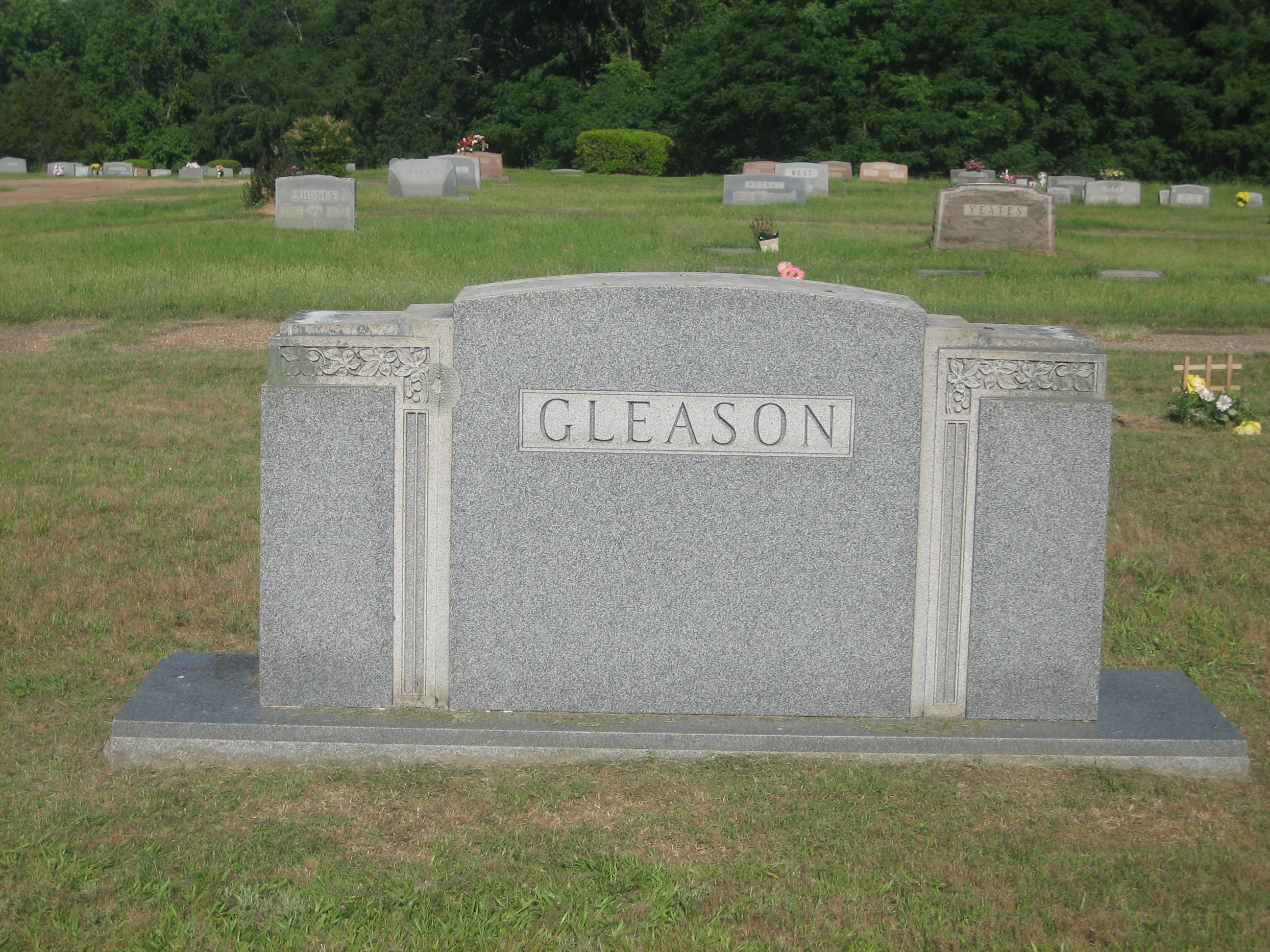
Gleason filed for a third term in 1959 but died of a heart attack in the Minden Sanitarium three months later. Services were held at the Evergreen Baptist Church. Interment was at Minden Cemetery. In addition to his wife, he was survived by two other sons, William E. Gleason, an educator later in Plaquemine, and Charles E. Gleason of Shreveport; a brother, Raleigh R. Gleason of Minden, and a sister, Gladys G. McGritinsey of Shreveport
Mrs. Gleason did not contest the seat in The Primary held in December 1959. Instead, son William Gleason (born ca. 1919) filed for the position. He ran moderately strong in the Democratic primary but finished in fourth place, thirty-one votes behind Minden businessman Frank B. Treat, Jr. (1923-1994), the third-place candidate. The coveted runoff berths went to Parey P. Branton, a former president of the Webster Parish School Board, and the Minden attorney and businessman Henry G. Hobbs. Hobbs led Branton in the primary, 1,634-1504, but in the runoff, Branton, a Shongaloo businessman, prevailed by 16 ballots: 4,300 votes (50.01 percent) to 4,284 (49.99 percent). Branton carried only two of the five wards in the parish to take the seat. Branton was then elected without Republican opposition in the April 19, 1960, general election and held the seat until 1972, though Hobbs, longtime president of the Webster Parish Library Board, ran unsuccessfully for the position several more times.