
E. D. Gleason
Ernest Dewey Gleason, known as E. D. Gleason (September 9, 1899 – July 25, 1959), was a Democratic member of the Louisiana House of Representatives from the Evergreen Community north of Minden in Webster Parish in northwestern Louisiana. Gleason served from 1952 until his death at the end of his second term. He was briefly succeeded in office by his widow, Mary Smith Gleason, who was appointed for the remaining eight months by then Governor Earl Kemp Long.
Background
Gleason was born in Shongaloo in central Webster Parish to William Thomas Gleason (February 18, 1868—September 14, 1947), a planter and banker, and the former Annie Craton (April 15, 1877—February 18, 1952). He graduated in 1918 from Cotton Valley High School in nearby Cotton Valley, north of Minden. The school closed in 2011. Gleason worked in Caddo Parish from 1919 to 1935, when he began to manage his own farm at Evergreen. He was subsequently named vice president of the Webster Parish Farm Bureau.
Gleason ran unsuccessfully in 1944 for the Webster Parish Police Jury, having been defeated by a 20-vote margin by the incumbent J. L. Munn, who served from 1936 to 1952. After the police jury candidacy, the Gleasons lost one of their three sons, Thomas D. Gleason (August 7, 1924—November 17, 1944), to hostile action in the United States Army Air Corps during World War II.
Political career
In 1947, Gleason joined Minden accountant Larkin L. Greer (1902–1991) and attorney Floyd D. Culbertson, Jr., who had been the mayor of Minden from 1940–1942, as co-chairmen of the Webster Parish "Kennon Club" to support Robert F. Kennon for governor of Louisiana. Kennon, also a former mayor of Minden, however, was eliminated in the Democratic primary. Former Governor Earl Long defeated another former governor, Sam Houston Jones, to return to office in 1948.
Gleason was elected to succeed interim Representative Lizzie P. Thompson of Doyline, who also had been appointed by Governor Long when her husband, Representative C.W. Thompson, died in office in 1951. In his successful legislative race, Gleason ran newspaper advertising on the theme "Better Highways". As a lawmaker, Gleason worked alongside the Bossier-Webster state senators, John J. Doles, Sr., a banker from Plain Dealing, and Herman "Wimpy" Jones, a businessman from Bossier City and Minden. As representative, Gleason worked for an extra judgeship for the 26th Judicial District, the construction of a new National Guard armory on Constable Street in Minden (since relocated), expansion of the Cotton Valley oil field, and several highway projects.
In 1956, Gleason won reelection by defeating Dr. Paul M. Campbell, who resigned from the Minden City Council in order to challenge the representative. Two other candidates, including B. C. Eeds of Cullen and the Minden barber Homer D. Acklen (1907–1981), also contested the election.
Gleason introduced a bill for a new one-cent state sales tax earmarked for teacher salaries. Governor Earl Long voiced opposition to the tax, but Gleason said that he believed Long would reverse himself if sufficient public support for the tax increase developed among the electorate. He also supported segregation, as did most Louisiana lawmakers at the time of the civil rights movement. Gleason also supported a bill to make liability insurance compulsory. Gleason supported right-to-work legislation, his view having been that workers should not be forced into union membership. He also favored old-age pensions and expanded farm-to-market roads.
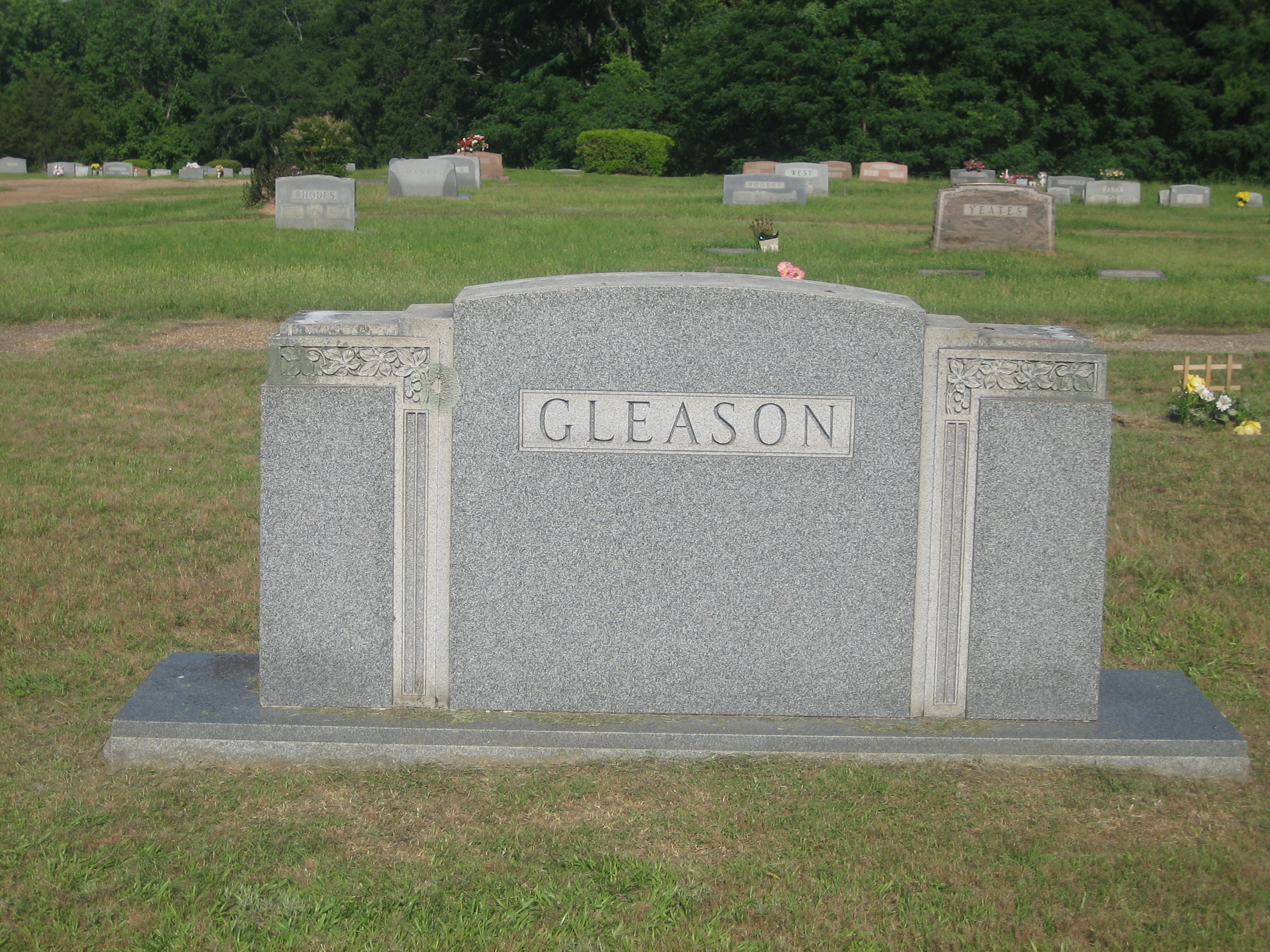
The race to succeed Gleason
Gleason filed for a third term in 1959 but died of a heart attack in the Minden Sanitarium three months later. Services were held at the Evergreen Baptist Church. Interment was at Minden Cemetery. In addition to his wife, he was survived by two other sons, William Ernest "Cotton" Gleason (born ca. 1919), an educator who taught at Minden High School, relocated to Plaquemine, and later returned to Evergreen, and Charles E. Gleason of Shreveport; a brother, Raleigh R. Gleason of Minden, and a sister, Gladys G. McGritinsey of Shreveport.
Mrs. Gleason did not contest the seat in the primary held in December 1959. Instead, son William Gleason filed for the position. He ran moderately well in the Democratic primary but finished in fourth place, thirty-one votes behind Minden businessman Frank B. Treat, Jr. (1923–1994), the third-place candidate. The coveted runoff berths went to Parey P. Branton, a former president of the Webster Parish School Board fron Shongaloo, and the Minden attorney, Henry Grady Hobbs (1923-2012), a Sarepta native later long active on the Webster Parish Library Board. Hobbs led Branton in the primary, 1,634-1,504, but in the runoff, Branton, a Shongaloo businessman, prevailed by 16 ballots: 4,300 votes (50.01 percent) to 4,284 (49.99 percent). Branton carried only two of the five wards in the parish to take the seat. Branton was then elected without Republican opposition in the April 19, 1960, general election and held the seat until 1972, though Hobbs, longtime president of the Webster Parish Library Board, ran unsuccessfully for the position again in 1967 against Branton.
Cotton Gleason case
Thereafter, William E. "Cotton" Gleason was arrested in 1961 for having given barbiturates known as "Yellow Jackets" to at least two female students at Minden High School. On February 2, 1962, he received a $1,000 fine and a two-year sentence, both suspended. Four months later he was pardoned by Governor Jimmie Davis. After his arrest, Gleason resigned from Minden High School. He then hired Shreveport attorney Whitfield Jack, brother of his late father's House colleague, Wellborn Jack, to procure reinstatement, having claimed that his resignation was under emotional duress. However, Gleason was not reemployed by the Webster Parish School Board.