
Cockatiel (aviculture)
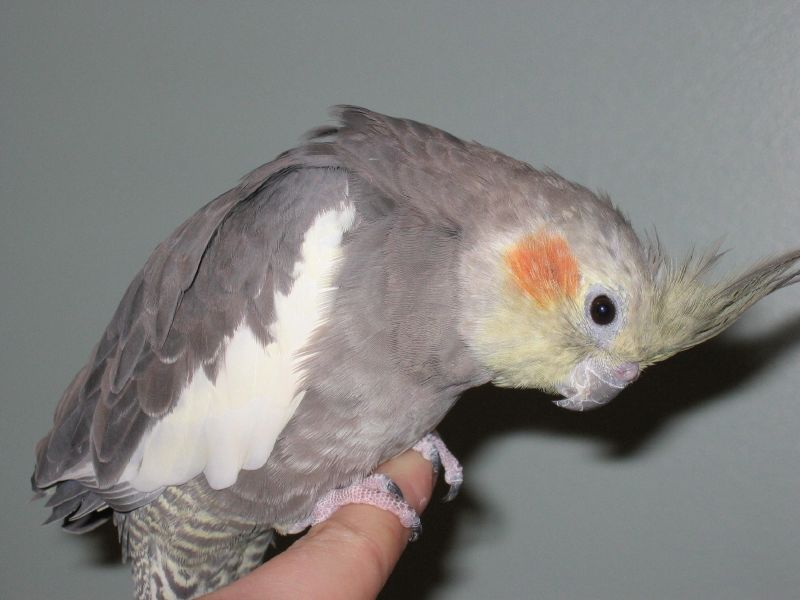 Cockatiels (Nymphicus hollandicus), are GeneRally regarded as good pets or companion parrots, having a sweet demeanor, though this is by no means a guarantee. Like most other pets, the manner in which the animal is raised, handled, and kept has a profound effect on the temperament of the animal. Some birds are quite gregarious and sociable while others can be shy, retreating to the back of the cage when an unfamiliar figure appears. If handled often and if they have a patient owner the cockatiel(s) will become tame very quickly compared to some of the other parrot species.
Background
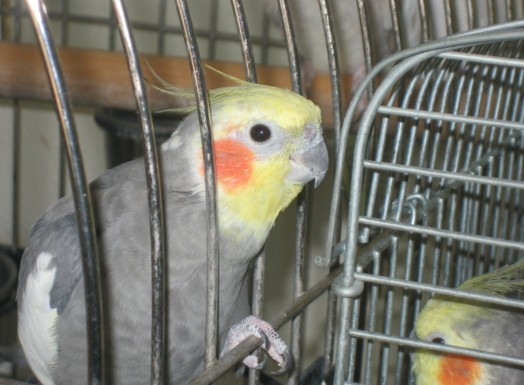 Cockatiels are generally kept in a cage and allowed to exercise and socialise with its owner outside of the cage for a few hours a day. In a specially prepared household environment Cockatiels May Be permitted to roam freely AbOUT a home or apartment, if the owner takes certain precautions; such as clipping the bird's wing feathers if the rooms have ceiling fans or other hazards that might pose a risk to the bird (stoves, chimneys, toilets, etc.). A scared cockatiel will choose flight over fight most of the time, and may injure itself accidentally. As a social bird, cockatiels prefer areas with a lot of activity during the waking hours, and return to a secluded area when it is time to sleep. Cockatiels may peacefully nap on or near their owner(s), including the owner's chest and shoulders if the owner is stationary for a long period of time.
Generally, well-socialized birds are gentle and friendly. Some cockatiels enjoy physical contact, lending themselves well to taming. Many cockatiel owners develop regular bonding rituals with their animals, engaging in preening, scratching, and even petting. A cockatiel that wishes to be petted will often lower his head or nibble at the owner's fingers to indicate that it wishes to have its head and neck scratched (two places it can't easily scratch on its own), and will emit a low squawk to show its pleasure. Cockatiels which are hand-fed and purchased from a young age are more readily suited for physical contact.
Some birds will emit a distinctive 'hiss' when irritated, retreating rapidly or defending with pecking bites, which can be relatively strong for their size, and the sharp [...] edges of their beaks can easily penetrate human skin causing a bleeding wound. This hissing may be coupled with the bird tapping its beak on a hard surface to generate additional attention while lowering its head and spreading its wings in a display of aggression.
Cockatiels do have a reputation for being demanding of the attention of their owners on a regular basis. Though noisy at times, their vocalizations range from ginger cheeps to piercing cries but they lack the screeching voice of other parrots (males are the loudest in comparison to the small peeps from a female). A cockatiel that has bonded with an owner may emit vocalizations if that owner leaves the room. Cockatiels permitted to roam freely will often seek out the owner by going from room to room or following the owner around the house; or, if the owner happens to be outdoors, going from window to window to keep the owner in visual range. Cockatiels may also recognize the signs of an owner preparing to go out and put themselves into their own cage.
Tamed cockatiels require a consistent few hours of quality time per day with a person or in a person's company and a good night's sleep in an area with very little noise or distractions. Following a natural daylight schedule is the best arrangement for sleep contrary to the popular belief that all birds must have 12 hours sleep each night. The reason for this is exposure to dawn and dusk causes a reaction which cannot be replicated. Dusk is especially important as it triggers the production of melatonin which makes the bird drowsy. Another reason for allowing exposure to a natural dawn and dusk, is some birds will react badly to its cage being covered, or the light being switched off. In the wild, it would not suddenly become dark, and suddenly become light again, so when it does in captivity, some birds will get confused and scared and may start thrashing around in their cage.
If left on their own, quiet birds will frequently make contact calls with their owners, calls that sometimes can be quite loud if the person is out of sight. Cockatiels can grow so attached to their owners that they may try to 'protect' them from anyone that tries to come near them, such as a partner or family member, by biting or hissing. This happens especially if cockatiels are kept in bedrooms or other rooms that are not generally shared by everyone in the family, because cockatiels perceive those rooms as their own personal territory. By keeping cockatiels in a shared household room, they are exposed to all family members equally and will not favour one person and feel the need to defend him or her as much. Cockatiels must be acquainted with the entire family, in order to assure even temperament toward all. The popularity of the Cockatiel as a pet is due in part because of its calm and timid temperament, to the point that they can even be bullied by smaller but more dominant birds such as Budgerigars and most particularly Lovebirds (Agapornis) or Parrotlets (Forpus). Budgerigars and Lovebirds may choose to pick at cockatiels' feet causing amputated toes, or may over-preen the Cockatiel's plumage, causing bald spots. It is not uncommon at all for a larger or smaller bird to maim the cockatiel, creating life-long disabilities and potentially life threatening injuries. However, some cockatiels will defend themselves.
Cockatiels don't necessarily make good pets for very young children because they startle easily with loud or unexpected sounds and may bite out of fear of sudden hand movements, however, they can make good pets for well-behaved older children. Once bonded with their owners, they will often cuddle and play, pushing their head against hands or FACES, tossing small items about for the owner to retrieve as a form of "reverse fetch", or whistling a favorite tune. Cockatiels, like almost all other parrots, love to chew paper and can chew objects (like cardboard, books, magazines, wicker baskets, etc) when left unattended.
Most cockatiels enjoy looking at themselves in mirrors and will engage in the activity for hours. Cockatiels that are exposed to mirrors perceive their reflections as their mates. This can induce hormonal behaviour (aggression and self-stimulation in males, egg-Laying in females) or frustration (due to the perceived non-responsiveness of the bird in the mirror) which can also lead to aggression. Upon seeing themselves once, Cockatiels are likely to experience anxiety until they find the mirror again.
The Cockatiel, is next behind the Budgerigar, as the most popular pet Parrot species. Today all Cockatiels available in the pet trade are captive-bred, as Australia no longer permits the export of native wildlife, whether endangered or not. As a result, the common way to acquire a cockatiel outside of Australia is to purchase one from a breeder or a pet store.
Often, a cockatiel sold through a pet store will have a toy in its cage when on display. Purchasing the toy to which the bird has become familiar helps comfort the bird as it adapts to its new surroundings. During times when the owner is in the room with the bird, the cage door can be left open and, once the bird has become comfortable with the owner's presence, the bird may exit the cage to investigate the owner. Forcing a bird to leave a cage if it isn't ready may cause the cockatiel to be less trusting of the owner.
Diet
Although Cockatiels in their natural-habitats of Australia eat mainly grass seeds, captive Cockatiels feed on either dry, sprouted and/or soaked seeds. A diet of only dry seeds is inadequate for Cockatiels and/or any parrot species' optimum health. Avian veterinarians recommend pet birds' diets be supplemented with foods such as:
- Bee Pollen:
- Good: The granules are the best whole food
- Whole cereals and whole grains :
- Good: amaranth, barley, couscous, flax, whole-grain pastas, oats, quinoa (truly a Fruit but used as a cereal), whole-wheat, wild-rice, whole rices.
- Edible blossoms and flowers:
- Good: carnations, chamomile, chives, dandelion, day lilies, eucalyptus, fruit tree blossoms, herbs' blossoms, hibiscus, honeysuckle, impatiens, lilac, nasturtiums, pansies, passion flower (Passiflora), roses, sunflowers, tulips, violets.
- Bad:Note that the leaves of some of these plants are poisonous to Cockatiels:
Agave,
Maguey,
Bayonet,
Agavaceae Toxic Principle: Sap from the leaves, Seeds, Calcium oxalate raphides, Acrid volatile oils, Mechanically injurious Clinical Signs: Oral mucosa irritation, Contact urticaria, Skin: Immediate burning, erythema, urticaria, and edema, Granuloma reaction from punctures by leaves Alacia
Amaryllis: Clinical Signs: Can cause vomiting, diarrhea, depression, appetite loss, tremors, drooling and abdominal pain American Yew
Apricot
Asparagus Fern - Sprengeri Fern, Lace Fern - Toxic Principle: Non-toxic, Berries, Sapogenins, Foliage Clinical Signs: Dermatitis, Irritant, Cardiac, sedative, and diuretic effects
Autumn Crocus/Meadow - Saffron
Avocado Azaleas: Can cause weakness, upset stomach, drooling, heart failure, depression and possible coma
Balsam Pear - seeds, outer rind of fruit
Baneberry - berries, root
Beans - all types if uncooked
Birch
Bird of Paradise - seeds
Bittersweet Nightshade
Black Locust - bark, sprouts, foliage
Bloodroot
Blue-green Algae - some forms toxic
Boxwood - leaves, stems
Bracken Fern
Broomcorn Grass
Buckthorn - fruit, bark
Buttercup - sap, bulbs
Caladium - leaves
Calla Lily - leaves
Candelabra Tree
Cardinal Flower -
Castor Beans:
Common Name:
Castor Bean,
Castor,
Castor Oil Plant,
palma Christi,
Wonder Tree, Higuerilla, Steadfast Toxic Principle: Leaves, Seeds, Ricin, Ricinin Clinical Signs: Decrease blood pressure, Hypothermia, Decrease in blood glucose, Increase in serum hepatic enzymes: AST, ALT, LDH, Increase in BUN, calcium, phosphorous, Upset Stomach, Vomitting, Abdominal Pain, Nausea, Diarrhea, Anorexia, Trembling, Weakness, Sudden Collapse, Seizures, Exercise intolerance, Ataxia, Slight Depression, Copious thick, ropy salivation, Thirsty Catnip Common Name: Catmint, Catnip Toxic Principle: Volatile oil Clinical Signs: Odd behavior, Drowsiness, Disorientation Chalice Vine/Trumpet vine Cherry Tree - bark, twigs, leaves, pits Chinaberry Tree Christmas Candle - sap Clematis/Virginia Bower Coral Plant - seeds Coriander Cowslip/Marsh Marigold Crown of Thorns aka Christ Plant, Christ Thorn, Crown of Thorns Toxic Principle: Miliamines, Terpenes, Diterpenes, Alkaloidal esters of diterpenoid ingenol, Stems: the juice, leaves, and thorns Clinical Signs: Eye irritation, Vomiting, Skin irritation, Diarrhea, Irritation to gastrointestinal tract Croton Curry Powder Daffodil / Bulbs: Clinical Signs: Can cause severe gastrointestinal illness, convulsions, seizures, low blood pressure and tremors. Daphne - berries Datura - berries Deadly Amanita Death Camas Delphinium Dumb Cane aka Dumb Plant, Dumb Cane, Mother-in-law’s Tongue Plant Toxic Principle: Histamine poisoning, All parts: leaves, stems, sap, Proteolytic enzymes, Calcium oxalate crystals, Other toxins Clinical Signs: Swelling of throat, Impairment of speech, Excessive salivation, Pain and swelling of mouth, Skin rashes Eggplant - fruit okay / leaves toxic Elderberry Elephants Ear/Taro - leaves, stem English Ivy berries, leaves English Yew Euonymus/Spindle Tree False Hellebore False Henbane Ficus (weeping) Fiddle-leaf Philodendron aka Tree Philodendron, Cut-leaf Philodenron Toxic Principle: Nephrotoxic, Entire Plant, Leaves, Oxalates, Calcium oxalate Clinical Signs: Dermatitis, Excessive salivation, Red and swollen oral cavity, Pain, swelling, irritation to throat, Irritation and burning of mouth, lips, and tongue Firethorn/Pyracantha Fly Agaric Mushroom Deadly Amanita Four O'Clock Foxglove - leaves, seeds Golden Chain/Laburnum Glory Bean Ground Cherry Hemlock - including the water the plant is in Henbane - seeds Holly: Commonly found during the Christmas season, can cause intense vomiting, diarrhea and depression. Honey Locust Honeysuckle Horse Chestnut/Buckeye - nuts, twigs Horsetail Hyacinth - bulbs Hydrangea - flower bud Indian Licorice Bean Indian Turnip/Jack-in-Pulpit Iris/Blue Flag - bulbs Ivy Jack-in-the-Pulpit Jade Plant, Jade Tree, Dollar Plant, leaves are toxic. Clinical Signs: Digestive upset, NauseaJapanese Yew - needles, seeds Jasmine Java Bean - lima bean - uncooked Jimsonweed/Thornapple Jerusalem Cherry - berries Johnson Grass Juniper - needles, stems, berries Kalanchoe aka Florist’s Kalanchoe, Kalanchoe, Palm Beach Belle Toxic Principle: Isoprene alkaloids, Cardiac glycosides, Cardiac bufadienolides,Bryotoxins, Non-toxic maybe Clinical Signs: Labored respiration, Cardio-toxic effects, Excessive salivation, Digestive disturbance, Loss of interest in food and water Kentucky Coffee Tree Lantana - immature berries Larkspur Laurel Lily of the Valley - also water the plant is in Lobelia Locoweed Lords and Ladies/Cuckoopint Lupines/Bluebonnet Mandrake Mango Tree - wood, leaves, rind - fruit safe [...]/Hemp - leaves Mayapple - fruit is safe Mescal Beans - seeds *Mistletoe Berries: A Christmas plant, ingestion can cause significant vomiting and diarrhea, difficulty breathing, collapse, erratic behavior, hallucinations and death. Mock Orange - fruit Monkshood/Aconite - leaves, root Moonseed Morning Glory Mountain Laurel Mushrooms - several varieties Narcissus - bulbs Nectarine Nettles Nightshade - all varieties Nutmeg, nectar Oak - acorns, foliage Oleander aka Rosa Laurel Toxic Principle: Seeds, Vase water, Whole plant, Smoke from burning, Cardioactive glycosides Clinical Signs: may cause diarrhea, nausea, vomiting, slowing of heart-rate, abdormal heart beat patterns, heart failure and possible death. Parsnip root contains three photoactive, mutagenic, and photocarcinogenic psoralens in a total concentration of about 40 parts per million. These chemicals are not destroyed by normal cooking procedures. Data about the toxicologic consequences of such exposure are not available. Peach Peanuts - raw: (Peanuts are often contaminated with aflatoxin, a fungal toxin. Aflatoxin is carcinogenic and causes liver damage in birds, other animals, and even humans. Roasting reduces aflatoxin but does not eliminate it entirely. North American peanut producers are currently working on eliminating contaminated peanuts from their products. Especially peanuts with dark spots on them should be considered suspect, but even those that look clean and perfect could possibly be contaminated.) Pencil Tree Periwinkle - Philodendron aka Sweetheart Plant, Heart-leaf Philodendron, Parlor Ivy Toxic Principle: Nephrotoxic, Entire Plant, Leaves, Oxalates, Calcium oxalate Clinical Signs: Dermatitis, Excessive salivation, Red and swollen oral cavity, Pain, swelling, irritation to throat, Irritation and burning of mouth, lips, and tongue Pigweed Pikeweed Pine needles - berries Plum Pointsetta - leaves, roots, immature Poison Ivy - sap Poison Oak - sap Pomegranates (root / bark of the Pomegranate) Pokeweed/Inkberry - leaf, root, young berries Potato - eyes, new shoots Pothos (Golden Ivy) Privet Prune Rain Tree Ranunculus/Buttercup Red Cedar Red Maple Red Oak Rhododendron Rhubarb - leaves (editable stalks fine) Rosary Peas/Indian Licorice - seeds Sandbox Tree Scarlet Runner Beans Schefflera aka Umbrella Tree, Starleaf,
Australian Umbrella Tree Toxic Principle: Entire Plant, Saponins, Falcarinol, Calcium oxalate, Oxalic acid Clinical Signs: Dermatitis, Vomiting, Leukopenia, Loss of coordination, Irritation of mouth, lips, and tongue Skunk Cabbage Snowdrop Snowflake Snow on the Mountain / Ghostweed Sorghum Grass Sorrel Sudan Grass Sweet Pea - seeds, fruit Tansy Ragwort Tobacco - leaves Vetch Virginia Creeper - sap Water Hemlock Western Yew Wisteria Yam bean - roots, immature roots Yello Jasmine Yew (Amer,Engl,Japan) - needles, thistles Yucca aka Spineless Yucca, Soapweed, Spanish Bayonet; Toxic Principle: Spines, Furostanols, Leaves, Saponins [steroidal], Spirostanols – sarsasapogenin; Clinical Signs: Vomiting, Bloat, Diarrhea, Nausea, Mechanical damage Zamioculcas - an indoor plant. All parts of the plant are poisonous if ingested.
- Greens and weeds:
- mainly ; bok-choi, broccoli and/or cauliflower leaves, cabbage leaves, collard greens, dandelion leaves, kelp, mustard leaves, seaweeds, spirulina, water cress...
- occasionally and sporadically ; amaranth leaves, beet leaves, carambola (starfruit), chards, parsley, spinach and turnip leaves. All of these feature high oxalic acid contents that induces production of calcium oxalates (crystals/stones) by binding calcium and other trace minerals present in foods and goods with which they're ingested - possibly leading to Calcium deficiencies and/or Hypocalcemia in minor cases, liver and/or other internal organ damage or failure in more severe cases.
- Fruit (except avocados which are toxic): all apple varieties, banana, all berries varieties, all citrus varieties, grapes, kiwifruit , mango, melons, nectarine, papaya, peach, all pear varieties, plum, starfruit. Pits and seeds from every citrus and drupe species must always be discarded as they are toxic. However, achenes and tiny seeds from pseudo and true berries (bananas, blueberries, elderberries, eggplants, persimmons, pomegranates, raspberries, strawberries, tomatoes) are all okay.
- Nuts and Seeds: Macadamia, Brazil pieces, Almond pieces, Filbert pieces, Cashew pieces, Pecan pieces, Pistachio meats, Pignolia pieces, Walnut pieces, almonds, hazelnut, walnut, pine nut, pistachio, sesame seeds, sunflower seeds, flax seed, pumpkin seed.
- Legumes: beans, lentils, peas, tofu.
- Grains, legumes and seeds sprouts: adzuki beans, alfalfa beans, buckwheat, lentils, mung beans, pinto beans, red kidney beans, sesame seeds, sunflower seeds. Caution with lima and navy beans' sprouts which are toxic.
- Vegetables (except uncooked potatoes, uncooked onions and all mushrooms): beet, broccoli, cauliflower, carrots, cucumber, all cabbage varieties, fresh beans, fresh romane Lettuce, fresh peas, parsnip, all pepper varieties, all squash varieties, sweet potatoes, tomato, turnip, yams, zucchini.
- Pellets specifically formulated for Cockatiels, for Platycercinae (Australian Grass Parakeets) and/or for small parrots are all healthy additions.
- Other fat-free, healthy and nutritious human foods.
Adding these foods provides additional nutrients and can prevent obesity and lipomas, as can substituting millet, which is relatively low in fat, for higher-fat seed mixes. Adult Cockatiels often do not always adapt readily to dietary additions, so care must be taken to introduce healthy diets as young as possible (ideally weaned onto fresh foods before introducing chicks onto seeds). Cockatiels like any other Parrots learn mainly by mimicry and thus most adult Cockatiels will be easily encouraged to try new foods by observing another bird eating the food, or by placing the new food on a mirror.
Parrot species (including Cockatiels) are biologically vegetarian species. Consequently, they should be fed vegetarian diets that are ideally supplemented with vegetable proteins. Produced by the combination of any type of whole grain/cereal with any type of legume/pulse. Eggs (hard-boiled and/or scrambled) are the only one appropriately healthy source of animal proteins. Mostly for birds in either breeding, growing, moulting and/or recovering conditions. High levels of proteins (most particularly animal proteins) are unhealthy for Cockatiels and any other Grass Parakeet species living under any alternate conditions (i.e. non-breeding, pets).
Alcohol, avocado, chocolate, caffeine, products containing lactose, garlic and onions present a danger of toxicosis and should not be fed.
Pellets
In more recent years, pellets or kibble have become very popular, especially in the US. They offer an advantage over a seed based diet in that a parrot cannot pick out and eat only its favorite (usually fatty) seeds. However, although these offer an easy alternative to other foods, they are not the best for many species. Many pellets contain artificial food dyes and preservatives that may be harmful, and most pellets contain soy, which is not a part of a parrot's natural diet. Pellets are also a very boring option for any bird, as the texture and flavour of each pellet is exactly the same. Although pellets may be advertised as a "complete diet", there are dozens of species of parrots commonly kept as pets, all with varying nutritional needs. There are still many birds which develop illnesses such as fatty liver disease or gout, despite being on a pellet based diet. A common mistake made by owners feeding pellets, is over-supplementing them with fresh food. As a pellet is, essentially, a supplemented grain, supplementing them even more "dilutes" the diet, making the pellets less efficient and the diet unbalanced. A pellet based diet is better than an all seed diet, but seed supplemented heavily with fresh fruit and vegetables is the best diet for most pet parrots, and when patient, it is not hard to provide this diet.
Vocalisation
Although cockatiels are part of the parrot order, they are better at imitating whistles than speech. They may learn to whistle different tunes. Although they can learn words, the only understandable parts of the words are the inflections, while the consonants are not easily discernible. Their whistles and other mimicking sounds such as 'lip-smacking' and 'tutting' are almost perfect imitations of the sounds their owners make. . Although some cockatiels do learn to repeat phrases, males are generally better at mimicry than females. It is said that some females cannot "talk" simple words and this is true, it mostly occurs in males. Cockatiel speech often comes out as a "whistle" when they do annunciate, the voice being soft in volume and difficult to make out. Cockatiels can mimic many sounds, such as the bleep of a car alarm, a ringing telephone, the sound of a zipper, the beeping of cell phones or microwaves, or the calls of other bird species such as blue jays or chickadees and loud weather like thunder. They can also mimic other pets such as dogs, occasionally barking back.
Although female cockatiels are not often known to speak, this is not an absolute. Males have been known to mimic noises, words and sometimes other animals. Females generally don't imitate speech, but tend to mimic sounds such as telephones, washing machines, toilet flushes, etc. Cockatiels that do imitate speech will usually mimic frequently heard phrases, particularly of the individual to whom the bird feels closest.
Cockatiels can also recognize sounds, such as the sound of the owner's vehicle as it parks nearby or the jingling of keys before one unlocks their front door.
Breeding
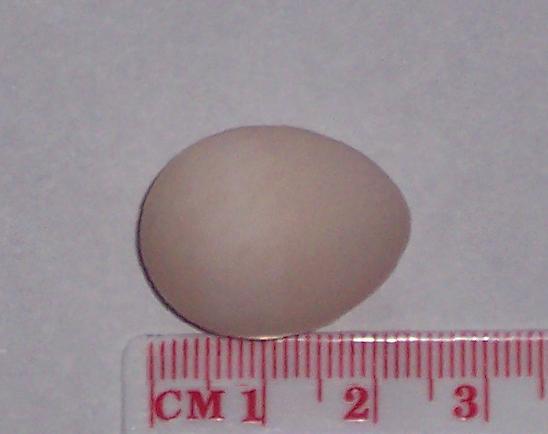
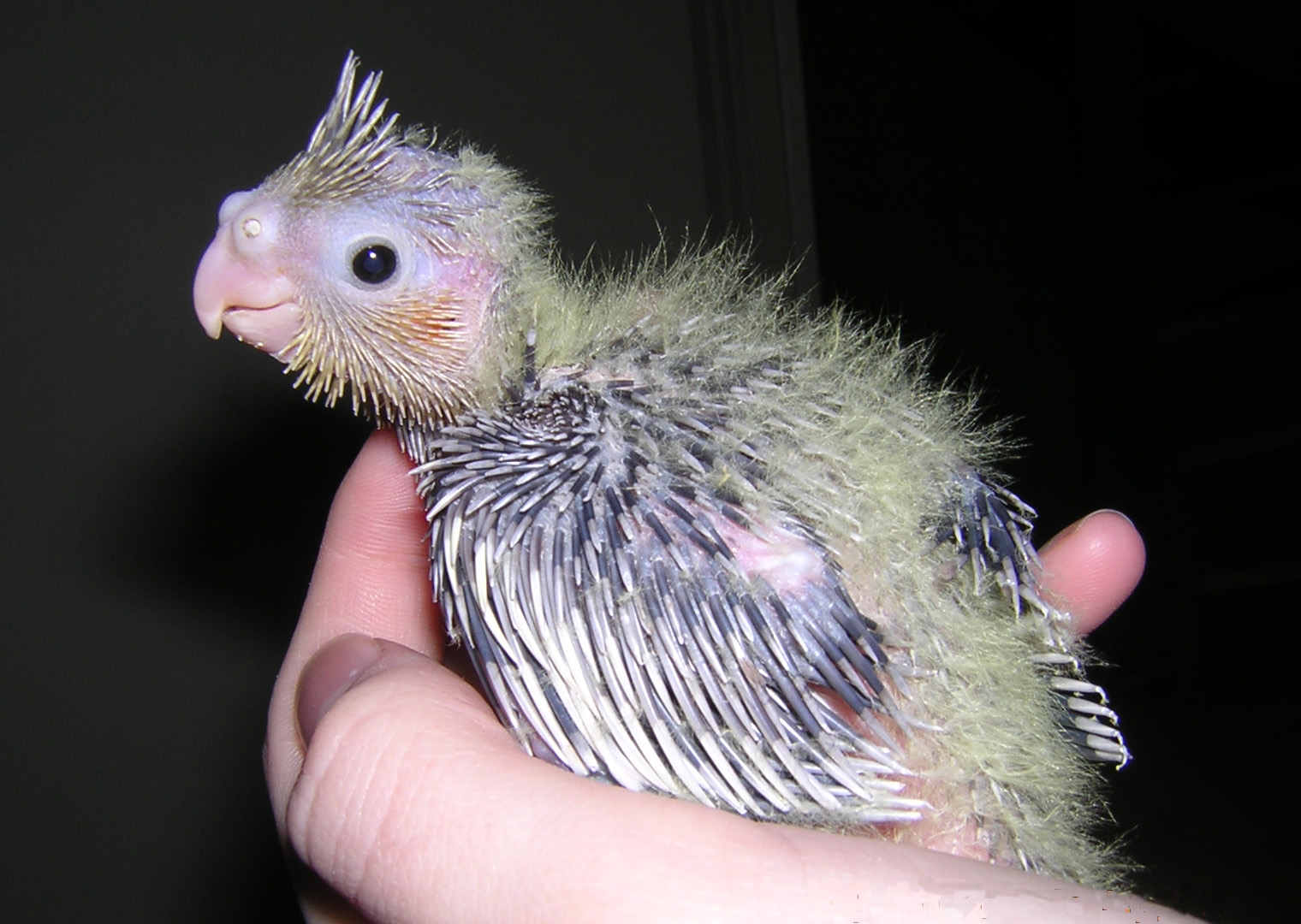 Cockatiels are a popular choice for amateur parrot breeders along with budgerigars. Compared to other parrot species they are relatively easy to breed and the costs for equipment are also quite low. A clutch can consist of 4-7 eggs, each approximately the size of one's thumbnail. Eggs are laid once every two days and incubated for 18–22 days. Hatchlings fledge between 4–5 weeks old and wean between 8–10 weeks old. Babies may often be gently handled while in the nest or removed for hand-feeding at 2 or 3 weeks old to help them become more tame and trusting. Puberty (adolescence) is reached around 9 months of age while adulthood is reached around 1 year and 9 months in males and/or 15–18 months in females.
In contrast to other parrots, male and female cockatiels both take part in raising their young. Cockatiels are the only members of the parrot family that do not feed their partner, therefore both male and female cockatiels incubate the eggs and raise their young together, where the male usually sits at night and the female during the day, but it can vary.
Some female cockatiels also lay eggs without fertilization, much as those of the chicken species used for food production. A cockatiel is getting ready to lay eggs when she makes their mating call—short chirps repeated rapidly. The bird will also get low to the ground, slightly spread her wings, and bounce as she chirps. Once the cockatiel has laid her eggs she will believe the egg holds a bird, therefore she will sit on it and protect it for about a week. Even the most even-tempered hen will attack to protect her egg. After about a week the cockatiel will realize the egg is empty and stop sitting on it. Laying can be prevented by keeping the Cockatiel in more darkness per day by covering it earlier in the evening and leaving the cage covered longer in the morning and by rearranging/replacing cage fixtures and toys or moving the Cockatiel's cage to a different location in order to make the cage appear less suitable to the hen as a nest site. Like all parrots, cockatiels of either [...] can grow to see their owner or a toy as a mate, engage in courtship and mating behavior including territoriality, and females may lay infertile eggs.
Petting the back, stomach or underwing area of the female cockatiel may inadvertently sexually stimulate her, promoting egg-laying; owners seeking to avoid egg-laying should avoid this particular form of bonding.
The cockatiel has been shown to be capable of hybridising with the Galah, producing offspring described as "Galatiels".
Colour mutations
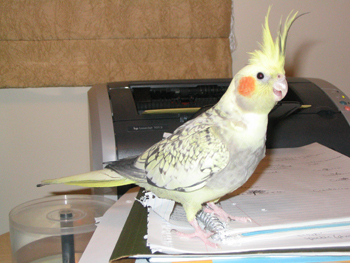
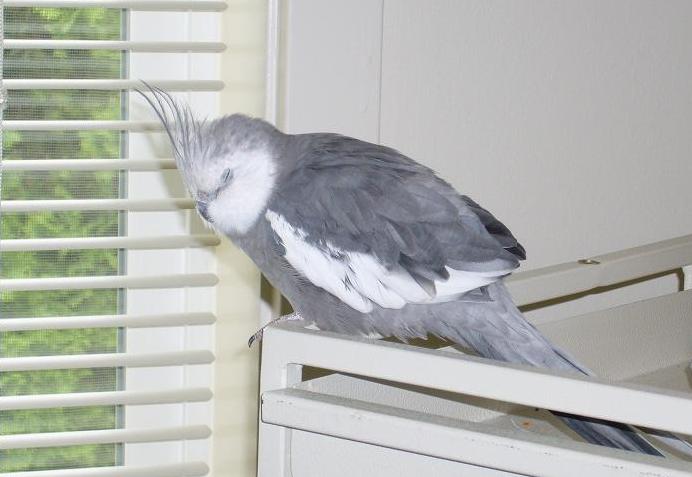 About fifteen primary mutations have been established in the species and enable the production of many different combinations.
Note: aka stands for "also known as," cka stands for commonly known as, and ika stands for "incorrectly known as."
- ADMpied (aka Recessive Pied aka Harlequin)
- Ashenfallow (ika Recessive Silver)
- Bronzefallow (cka Brownfallow)
- Cinnamon
- Dilute (ika Pastel Silver)
- Dominant Silver (aka Ashen Dilute)
- Edged dilute (ika Spangled or Spangled Silver)
- Faded
- SL Ino
- NSLino (Recessive Ino)
- Opaline (cka Pearled)
- Palefaced (ika Pastelfaced)
- Platinum (ika Pallid)
- Whitefaced (same gene as genuine Blue mutation in typical Parrot and Parakeet species)
- Dominant and [...] Linked Yellowcheeked
- Yellow-suffused (ika Emerald or Olive)
The multiple names for these mutations are due in part to different regions of the globe naming the same colour change a different term. This does not mean that it is a different mutation. It only means it is a different name.
Colour mutations are a natural but very rare phenomenon that oddly occur in both captivity and the wild.
External links