
Black Egyptian Hypothesis
In the late 20th century, scholars suggested that Ancient Egypt was a black civilization. This includes a particular focus on links to southern African (Sub Saharan) cultures and the questioning of the race of specific notable individuals from Dynastic times, including Tutankhamun, Cleopatra VII, and the king represented in the Great Sphinx of Giza.
In modern times, typological and hierarchical models of race have increasingly been rejected by scientists. Since the second half of the 20th century, scholarly consensus has held that applying modern notions of race to ancient Egypt is anachronistic. In the 2001 Oxford Encyclopedia of Ancient Egypt Stuart Tyson Smith says that "Any characterization of race of the ancient Egyptians depends on modern cultural definitions, not on scientific study.”
History
Modern scholars such as W.E.B. DuBois, Chancellor Williams, Cheikh Anta Diop, John G. Jackson, Ivan van Sertima, and Martin Bernal have supported the theory that the Ancient Egyptian society was mostly Black. The oft criticized Journal of African Civilizations has continually advocated that Egypt should be viewed as a Black civilization. The debate was popularized throughout the 20th century by the aforementioned scholars, with many of them using the terms "Black," "African," and "Egyptian" interchangeably, despite what Snowden calls "copious ancient evidence to the contrary." In the mid 20th century, the proponents of the Black African theory presented what G. Mokhtar referred to as "extensive" and "painstakingly researched" evidence to support their views, which contrasted sharply with prevailing views on Ancient Egyptian society. Diop and others believed the prevailing views were fueled by scientific racism and based on poor scholarship. Diop used a multi-faceted approach to counteract prevailing views on the Ancient Egyptian's origins and ethnicity.
Greek historians
The Black African model relied heavily on interpretation of writings from Classical historians. Several Ancient Greek historians noted that Egyptians and Ethiopians had complexions that were “melanchroes". There is considerable controversy over the translation of melanchroes, as some scholars translate it as black. Other scholars translate melanchroes as dark. Supporters of the Black theory saw the Ethiopians and Egyptians as racially and culturally similar, while others felt that the Ancient Egyptians and Ethiopians were two ethnically distinct groups. This is one of the most popular and controversial arguments for this theory. Proponents of the Black theory believed that the Black racial grouping was comprehensive enough to absorb the red and black skinned images in Ancient Egyptian iconography. Opponents of the Black theory believed that often dark red Ancient Egyptians and often black skinned Africans could not represent the same race.
The British Africanist Basil Davidson stated "Whether the Ancient Egyptians were as black or as brown in skin color as other Africans may remain an issue of emotive dispute; probably, they were both. Their own artistic conventions painted them as pink, but pictures on their tombs show they often married queens shown as entirely black, being from the south (from what a later world knew as Nubia): while the Greek writers reported that they were much like all the other Africans whom the Greeks knew."
Some of the most often quoted historians are Strabo, Diodorus Siculus, and Herodotus. Herodotus states in a few passages that the Egyptians were black/dark (depending on the translation used.) According to most translations Herodotus states that a Greek oracle was known to be from Egypt because she was "black", that the natives of the Nile region are "black with heat", and that Egyptians were "black skinned with woolly hair". Lucian observes an Egyptian boy and notices that he is not merely black, but has thick lips. Diodorus Siculus mentioned that the Ethiopians considered the Egyptians a colony. Appollodorus, a Greek, calls Egypt the country of the black footed ones. Aeschylus, a Greek poet, wrote that Egyptian seamen had "black limbs." Gaston Maspero states that "by the almost unanimous testimony of ancient [Greek] historians, they [Ancient Egyptians] belonged to the African race, which settled in Ethiopia." Simson Najovits states that Herodotus "made clear ethnic and national distinctions between Aigyptios (Egyptians) and the peoples whom the Greeks referred to as Aithiops (Ethiopians)."
Melanin samples
While at the University of Dakar, Diop used microscopic laboratory analysis to measure the melanin content of skin samples from several Egyptian mummies (from the Mariette excavations). The melanin levels found in the dermis and epidermis of that small sample led Diop to classify all the Ancient Egyptians as "unquestionably among the Black races." At the UNESCO conference, Diop invited other scholars to examine the skin samples. Diop also asserted that Egyptians shared the "B" blood type with black Africans.
Many other scholars at the symposium however rejected Diop’s Black-Egyptian theory.
Language
Diop and Obenga attempted to linguistically link Egypt and Africa, by arguing that the Ancient Egyptian language was related to Diop's native Wolof (Senegal). Diop's work was well received by the political establishment in the post-colonial formative phase of the state of Senegal, and by the Pan-Africanist Négritude movement, but was rejected by mainstream scholarship. At the UNESCO Symposium, Prof Abdelgadir M. Abdalla stated that “The linguistic examples given by Prof Diop were neither convincing nor conclusive.”
Cultural practices
According to Diop, historians are in general agreement that the Ethiopians, Egyptians, Colchians, and people of the Southern Levant were among the only people on Earth practicing circumcision, which confirms their cultural affiliations, if not their ethnic affiliation. Diop also points to other cultural traits that are shared with among others African communities, such as matriarchy, totemism, and kingship cults.
Diop and Ham
According to Diop, "Ham was the ancestor of Negroes and Egyptians." Ham was the father of Mizraim (the Hebrew word for Egypt), Phut, Kush, and Canaan. For Diop, Ham means "heat, black, burned" in Hebrew, an etymology which became popular in the 18th century. A review of David Goldenberg's The Curse of Ham: Race and Slavery in Early Judaism, Christianity and Islam states that Goldenberg "argues persuasively that the biblical name Ham bears no relationship at all to the notion of blackness and as of now is of unknown etymology." Kush is identified with black Africa.
KEMET
Supporters of the Black Egyptian hypothesis claim that the name (KMT, or Kemit) used by Egyptians to describe themselves, or their land (depending on your point of view), meant "Black."
Ancient Egyptians referred to their homeland as "km.t" (read Kemet). The translation of "km.t." is also controversial. According to scholars such as Diop, the Egyptians referred to themselves as "Black" people, or "km.t", and "km.t" was the etymological root of other words, such as Kam or Ham, which Diop says refer to Black people in Hebrew tradition. Cheikh Anta Diop William Leo Hansberry, and Aboubacry Moussa Lam have argued that km.t was derived from the skin color of the Nile valley people, which Diop et al. claim was black.
The claim is rejected by a strong majority of Egyptologists. Mainstream scholars hold that km.t means 'the black land' or 'the black place', and that this is a reference to the fertile black soil which was washed down from Central Africa by the annual Nile inundation. By contrast the barren desert outside the narrow confines of the Nile watercourse was called the 'red land'. Raymond Faulkner's Concise Dictionary of Middle Egyptian translates "km.t" into "Egyptians," as do most sources.
At the UNESCO Symposium, Professor Sauneron clarified that the Egyptians never used the adjective Kmtyw to refer to the various black peoples they knew of, they only used it to refer to themselves.
Ancient art
Diop saw the representation of black people in Egyptian art and iconography throughout Egyptian history. University of Chicago scholars state that the skin pigment used in Egyptian paintings to refer to Nubians can range "from dark red to brown to black." This can be observed in paintings from the tomb of the Egyptian Huy, as well as Ramses II's temple at Beit el-Wali. Also, Snowden indicates that Statius spoke of "red Ethiopians" and Roman's had accurate knowledge of "negroes of a red, copper-colored complexion...among African tribes."
Professors Vercoutter, Ghallab and Leclant stated that “Egyptian iconography, from the 18th Dynasty onward, showed characteristic representations of black people who had not previously been depicted; these representations meant, therefore, that at least from that dynasty onward the Egyptians had been in contact with peoples who were considered ethnically distinct from them.”
Depictions of Egyptians in art and artifacts are rendered in sometimes symbolic, rather than realistic, pigments. As a result, ancient Egyptian artifacts provide sometimes conflicting and inconclusive evidence of the ethnicity of the people who lived in Egypt during dynastic times. Najovits states that "Egyptian art depicted Egyptians on the one hand and Nubians and other blacks on the other hand with distinctly different ethnic characteristics and depicted this abundantly and often aggressively. The Egyptians accurately, arrogantly and aggressively made national and ethnic distinctions from a very early date in their art and literature." He continues that "There is an extraordinary abundance of Egyptian works of art which clearly depicted sharply contrasted reddish-brown Egyptians and black Nubians."
Sculpture and the Sphinx
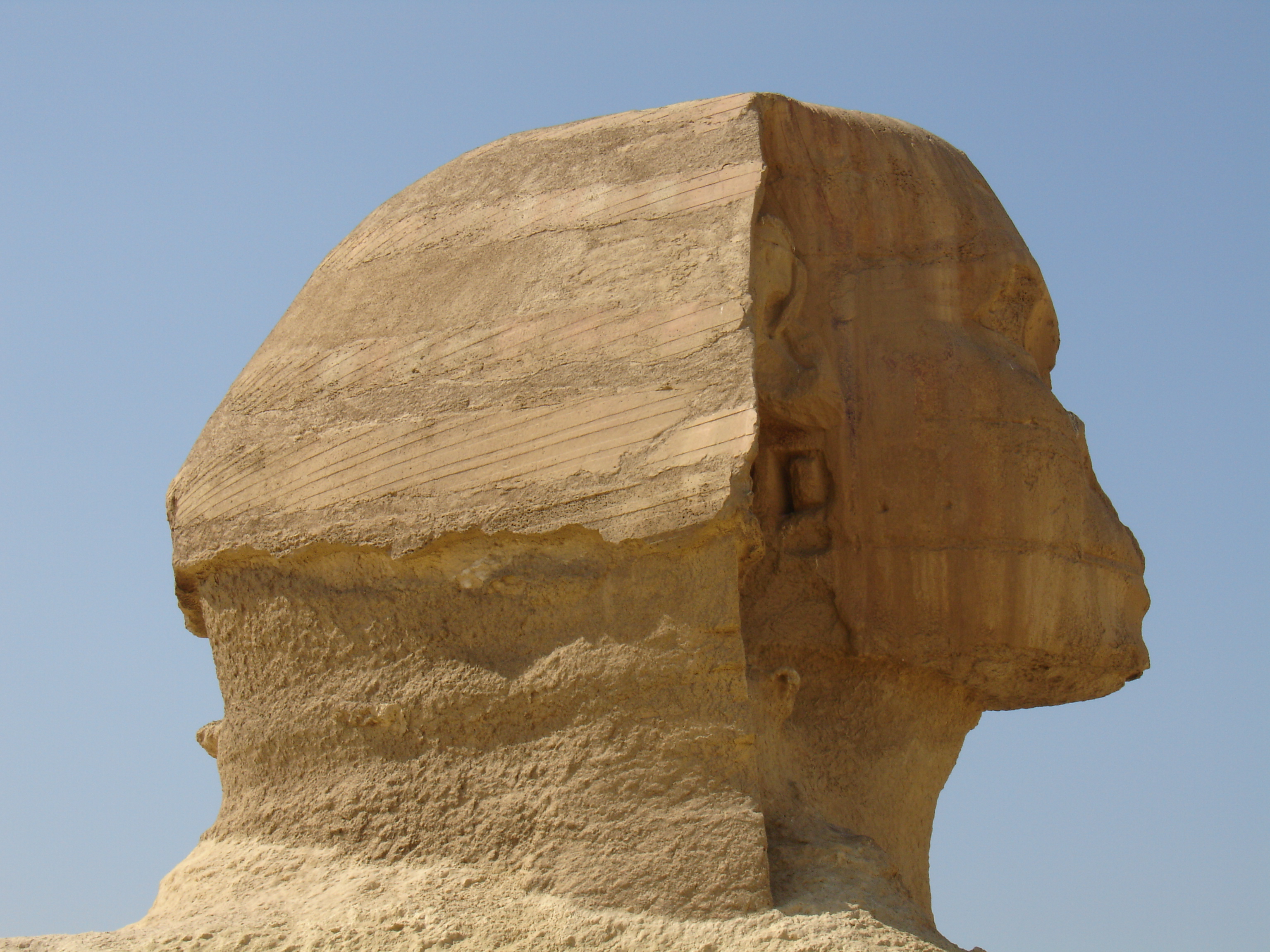
Scholars supportive of the Black Egyptian hypothesis reviewed Egyptian sculpture from throughout the dynastic period and concluded that the sculptures were consistent with the phenotype of the black race. This debate is best characterized by the controversy over the Great Sphinx of Giza.
Numerous scholars, such as DuBois, Diop, Asante, and Volney, have characterized the face of the Sphinx as Black, or "Negroid." Around 1785 Volney stated, "When I visited the sphinx...on seeing that head, typically Negro in all its features, I remembered...Herodotus says: "...the Egyptians...are black with woolly hair"..." Another early description of a "Negroid" Sphinx is recorded in the travel notes of a French scholar, who visited in Egypt between 1783 and 1785, Constantin-François Chassebœuf along with French novelist Gustave Flaubert. The identity of the model for the Great Sphinx of Giza is unknown. Virtually all Egyptologists and scholars currently believe that the face of the Sphinx represents the likeness of the Pharaoh Khafra, although a few Egyptologists and interested amateurs have proposed severaldifferent hypotheses.
Qustul artifacts
Scholars from the University of Chicago Oriental Institute excavated at Qustul (near Abu Simbel - Modern Sudan), in 1960-64, and found artifacts which incorporated images associated with Egyptian pharaohs. From this Williams concluded that "Egypt and A-group Nubia shared the same official culture", Nubia participated in the most complex dynastic developments, and "Nubia and Egypt were both part of the great East African substratum." Williams also wrote that Qustul in Nubia "could well have been" the seat of Egypt's founding dynasty. Diop seized on this as further evidence in support of his Black Egyptian Hypothesis. David O'Connor wrote that the Qustul incense burner provides evidence that the A-group Nubian culture in Qustul marked the "pivotal change" from predynastic to dynastic "Egyptian monumental art".
However most scholars do not agree with this hypothesis, as more recent finds in Egypt indicate that this iconography originated in Egypt not Nubia, and that the Qustul rulers adopted/emulated the symbols of Egyptian pharaohs.
Position of modern scholarship
Since the second half of the 20th century, most (but not all) scholars have held that applying modern notions of race to ancient Egypt is anachronistic. The 2001 Oxford Encyclopedia of Ancient Egypt states that "Any characterization of race of the ancient Egyptians depends on modern cultural definitions, not on scientific study.” The focus of some experts who study population biology has been to consider whether or not the Ancient Egyptians were primarily biologically North African rather than to which race they belonged.
UNESCO convened the "Symposium on the Peopling of Ancient Egypt and the Deciphering of the Meroitic Script" in Cairo in 1974. At that forum the "Black Egyptian" theory was rejected by 90% of the delegates. The arguments for all sides are recorded in the UNESCO publication General History of Africa, with the "Origin of the Egyptians" chapter being written by Diop.
In 2008, S. O. Y. Keita wrote that "There is no scientific reason to believe that the primary ancestors of the Egyptian population emerged and evolved outside of northeast Africa.... The basic overall genetic profile of the modern population is consistent with the diversity of ancient populations that would have been indigenous to northeastern Africa and subject to the range of evolutionary influences over time, although researchers vary in the details of their explanations of those influences."
See also
- Demographics of modern Egypt
- Dynastic race theory
- Négritude
- Archaeogenetics of the Near East
References
- Mary R. Lefkowitz: "Ancient History, Modern Myths", originally printed in The New Republic, 1992. Reprinted with revisions as part of the essay collection Black Athena Revisited, 1996.
- Kathryn A. Bard: "Ancient Egyptians and the issue of Race", Bostonia Magazine, 1992: later part of Black Athena Revisited, 1996.
- Frank M. Snowden, Jr.: "Bernal's "Blacks" and the Afrocentrists", Black Athena Revisited, 1996.
- Joyce Tyldesley: "Cleopatra, Last Queen of Egypt", Profile Books Ltd, 2008.
- Alain Froment, 1994. "Race et Histoire: La recomposition ideologique de l'image des Egyptiens anciens." Journal des Africanistes 64:37–64. available online: Race et Histoire
- Yaacov Shavit, 2001: History in Black. African-Americans in Search of an Ancient Past, Frank Cass Publishers
- Anthony Noguera, 1976. How African Was Egypt?: A Comparative Study of Ancient Egyptian and Black African Cultures. Illustrations by Joelle Noguera. New York: Vantage Press.
- Shomarka Keita: "The Geographical Origins and Population Relationships of Early Ancient Egyptians", Egypt in Africa, (1996), pp. 25–27