
Bearing from coordinates formula
Bearing from coordinates formula is used for calculating bearing between two points with known coordinates (x and y).
According to the formula, bearing ϕ is:
$tan \phi P1 \rightarrow P2 = \left( \frac{y2-y1}{x2-x1} \right)$
A quadrant addition has to be added to get a correct bearing value. Positive or negative numbers in the nominator and denominator shows the quadrant.
First quadrant: $\left( \frac{+}{+} \right)$: nothing is added
Second quadrant: $\left( \frac{+}{-} \right)$: 200 grads is added
Third quadrant: $\left( \frac{-}{-} \right)$: 200 grads is added
Fourth quadrant: $\left( \frac{-}{+} \right)$: 400 grads is added
These quadrants are geodetic which means they are numbered clockwise, unlike mathematical quadrants which are numbered counterclockwise.
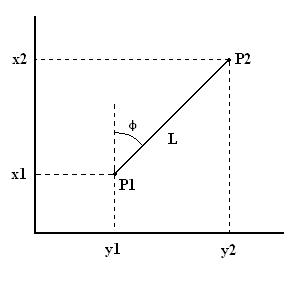
Example: Point P1 has coordinates x=20 and y=50. Point P2 has coordinates x=100 och y=120. Calculating bearing from P1 to P2:
$tan \phi P1 \rightarrow P2 = \left( \frac{120-50}{100-20} \right) \Rightarrow \phi = 45,76 grad$
Since both nominator and denominator has positive values this bearing is in first quadrant and nothing is added.
Calculating bearing from P2 to P1:
$tan \phi P2 \rightarrow P1 = \left( \frac{50-120}{20-100} \right) \Rightarrow \phi = 45,76 grad$
Since both nominator and denominator is negative this bearing is in third quadrant and 200 grads is added: ϕ = 45, 76 + 200 ⇒ ϕ = 245, 76grad