
4th United States Congress - Membership Changes
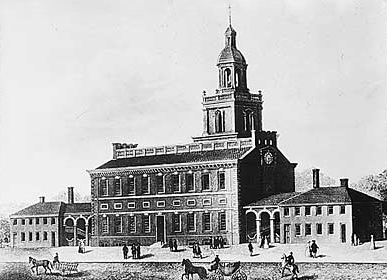 The Fourth United States Congress was a meeting of the legislative branch of the United States federal government, comprised of the United States Senate and the United States House of Representatives. It met at Congress Hall in Philadelphia Pennsylvania from March 4 1795 to March 3 1797, during the last two years of the second administration of U.S. President George Washington.
The apportionment of seats in this House of Representatives was based on the First Census of the United States in 1790. The Senate had a Federalist majority, and the House had a Democratic-Republican majority.
- See also: 4th United States Congress - political parties
- See also: 4th United States Congress - State Delegations
- See also: United States House elections, 1794
Dates of sessions
March 4 1795 - March 3 1797
- Special session of the Senate: June 8 1795 - June 26 1795
- First session: December 7 1795 - June 1 1796
- Second session: December 5 1796 - March 3 1797 — a lame duck session
Previous congress: 3rd Congress
Next congress: 5th Congress
Membership changes
Tennessee was newly admitted as a state and is first represented in this Congress.
- See also: 4th United States Congress - Membership Changes
|
|
Senate
State |
Outgoing Representative |
Reason for Change |
Successor |
|
|---|---|---|---|---|
Connecticut |
| |
Oliver Ellsworth |
Resignation. |
| |
Connecticut |
| |
Jonathan Trumbull, Jr. |
Resignation. |
| |
Georgia |
| |
James Jackson |
Resignation. |
| |
Georgia |
| |
George Walton |
Interim appointment. |
| |
Maryland |
| |
Richard Potts |
Resignation. |
| |
Massachusetts |
| |
George Cabot |
Resignation. |
| |
Massachusetts |
| |
Caleb Strong |
Resignation. |
| |
New Jersey |
| |
Frederick Frelinghuysen |
Resignation. |
| |
New York |
| |
Rufus King |
Resignation. |
| |
South Carolina |
| |
Pierce Butler |
Resignation. |
| |
Tennessee |
| |
new seat |
New state admission. |
| |
Tennessee |
| |
new seat |
New state admission. |
| |
Vermont |
| |
Moses Robinson |
Resignation. |
| |
House of Representatives
State |
Outgoing Senator |
Reason for Change |
Successor |
|
|---|---|---|---|---|
| |
James Hillhouse |
Resignation. |
| |
|
| |
Uriah Tracy |
Resignation. |
| |
|
| |
Gabriel Duvall |
Resignation. |
| |
|
| |
Jeremiah Crabb |
Resignation. |
| |
|
| |
Theodore Sedgwick |
Resignation. |
| |
|
| |
Benjamin Goodhue |
Resignation. |
| |
|
| |
Absalom Tatom |
Resignation. |
| |
|
| |
vacant |
Death. |
| |
|
| |
Daniel Hiester |
Resignation. |
| |
|
| |
Benjamin Bourne |
Resignation. |
| |
|
| |
new seat |
New state admission. |
| |
|