
Zalishchytska tragedy
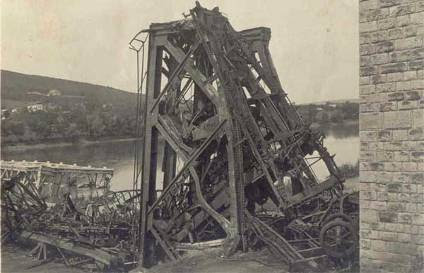 The Zalishchytska tragedy (; , Englishized as the Zalishcyky tragedy) was an incident occurring in Zalishchyky on July 7, (though some say July 4 or 5) 1941, when the NKVD massacred several hundred political prisoners under the guise of an evacuation.
Background
In the lead-up to the "Great Patriotic War", as the USSR would come to call it, gulags were overflowing with prisoners. By June 1941, a total of 72,768 persons were imprisoned all over the USSR, when the maximum capacity of all the NKVD prison camps in the country were 30,753 prisoners in entirety. Outside the motherland, prisons in Ukraine were also overwhelmingly overcrowded. The majority of these prisoners were Bolsheviks arrested during the Sovietization of Ukraine in 1939 and 1940.
On June 23, 1941, the People's Commissar of State Security Vsevolod Merkulov issued Order No. 2445/M, which ordered the urgent registration of all prisoners in prisons and gulags to be either deported or executed. That same day, an order was issued by the Chief of the Prison Directorate of the NKVD and the Captain of State Security which ordered the evacuation of prisoners. According to the "Evacuation Plan", during deportation from Lviv, it was planned to remove 23,236 people via 778 railway cars. However, the quickly advancing German troops, the lack of transport, and panicked confusion made it impossible for the Soviet punitive bodies to implement the plan. Soon, evacuation of prisoners was only possible in certain cities, and even then most of the prisoners did not reach their destination. By the end of June 1941, tens of thousands of arrested innocent people, whom the Bolshevik Inquisitors did not manage to condemn, were ordered to be shot by the People's Commissar of Internal Affairs of the USSR. Mass [...] was committed in the prisons of Vinnytsia - where 9439 people died - Lutsk - where 2754 people died - Drohobych- where more than 1000 people died - Zolochiv - where 1600 people died - Sambir - where almost 5 thousand people died - Dubno - where 1500 people died - and Stanislav - where 2500 died. In general, more than 10 thousand Ukrainians were slaughtered in the Ivano-Frankivsk Oblast.
The tragedy
In early July, for tactical reasons, the Red Army decided to destroy Zalishchyky's railway bridge over the Dniester which connected it to Kostryzhivka. Hundreds of political prisoners from neighboring towns and oblasts were arraigned to be transported by train through the country, and soon two echelons of 14 boxcars were traveling towards Zalishchyky. At around 15:00 hours (or 3:00 in the afternoon) the locomotive and most of the train cars were stopped on the bridge over the Dniester. Operatives of the NKVD then doused the wagons in petrol and ignited them. After AbOUT ten minutes, a wagon exploded, setting off other boxcars and causing the bridge to collapse into the Dniester. The blast caused some train cars to be propelled away from the site and roll back towards Kostryzhivka. As the locomotive and flaming boxcars submerged, the heat caused the river’s temperature to exceed 100°C. Those that escaped the boxcars were boiled alive in the waters above.
One eyewitness, F. S. Babalyuk, later recalled:
I was living in the village of Zveniachyn. On the morning of July 7, 1941 I was in a sugar factory, because I worked there. The Soviet soldiers controlled the main production facilities. Work was not in question, so I decided to go home. On the railroad, there were four freight wagons with locked windows. Every train passing through the bridge was allowed, and cars with people stood there. I had already climbed to the hill, and everything was visible from a glance. Finally, the locomotives hoisted cars with people, and behind them - another 6-7 wagons. The whole echelon was moved to the length of the bridge. The guards, the officers, and the machinist left the echelon and walked towards Zalyshchitskaya station. The machinist was somehow indignant, because the officer pushed him in the chest, waving a revolver. And after about 10 minutes, a terrible blast lifted cars with people over the bridge. The next moment they flew into the water. On top of them the locomotive fell. At this point, the water seemed to boil, like hot boilers and steam heated it to a high temperature. Those staying in the upper part of the water [were] just cooked alive. The spectacle was terrible. It happened on July 7, 1941 about 15 o'clock. The rest of the cars did not fall into the river, because the cluster burst from the explosion and they rolled back to Kostryzhiv station...
The high and steep banks of the river proved auspicious for the NKVD - many surviving the initial fires and explosions were almost certainly killed by the impact(s). Bodies were carried by the river’s current for more than 303km before washing up in the Moldovan settlement of Vadul lui Vodă, where they were bound by wire and thrown into a mass grave. Supervisors noted several people were confirmed to have escaped the cars as the bridge collapsed and survived.
Between 700 and 1000 civilians were killed.
Other eye-witness testimonies follow:
From T.I. Baranetsky,
In early July 1941, when ill-fated wagons traveled to their death, Todor's son, my husband Ivan, was accidentally found at Kostryzhevskaya station. Through a locked window, his father waved his hand to his son for the last time, as if to say goodbye forever. I only managed to convey the phrase "Tell my mother that I'm here!"
From M.G. Tugaevich,
A freight train from Kolomyia arrived at Gorodenka on July 7 at about 10 AM. I realized what the thing was. I climbed to the platform and stealthily began to watch the windows of cars, saw people there, even recognized fellow villager Vasily Babiyah. He was arrested with four of his comrades in Serafyntsi in December 1940. He recognized me, gesturing, asking "What's up?" I responded with the gesture "War!" A few minutes later the train went to Zalishchyky through the stations of Yaseniv-Pil'nyi, Stefanivka, and Kostryzhivka stations.
From M.I. Godovnets,
I sat on the platform at Zalishchyky station, waiting for a wagon. Suddenly, I heard a person in a carriage. But, the day was hot, everyone wanted to drink. A woman from the military filled tins with water, but it was not enough. Around 15:00, a powerful explosion broke out on the bridge and the middle framework collapsed into the Dniester. It was the same train that traveled from Kolomyya through Horodenka, Zalishchyky, Chortkiv. A wagon with people flew into the abyss.
From Anna Muibko,
During the retreat of the Red Army, I saw that, as a long drawn train of tanks and cars was dragged onto the bridge, and stopped and stood on the bridge. After a while, on the side of the village of Kostrizhivka (Bukovina) a car came up, from which people went to the bridge and did something near the bridge. After they turned back, on the shore, a powerful explosion broke. Two trusses of the bridge fell down. The water started to boil, we ran out with our brother to look closer...we saw a burning, smoky corpse. Facial features were well visible.
From Maria Vasyl Uhryn,
My father, Mykola Uhryn, was the organizer of the permanent OUN village of Pecherna. So, he was interested in the midst of the political events of 1941. He told his friends, in conversation, what he had saw, transmitted unchanged: On the bridge, the Bolsheviks had three wagons. All of them were filled with political-prisoners from the Chortkiv jail, which the NKVD did not take. When the bridge was blown up, two carriages on the side of Zalishchytska station fell into the water. The third sped to the Bukovina side. It was the third one was chock full of people. The guards pushed it down by the locomotive. From the windows came the cries of the doomed. One woman at the station on the side of Kostrizhivka was screaming in horror, probably crazy...The OUN leadership ordered my father to retrieve the wagon number panels to start an investigation. Dad was a fisherman and had a boat. On two cars he managed to unscrew the panels, not on the third. That panel's wagon was at a depth. My father dived, but he took out the corpses.
Aftermath
Soviet propaganda pinned the heinous act on the Nazis, however it was known that the act was witnessed by numerous people who knew the Soviets were behind the massacre.
After Ukraine gained independence in 1991, the Zalishchyky City Council and the Memorial society set up a committee to investigate the incident over the Dniester, concluding the NKVD blew up a railway bridge and dropped wagons with people into the River. On both banks of the Dniester there are memorial crosses in place to commemorate the tragedy, and a memorial service is conducted annually in July.