
Yurmat
Yurmat (, compare ) is one of the ethnonyms of the seven Bashkir tribes.
Generic composition
- Yurmaty - (tribal divisions: aj-bash, aju, ajusy, bikey, bikkinin, bish-ujle, aznabaj, buskun, burzyan, bepke, ilsegul, irale, isyanbirde, yumak, keze, kazak-kul, kalmak, kara-bilgau, kara, karga, kashkajmak, kudash, kuzgun, kultaj, kusyapej, kudej, kuyan, kesim, majryk, mustafa, mullakaj, musa, Saldyj, serek, sibek, suvash-aj, setej, tabyn, taz, turna, tubaj, tyzym, urakaj, uzbek, shalavar, shurale, shymtyr, yuldash, yulyj, yurmaty, yakshembet).
- Karmysh (Makar) - (tribal divisions: aitkul, akkubyak, abyz bikzyan, ibraj, kudash, kusyar, kara-tuyak, kabyrga, kalmak, kilmysh, moksha, sade, saz, siksyantoyak, tungatar, sarkaj, etemes).
- Mishar-Yurmaty - (tribal divisions: magar, sunke, bakaj).
- Nogai-Yurmaty - (tribal divisions: arlar, yuannar, jejen, mugash).
- Taltim - (tribal divisions: aznaj, ait, ayu, bashkir, bishkadak, burzyan, gabzalil, daut, ilsektimer, ishmurat, elembet, kajnau, kalmak, kanykaj, kara, karmysh, kasym, kuzgun, kyzylbash, kyrau, minzelya, myshy, umetbaj, usen, saran, turdakyn, husain, hala-bash, shakir, sheker, Ajtkul, yuldashbaj, yurmaty, yarylkap, yaugilde).
- Tatigas - (tribal divisions: ajtugan, alatube, kalmak, kortlas, meretek, sure, selesh, setej, Tabyldy, tejeldek).
Ethnic History
The ethnic origins of the Yurmaty are probably traceable to the ancient Sarmatians, survivors of an ethnic interaction and mixing with Ugric and Turkic (Bulgar) tribes, emerging around the Azov region and adjacent areas. They form an early (Bulgar-Ugric) layer of the ethnic Bashkir people. This implies a continuity in the formation of the physical ancestors of Bashkirs since pre-Christian times. Some continuity can be traced through the material culture and language, ascribing it to the "corrupted language" of the Sarmatians of the Urals, the Oirpata.
In the 15th century, they obeyed the Nogai Horde.
Ethnonym
Some researchers believe that the Bashkir ethnonym Yurmat is a transcription of the Sarmatian self designation Sarmat which may shares a common root with the Sarmatian ethnonym oirpata "man killers", from oip "man" (cf. Bash. and Chuv. Turkic ir/ar, and Old Turkic ar, "man, husband"). In the historiography of Hungarians the tribe Kürt-Gyarmat is also compared with Bashkir Yurmat. An anthroponym in the form of Yurmaty is also known in Chuvash. Hungarian gy is equal to common Turkic y in many other examples: gyula = yula, gyapjú = yapaği, gyarta- "to produce" = yarat- "to create", gyász = yas, gyúr- = yoğur-, gyürü = yüzük, gyüszü = yüksük etc. Turkic y, thus Hungarian gy in concerning loanwords, have the letters ś/s as their equivalents in Chuvash (śĭn- = yen-, śĭl- = yol-, śĭt-, = yut-, śĭm = yün, śur = yaz, etc.) and Yakut (sette = yedi, süs = yüz, sās = yaz, etc.), both of which are to save very archaic peculiarities of Turkic. Due to the linguistic circumstance that the Chuvash ś and Yakut s are older than the common Turkic y and its Hungarian equivalent gy, this would recall that the word Sarmat was merely an older form of Turkic Yarmat (< Yurmat) and Hungarian Gyarmat, both of which denominate one and the same Turkic tribe.
According to Herodot, the homeland of the Sarmatians Sauromats was in 15 days distance from the Scythians, this is roughly where now Bashkortostan is located.
Other possibilities of the etymology of the word "Sarmat" are also provided in some Ural-Altaic word roots such as common Turkic sary "yellow, light", Mongolian shar "yellow, brown", Chuvash shur "white", Evenki sharama "grey". The modern Chuvash word Sarmas (compare Tatar Çirmeş), a designation for the Finno-Ugric Mari, can also be regarded as a version of the Sarmatian ethnonym "Sarmat".
Settlement area
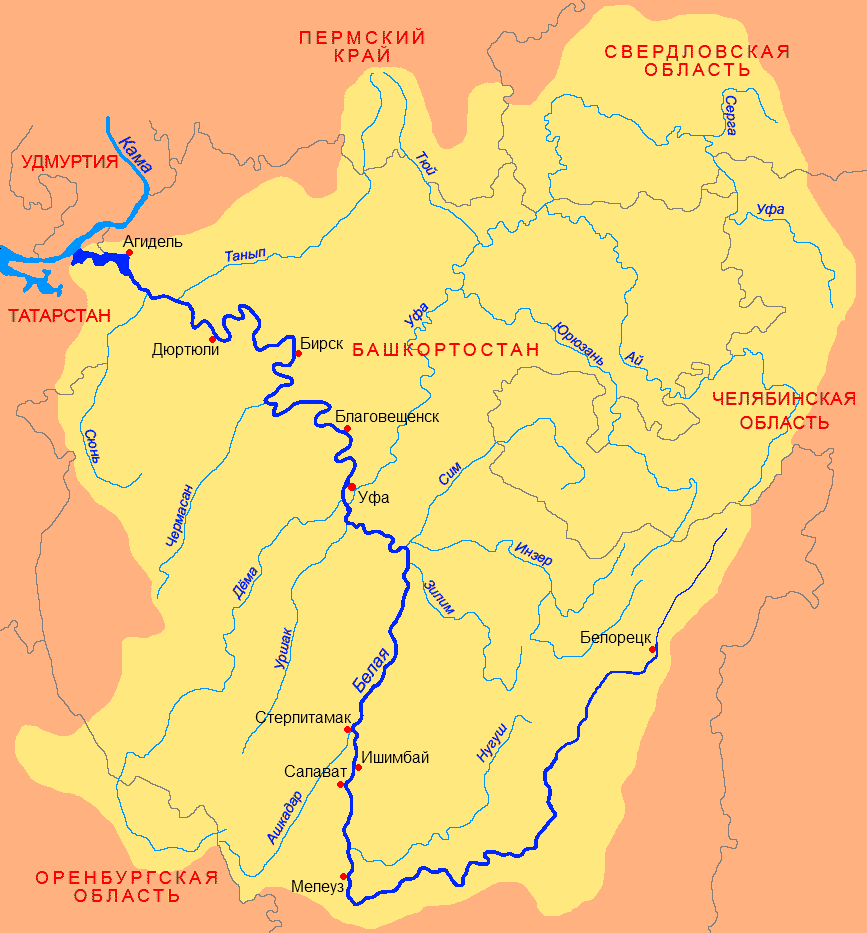 Between the 13th and 14th centuries the territory of the Yurmat tribe was located along the rivers Zay and Sheshma. In the 15th century the majority of Yurmat tribe migrated to the south-east, where they settled in the river basin of the Belaya and the valleys on the right bank of the river Nugush and on the left bank of the river Urshak. In the 17th century they moved to the upper reaches of rivers Small Uran and Tok river (Samara). In the 18th century the Yurmaty land bordered the territory of the settlements of other Bashkir tribes such as Burzyan, Kypsak and Tamyan. At the end of the 18th and 19th centuries the Yurmaty settlements administratively belonged to the Orenburg and Sterlitamaksky counties. Today, the Yurmaty tribal settlement area includes the Perelyubsky district of the Saratov region.
See also
- Gyarmat
- Tribal subdivision of Bashkirs
References
Sources
- James Minahan (2000), One Europe, Many Nations: A Historical Dictionary of European National Groups.
- Petrov K. I. (г. Фрунзе), (1969), Plenary meeting of the scientific session on the ethnogenesis of the Bashkirs, May 13–15, Ufa. In: Сборник Археология и этнография Башкирии [Collection of Archaeology and Ethnography of Bashkiria]. Bashkortostan, Ufa (1971), USSR Academy of Sciences (АН СССР ОИБФ).
- Karatay O. (2003), In Search of the Lost Tribe: The Origins and Making of the Croation Nation.
- Né[...] G. (1966), Ungarische Stammesnamen bei den Baschkiren [Hungarian tribal names among the Bashkirs]. Acta Linguistica 16: 1-2. Budapest.