
World of Ghost in the Shell
The anime and manga series Ghost in the Shell takes place in a cyberpunk version of Earth in the near future. The series focuses on Japan but several other nations figure prominently in some stories. The world of Ghost in the Shell features significant advances in technology, the most significant of which is the Cyberbrain, a mechanical casing for the human brain that allows mental interface with the Internet and other networks.
Technology
Cyberbrains
A is a device in the fictional universe of Ghost in the Shell by Masamune Shirow (and also in Shirow's later work Real Drive) that acts as a self-contained module containing, protecting, and interfacing an artificially augmented brain. The "brain" includes the brain stem but excludes the eyes, optic nerves, and most of the spine. By being physically self-contained, the cyberbrain allows the artificially augmented brain inside to function or be physically stored inside a body, to be physically transferred between bodies, or to be temporarily stored or transported outside any body. Cyberbrain implants, in conjunction with micromachines, allow the brain to initiate and maintain a connection to computer networks or other individuals who also possess a cyberbrain. This capability results in a number of unforeseen psychosocial phenomena whose emergence is a major plot element of the various Ghost in the Shell stories.
The process of augmentation of the brain in this fashion is referred to in the series as cyberization. It is not necessary for a subject to undergo complete cyberization, acquiring a full-body prosthesis, to support the cyberized brain; an individual may choose to only have their brain cyberized. Cyberization is imagined to take three distinct forms:
- Minimal cyberization, for the purposes of external memory and wireless communication, leaving the brain itself essentially identical to its biological form. Nano-scale interfaces are placed in the cerebellar region, permitting a pluggable interface, and allowing prosthetic parts to be upgraded. Physical improvements are limited to a very thin titanium shell around the cortex.
- Partial cyberization, replacing larger parts of the cortex with nanotechnological interfaces and computational elements. However, the autonomic systems of the brain remain intact, which is necessary to retain the "ghost" (the term used in the series to refer to the soul).
- Full cyberization, in some extreme cases of disease or accident, in which as much as 97% of the original brain is replaced with artificial elements.
Drawbacks
In the series, "super-class-A hackers" are able to take over people's cyberbrains, to the extent that they can alter memories or "steal eyes", altering the victim's sensory input. The Laughing Man character was able to alter the vision of an entire crowd and superimpose his logo over his face to disguise his identity. "Ghost hacking" is a criminal technique wherein the victim's entire memory is replaced with false memories. This is notably used in the series by the "Puppet Master" in the first Ghost in the Shell film. "Cyberbrain hijacking" involves the replacement of a victim's cyberbrain with the criminal's own, whilst the same criminal retains another body in storage. Alternatively, a criminal may choose to place their cyberbrain into a copy of the victim's body, and then impersonate the victim. Both of these methods were portrayed in the episode Face.
In the series, is a form of cyberbrain-induced autism, occurring when users of cyberbrain technology shut themselves off from the outside world to avoid harming others or themselves. It can also be a psychological barrier induced by the subconscious to protect the ego from being overwhelmed by the depth and connective nature of the internet. CSS patients have the appearance of savants with extremely high computer skills.
is a disease characterized by a hardening of the brain tissues precipitated by the cyberization process. It is described as being that century's cancer or tuberculosis. Cyberbrain sclerosis is described as being extremely rare, enough so that it doesn't deter most people from being cyberized, but it is incurable once diagnosed. In Stand Alone Complex, cyberbrain sclerosis patients are used by large corporations as guinea pigs in the development of micromachine technology, while a vaccine for cyberbrain sclerosis is withheld from the public by those corporations via their political power - yet still being available to corporate executives and celebrities. This proves to be the explanation of the original "Laughing Man Incident", in which the Laughing Man kidnapped the head of Serano Genomics, a micromachine manufacturer, in an attempt to persuade him to reveal the depth of the corruption within the political and medical community over the vaccine.
Prosthetic bodies
People who undergo extensive cyberization ("cyborgs") have bodies that consist mostly of synthetic parts. These prosthetic parts can be exchanged or replaced when damaged. Cyborgs do not eat normal food; rather, they eat special processed protein bars which provide nutrients for their remaining organic parts. This "food" does not taste good to those who still have organic taste buds due to an inability to manipulate taste input cybernetically. The most heavily cyberized individuals, such as Major Kusanagi, have only their brain remaining as their sole organic parts. As Kusanagi muses in the original film, she is basically a fist-sized clump of brain cells wired into a robotic body.
ACTIVE camouflage
An important technology used in the series is . Members of Section 9 as well as their Tachikoma tanks have the ability to activate a special camouflage technology which enables them to BLEND in with the environment, making them near-invisible to the [...] eye. It is an active stealth system which projects ambient conditions of the opposing side, thus rendering the masked object transparent by transmission. The system is not shown to be perfect, as it seems unable to compensate for sudden changes and physical impacts and not impervious to close observation. It also has difficulty working in rain or if walking through shallow water. A faint translucent distortion is shown as the limitations of the technology. In the legal landscape of the series, usage of the technology without a warrant is heavily restricted. The use of this technology by Section 9 is the exception, and not the norm - further highlighting their extraordinary legal standing.
In the Stand Alone Complex alternate timeline, however, this technology seems to have been perfected and is capable of operating in highly illuminated environment, as evidenced in the episode "Robot and I." The visual distortions are therefore purely for the benefit of the viewers.
There is present-day research into the active optic camouflage at the University of Tokyo inspired by the technology's fictional portrayal in the series.
Think tanks
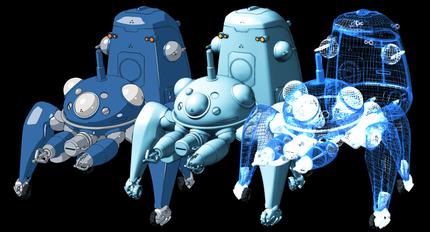 "Think tank" is a slang term used to describe a robotic weapons platform that makes use of artificial intelligence (AI) to enhance its abilities. In the Japanese version, they are officially referred to as , but they are more commonly referred to as . The most prominent think tanks are those used by Section 9 in its various incarnations, including the (original manga), (Stand Alone Complex), and (Solid State Society). Section 9's think tanks are spider-like in appearance, having four walking legs, a pair of front-mounted manipulators, and a segmented body. The pilot sits in a posterior pod attached to the main body, but the tanks can operate independently using their AI. The AI of the tanks exhibit learning algorithms to help them adapt to new situations and these experiences are synchronized among the tanks after each mission. Fuchikoma and Tachikoma AIs have child-like personalities and the latter's AI develop rapidly over the course of Stand Alone Complex, almost to the point of sentience and individuality. Uchikoma are seen at the end of 2nd GIG after the destruction of the satellite containing the Tachikoma AIs. Their AIs are considerably less advanced, and their failure during a mission in Solid State Society leads to the return of the Tachikoma.
The think tanks in each series often to their child-like demeanor. During the development of Stand Alone Complex, the creators had wanted to include Fuchikoma into the new series, but could not due to copyright issues. Instead, they designed Tachikoma using Fuchikoma as inspiration. There are several Tachikoma models seen in video, manga and after-market toys. There is a brown one with a more squat rear end, a yellow "construction" version, as well as yellow and red "cyber" versions named Musachi and Max. A prototype Tachikoma is seen in the PSP game Ghost in the Shell: Standalone Complex - Territory of Hunter. In Ghost in the Shell: Solid State Society, a 2006 television anime film based on the anime series, the Tachikoma have their own names.
Setting
Ghost in the Shell takes place in the early 21st century. World War III was a nuclear war that resulted in major changes in national BOUNDARIES. World War IV was a non-nuclear war, also known as the second Vietnam War, which was fought when many Third World countries left devastated by World War III disintegrated even further. As a result of these major wars the global political landscape has become heavily balkanized, with even former First World countries like the United States splitting up. Civil wars and non-state revolutionary movements are incredibly common, and the millions of refugees displaced by the global wars have become a major problem. The continuing advance of technology, particularly cyberization technology and the internet, has also drastically increased the frequency of cyber-[...]. Japan, at least, is shown to still be a productive nation with high standard of living, though much of the rest of the world is still reeling from the military and economic after-effects of the wars.
Japan
Japan is a major world power, having gained equal footing with the descendant countries of the former United States. The events of an unnamed conflict in Korea results in the destruction of the North Korean regime and an influx of refugees into Japan. Japan is also the only country with access to "radiation scrubber" technology. Also known as the "Japanese Miracle", these nanomachines can eliminate nuclear fallout, although they must be distributed before a blast occurs to work effectively. The original capital city Tokyo was destroyed by a nuclear bomb during World War III, resulting in the seat of government being moved to the city of Fukuoka.
There are a number of organizations operating within Japan, including the Cabinet Intelligence Service, the [...] Enforcement Agency, the Public Security Bureaus, and the various branches of the Japan Self-Defense Forces (JSDF).
Public Security Bureaus
Section |
Description |
|---|---|
Section 1 |
Also known as the Special Service Squad. It is responsible for conducting investigations on very serious criminal cases. Its jurisdiction is limited to Japan only, supposedly under the jurisdiction of the Ministry of Home Affairs. |
Section 2 |
Controlled by the Ministry of Health, Labour and Welfare, and is in charge of law-enforcement matters regarding unauthorized biomedical experiments taking place without MHLW authorization, as well as patent enforcement. |
Section 3 |
Has duties similar to those of the American DEA, enforcing [...] policies within Japan. |
Section 4 |
A special-forces military unit on the JGSDF, also known as “The Rangers”. It likely reports to the Minister of Defense. Its missions and capabilities are similar to present-day SOCOM; all its members have identical white cybernetic eyes. Section 4 re-emerged in the TV series during the Dejima Refugee Crisis in an operation to recover a nuclear warhead from members of Section 9. The conflict between the units ended when Batou revealed that he was once a Ranger himself, and both units returned the warhead to JGSDF. Unlike most modern Ranger units, the Rangers have female soldiers. |
Section 5 |
Unknown |
Section 6 |
An Intelligence, Surveillance and Reconnaissance unit that first appeared in the original Ghost in the Shell manga and film, under the jurisdiction of the Ministry of Foreign Affairs known as the Treaty Council. Due to maintenance and political concerns, members do not have cyberization/prosthetics like much of Section 9. Section 6 gained notoriety by becoming the first unit to effectively assassinate another member of Public Security during the end of the original Ghost in the Shell film. They were also responsible for guarding anything related to Project 2501. They are in charge of gathering intelligence on international crime and [...]. |
Section 7 |
Unknown |
Section 8 |
Unknown |
Section 9 |
, also referred to as Public Safety Section 9 in some translations, is a fictional intelligence department under the Ministry of Home Affairs. It is an elite counter-[...] unit specializing in cyber-warfare, as by the mid-21st century the line between the two has blurred, and most acts of [...] involve cyber-fields to at least some degree. Section 9 is also often tasked with high-profile or politically sensitive responsibilities, such as guarding ambassadors (due to perceived threat of [...]), etc. The public at large is unaware that Section 9 actually exists, though the Diet of Japan and other security sections are generally aware of them as a black ops unit. Section 9 is more of a police unit than a military one, though the overwhelming majority of its members have former military special ops backgrounds. In the original movie, it's known as the Shell Squad or Security Police Section 9. Its operatives are trained in various methods ranging from police investigations to cyber warfare, as their structure was based on the German GSG-9. They had cross-training exercises in the past with the British SAS's 22nd Regiment. |
American Empire
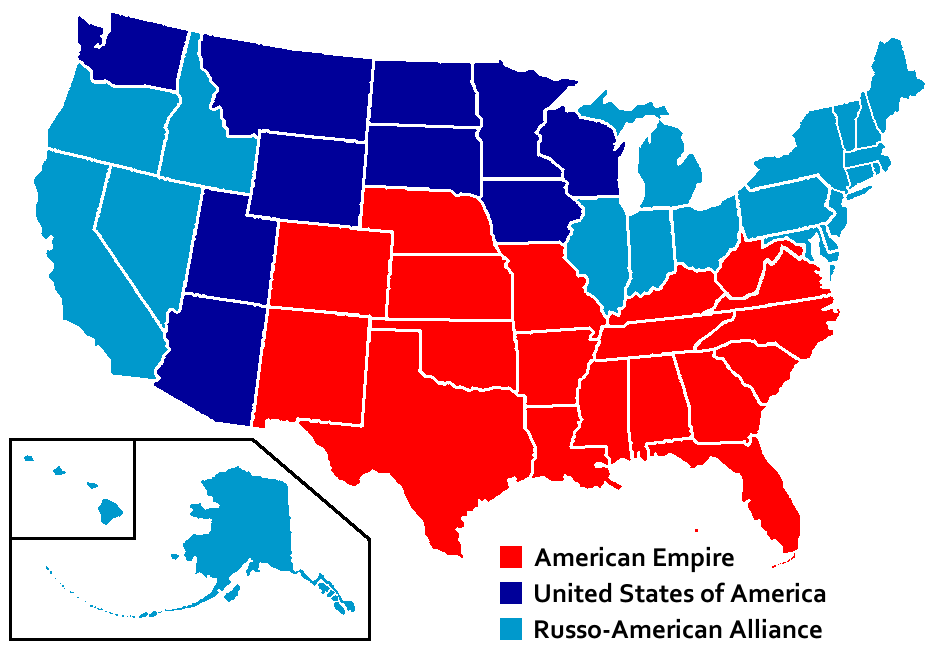 The is a fictional country appearing in Masamune Shirow's anime and manga series' Ghost in the Shell and Appleseed, featuring most prominently in Ghost in the Shell: S.A.C. 2nd GIG. The AE exists from before 2020 and at least until 2147, and consists primarily of the American states that had formed the Confederate States of America, plus parts of the Great Plains and Southwest.
After the end of the nuclear World War III, the United States is partitioned by an unspecified process into three countries: the American Empire, the , and the rump state . The American Empire is the only successor state to play a major role in world politics. Its government seems driven by a desire to restore its diminished power and prestige, towards which end it adopts a policy of militarist aggression and open imperialism, directed primarily against Latin America.
Due to war damage to its economy and its weakened political position, the American Empire enters into a security pact with Japan, which had escaped World War III largely unscathed. The pact reaffirms Article 9 of the Japanese Constitution, prohibiting Japan both from deploying its military overseas and possessing nuclear weapons. One of the principal reasons the American Empire seeks the treaty is its desire to co-opt the "Japanese Miracle," radiation-scrubber nanomachines which can negate the effects of nuclear fallout. This technology makes the Ghost in the Shell universe's nuclear weaponry somewhat less apocalyptic in its implications than the real-world article, since the radioactive particulates created by an atomic event can be safely contained, reducing the weapons' deterrence potential.
Siak Republic
The is a fictional state in the Ghost in the Shell: Stand Alone Complex universe, referred to in the latest film, Ghost in the Shell: S.A.C. Solid State Society.
The Siak Republic is presumed to occupy the present territory of the Republic of Singapore and the surrounding territory of Riau, Indonesia. At some point within this fictional universe these territories must have merged to become a new state, adopting the system of government of the old Singaporean republic. The name is derived from the Siak Regency of Riau. At some point before the film, the Siak Republic's ruling regime, led by General Ka Rum, was deposed, and Ka Rum lived in exile in Japan.
References
{{-}}
ja:攻殻機動隊 S.A.C. 2nd GIG#用語