
Wolfgang Pilz
Wolfgang Pilz (4 September 1911 in Vrchlabí, Bohemia – 1 April 1994 in Velden am Wörther See, Austria) was a German aerospace engineer who started working on V-2 rockets in Peenemünde during the World War II, before developing the French liquid-fuelled rocket Véronique, and then on the ground-to-ground missile programs of the Egyptian President, Gamal Abdel Nasser.
Biography
 During the World War II, Pilz was employed as a rocket engine specialist at the center of Peenemünde where he developed the first V-2 rocket in the 1940s. From 1947 to 1958, he worked in France at the "Laboratory for Ballistic and Aerodynamic Research" ( (LRBA)) and played a decisive role in the development of the sounding rocket, Véronique. Afterwards, he worked in Stuttgart at the "Research Institute for the Physics of Jet Propulsion" () with Eugen Sänger.
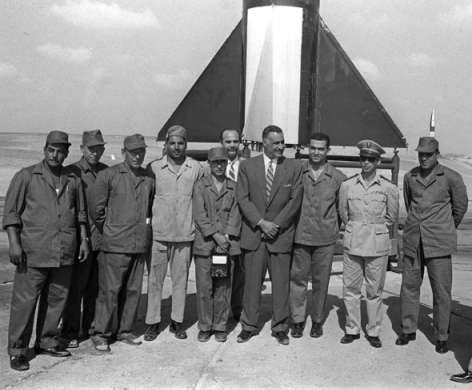
In 1960, Pilz was recruited with several other German specialists by the Egyptian government of Gamal Abdel Nasser to develop guided ballistic missiles. He joined a large contingent of German engineers and technicians who built weapons factories at the time and set up an assembly line for jet fighters. In July 1962, the ballistic missiles "El-Kahir" ( "The conqueror") and "El-Zafir" ( "The winner"), developed by Pils, are presented by Nasser to the international press as precursor weapons whose range can reach the south of Beirut, Lebanon. In other words, they can likely hit the whole of Israel with which Egypt is in conflict.
After several rockets were tested, the threat triggered the reaction of the Israeli secret services which set up the Operation Damocles. The Mossad intimated the scientists by sending letter bombs to Pilz and his collaborators in November 1962; five Egyptians were killed and the German secretary of Pilz, Hannelore Wende, lost her sight. Meanwhile, Israel pressured the German government to cease providing assistance to a government whose goal is to complete the work of the Nazis. Pilz quoted saying:
Following Egypt's rapprochement with the Soviet Union, which was able to supply the most sophisticated military equipment, Egypt decided to separate from its German specialists, and Pilz returned to Germany in 1965. Ironically, long-range missiles were not used during the Six-Day War in 1967 which Egypt lost miserably against Israel.
Pilz later retired in Velden am Wörther See, Carinthia where he lived with Hannelore, his blind wife, until his death in 1994.