
War of the Elves and Sauron
In The Fiction of J. R. R. Tolkien's legendarium, the War of the Elves and Sauron was a great conflict fought in the Second Age. This is one of the great wars of Middle-earth, and it is sometimes informally referred to as the Invasion of Eriador. It is the war caused by the forging of the One Ring.
Rings of Power
The war began in 1693 S.A., almost a century after Sauron had deceived the Noldor smiths of Eregion and had secretly forged the One Ring to rule over the other Rings of Power. When Sauron put on the One Ring, Celebrimbor, lord of Eregion, realized that the Elves had been betrayed and revolted against the Dark Lord's influence. With his disguise uncovered, Sauron then demanded that all of great rings in Eregion to be surrendered to him, as all of them were made with Sauron's counsel, except the Three Rings of the Elves. Celebrimbor refused and sent the Three to Gil-galad and Galadriel, while Sauron raised a great force to invade Eriador.
The War
Messages of the invasion were sent north to Lindon where the High King Gil-galad ruled, and he began amassing his forces, preparing for war. He also appealed for help from Tar-Minastir of Númenor and the latter obliged, but the Númenóreans were delayed.
In 1695 S.A. Sauron had reached Eregion, though his vanguard was temporarily driven off by Celeborn's sortie. (While Celeborn's wife Galadriel had entered Moria to reach Lórien, Celeborn himself refused to enter the mansion of the dwarves, and he was disregarded in Eregion by Celebrimbor until the One Ring.) Elrond had been sent to Eregion by Gil-galad but Sauron's host was great enough to ward him off while concentrating on the assault upon Eregion. In 1697 S.A., Celebrimbor tried to make a last stand at the doors of the Ost-in-Edhil, the main fortress of Eregion where the Noldor's chief works were held, but he was overwhelmed and taken captive. Placed under torment, he revealed the location of the Nine and Seven rings but would tell nothing about the Three, at which Sauron put him to death. It is clear that Sauron seized the Nine from Eregion, though it is less sure whether he or Celebrimbor had given the Seven to the Dwarves.
Elrond gathered with Celeborn and the survivors of Eregion and they were almost overwhelmed by Sauron's pursuit, but the Dark Lord's host was unexpectedly assailed in the rear by Durin of Moria and some Elves of Lórien. Sauron then halted his advance and drove the Dwarves back but he could accomplish little as Khazad-dûm's gates were closed. Afterwards, Sauron harboured deep hatred for Moria and ordered his Orcs to trouble the Dwarves at every turn. Elrond managed to escape to the north and established Imladris.
By 1699 S.A. all of Eriador fell under Sauron's control. Imladris was besieged, and Lindon cut off from Imladris and Khazad-dûm.
The next year, the great army of Númenor which was sent by Tar-Minastir landed in Lindon, at Tharbad on the Gwathló, and south near Pelargir. The intervention at Lindon was in the nick of time, as Gil-galad and Círdan were desperately holding Mithlond, but the arrival of the Númenóreans turned the tide and Sauron was heavily defeated and driven back. The Dark Lord was subsequently forced on the retreat after the great slaughter on the Brandywine. The Númenórean admiral Ciryatur landed forces further south at Lond Daer and hurried up the river to Tharbad, catching Sauron in the rear for the second time. At the resulting Battle of the Gwathló, Sauron was utterly routed and he fled back to Mordor with only his guard. His remaining army besieging Imladris was caught between the allies and destroyed. The war ended in 1701 S.A. but Eregion was gone, and most of Eriador was in ruins.
Aftermath
Sauron was at his pinacle of his power as a sorcerer, but not militarily, when he initiated the war. The strength of Elves was still then great enough to resist him, and the growing aid from Númenor enough to defeat him in the field and force him to retreat from Eriador. It would take a long time before Sauron could rebuild his former military strength and he abandoned Eriador while he built power eastwards using the Rings. This conflict is perhaps the only time that Sauron managed to, for a short while, master most of Middle-earth.
Around the end of the War of the Elves and Sauron, the great forests in Enedwaith and Minhiriath, which the Gwathló flows through, have been completely destroyed. The Númenóreans since Tar-Aldarion had already been felling many trees for shipbuilding, incurring the wrath of the locals when the extent of the devastation become known. Sauron allied himself with some of the tribes to harass the Númenóreans', setting fire in the woods and burning their wood-stores; the Númenóreans responded by ruthlessly felling timber without any thought of conservation or replanting.
Some fifteen hundred years later, Sauron would exact his revenge against the Númenóreans by corrupting Ar-Pharazôn, the king, and causing the utter downfall of Númenor. However, a remnant (the Lords of Andúnië) escaped the ruin and established the kingdoms of Arnor and Gondor, the latter being close to Mordor. Meanwhile, the power of Gil-galad had spread east of the Misty Mountains to Greenwood the Great and even towards Mordor during Sauron's absence. Sauron hoped to defeat his enemies, but he underestimated the strength of the Exiles and the Elves, striking Gondor before his own power had been rebuilt, and he was overthrown by the Last Alliance of Elves and Men.
In the Third Age, when Sauron returned, he was but a shadow of his former power as he had lost the One Ring. Still, he had greater forces than the Men and the Elves, who had themselves declined precipitously. Indeed, Sauron was relatively more powerful in the Third Age than he had been at his strongest in the Second Age. Near the end of the Third Age, as told in The Fellowship of the Ring, Gandalf tells Frodo Baggins that Sauron needed to recover the One Ring in order to "cover the lands in a second darkness", referring to the first darkness caused by Morgoth, the Great Enemy, during the First Age. 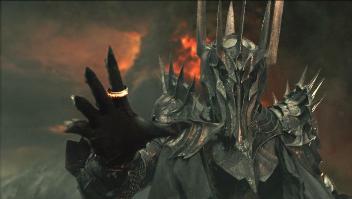
Adaptations
Though both the 1978 animated film and the 2001 live-action film based on The Lord of the Rings show the forging of the Rings of Power, the War of the Elves and Sauron is skipped and the films go straight to the much later War of the Last Alliance.
References
zh:精靈與索倫之戰爭