
Virgil L. Highland
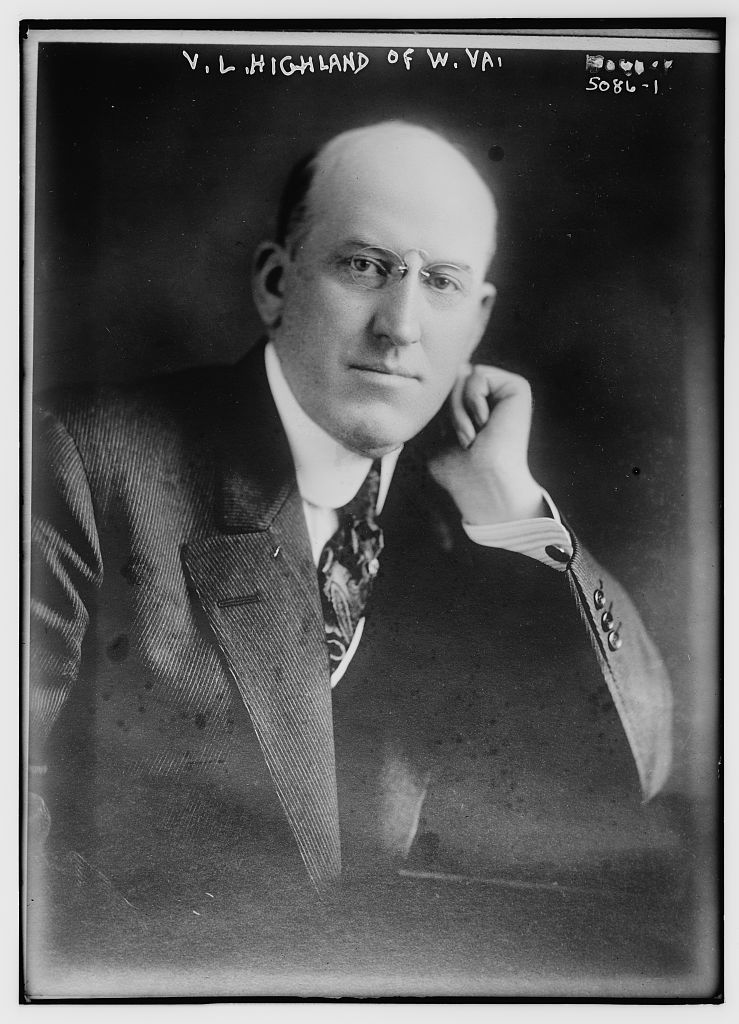
Virgil Lee Highland (August 31, 1870 – August 9, 1930) was an American banker, newspaper publisher, coal operator and Republican political figure based in Clarksburg, West Virginia. He was president of the Empire National Bank and controlled the Clarksburg Telegram Company. In 1927, Highland and J. Hornor Davis organized the Clarksburg Publishing Company to publish the Clarksburg Telegram and Clarksburg Exponent.
Highland chaired the West Virginia Republican State Committee from 1912 to 1916 and served as West Virginia's member of the Republican National Committee. In 1913, he was appointed the first chairman of the West Virginia Public Service Commission. He later served on the commission overseeing construction of the West Virginia State Capitol from 1922 until his resignation in 1923.
Early life and county office
Highland was born on August 31, 1870, at West Milford in Harrison County, West Virginia, the son of John Edgar Highland and Lucy Earl Patton Highland. He grew up on a farm and attended local common schools. He later took a business course in Delaware, Ohio, and attended Scio College in Ohio.
The National Register nomination for Clarksburg's Quality Hill Historic District states that Highland began his career as a schoolteacher and bookkeeper for Clarksburg businessman R. T. Lowndes. Highland moved to Clarksburg in 1890, when he was 20 years old, and worked as a bookkeeper for R. T. Lowndes and Company for seven years.
In 1896, Highland became clerk of the Harrison County Court. The 1923 History of West Virginia, Old and New states that he was elected to the office and served one six-year term.
Business career
Banking and other business interests
Highland helped organize the Empire National Bank of Clarksburg and became its president. He remained president for many years.
As president of the bank, Highland commissioned the Empire National Bank Building at the northwest corner of West Main and Fourth streets in downtown Clarksburg. The seven-story steel-frame building was constructed from 1903 to 1907. Its first two floors are faced with rusticated brownstone, with brown brick above, and its rounded corner contains the original bank entrance.
The 1923 state history listed Highland as treasurer and a director of the Union Gas and Carbon Company, West Chevy Chase Land Company and Union Land Company. It also listed him as a director of the Valley Coal and Coke Company, Wilbur Coal and Coke Company, Monongahela Valley Traction Company, Elkhorn Coal Corporation and West Virginia Metal Products Company.
The Quality Hill National Register nomination identifies additional business interests. It states that Highland served on the boards of the Elk Horn Coal Company, Bethlehem Coal Company of Pennsylvania and West Penn Public Service Company. It also describes his business activities as including banking, land, coal, oil and gas.
Newspaper publishing
Highland was closely involved with the Clarksburg Telegram Company, publisher of the Clarksburg Daily Telegram. The 1923 state history listed him as secretary and a director of the company. A 1933 decision of the Supreme Court of Appeals of West Virginia described Highland as the practical owner of the company and stated that he directed and controlled its affairs and policies from its beginning in 1901 until his death.
In 1927, Highland and J. Hornor Davis combined their newspaper interests. Highland controlled the Clarksburg Telegram Company, while Davis held the controlling interest in the Exponent Company, publisher of the Clarksburg Exponent. They organized the Clarksburg Publishing Company to publish the two newspapers.
The new corporation had 3,000 common shares and 2,000 preferred shares. Under its voting-trust arrangement, 1,800 Class A common shares representing the Telegram interests were issued to Highland as trustee, while 1,200 Class B common shares representing the Exponent interests were issued to Davis as trustee. The Quality Hill National Register nomination later described Highland as president of the company that published Clarksburg's two daily newspapers.
Politics and public service
Highland was active in Republican Party organization in Harrison County and across West Virginia. The Quality Hill National Register nomination identifies him as a chairman of the Harrison County Republican Committee before he later headed the state Republican organization.
Highland was a West Virginia delegate to the 1904 Republican National Convention in Chicago. In January 1908, he became secretary of the West Virginia Republican State Committee. He served as chairman of the state Republican committee from 1912 to 1916.
In 1913, Highland was appointed the first chairman of the Public Service Commission of West Virginia. The Quality Hill National Register nomination also identifies him as a chairman of the commission.
Highland was a Republican candidate for the United States Senate in 1918. A photograph preserved by West Virginia University Libraries shows campaign banners identifying him as the Republican candidate for United States senator.
Highland also served as West Virginia's member of the Republican National Committee. The 1921 West Virginia Blue Book lists "Virgil L. Highland, Clarksburg" as West Virginia's member of the committee. The 1923 state history also identifies him as the state's Republican national committeeman.
Highland later participated in the construction program for the new West Virginia State Capitol in Charleston. After Capitol Building Commission member N. Price Whitaker died in 1922, Highland was appointed to replace him. Highland resigned from the commission in 1923 and was succeeded by George A. Laughlin of Wheeling.
Personal life
Highland married Gertrude Morgan of Clarksburg on December 31, 1902. They had four children: Stephen Lee, Anita, Linda Marion and Florence Jean. A later West Virginia Supreme Court decision identifies his widow as Gertrude M. Highland and names the same four children: Stephen Lee Highland, Anita Highland Simmons, Linda Marion Highland and Florence Jean Highland.
Highland's residence at 240 East Main Street in Clarksburg was built between 1903 and 1905 and is a contributing property in the Quality Hill Historic District. The house combines Romanesque Revival, Queen Anne and Tudor Revival elements. It has a sandstone first story, buff-colored brick upper stories, a brownstone porch with Tudor-arched openings and a crenellated parapet, and a three-story tower with a conical roof.
The 1923 state history described Highland as a Baptist and a 32nd-degree Scottish Rite Mason. It also listed him as a member of the Independent Order of Odd Fellows, the Benevolent and Protective Order of Elks, the Clarksburg Rotary Club, the New York Bankers Club and the National Republican Club of New York.
Death
Highland died on August 9, 1930, in Rochester, Minnesota, at the age of 59. The Associated Press described him at the time of his death as a former Republican National Committeeman and stated that his career had included banking, newspaper publishing and coal operations in Clarksburg.