
Venetian school of fencing
The Venetian school of fencing refers to the style of fencing that arose in Venice in the early twelfth century and prevailed until the beginning of the nineteenth century.
The Venetians were masters of the art of fencing, and shared with their colleagues of Bologna the sound principles of fencing known as Bolognese or Venetian. The earliest writings on Venetian fencing focused on the properties of different parts of the blade which were used in defense and offense. From this approach arose the concept of the "center of percussion", the ideal spot on the blade at which a blow should be struck. The blade was divided into four parts: the first two parts from the hilt should be used for protection; the third one near the "center of percussion" was used for striking; and the fourth part at the tip was used for pricking.
In the beginning of the sixteenth century, French nobles earned a reputation as excellent swordsmen, however it was customary for them to go secretly to Italy to learn martial skills in the schools of Bologna or Venice schools.
As depicted in mosaics in St Mark's Basilica in Venice (dating from the twelfth century) and manuscripts (from the fourteenth century), Venetian soldiers of that era carried round shields (called bucklers). However, the buckler fell into disuse by the sixteenth century, giving way to a technique involving the use of a sword in the right hand and a dagger in the left.
Famous Masters of Venetian school of fencing
Salvator Fabris
Salvator Fabris (1544-1618) was an Italian fencing master. He published his treatise on fencing, Lo Schermo, overo Scienza d'Arme, in 1606. His treatise became a bestseller in Europe and was reprinted until 1713.
Nicoletto Giganti
Nicoletto Giganti has been described as "a fruitful innovator in fencing." Giganti was a 17th-century Italian rapier fencing master. The frontispiece of his 1606 work names him as “Nicoletto Giganti, Venetian”, although evidence suggests he or his family moved to Venice from the town of Fossombrone, in Le Marche, Central Italy. Little is known of Giganti’s life, but in the dedication to his 1606 treatise, he counts professional experience arising from 27 years work, whereas the Giganti family of Fossombrone were lesser nobility, long in the military service of Venice.
Giacomo di Grassi
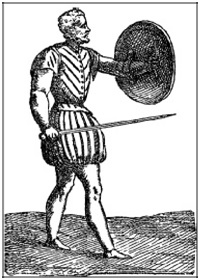
Another representative of the Venetian school of fencing was Giacomo di Grassi, an Italian fencing master who wrote the fencing treatise Ragione di adoprar sicuramente l'Arme, si da offesa come da difesa in 1570. The Venetian master of fencing developed his own theory of the fencing art. His method was much simpler than the technical elements of Achille Marozzo. There are some typical examples of his systems in the works by Henry de Saint Didier and Vincentio Saviolo.
Further reading
- The History and Art of Personal Combat. Arthur Wise. Courier Corporation, 15 янв. 2014 г. — Всего страниц: 288
- Renaissance War Studies. J. R. Hale, A&C Black, 1 июл. 1983 г. — Всего страниц: 624.
- Fencing. Walter Herries Pollock, F. C. Grove, Camille Prevost. Longmans, Green, and Company, 1893 — Всего страниц: 304
- La storia di Venezia nella vita privata dalle origini alla caduta della Republica, Pompeo Gherardo Molmenti, 1908
- Cent’anni di scherma a Venezia (1889—1989). A cura di Dante Galante. Venezia 1989.
- Treatise or Instruction for Fencing: By Hieronymus Calvacabo of Bologna and Patenostrier of Rome. Rob Runacres. Lulu Press, Inc, 25 янв. 2015 г.